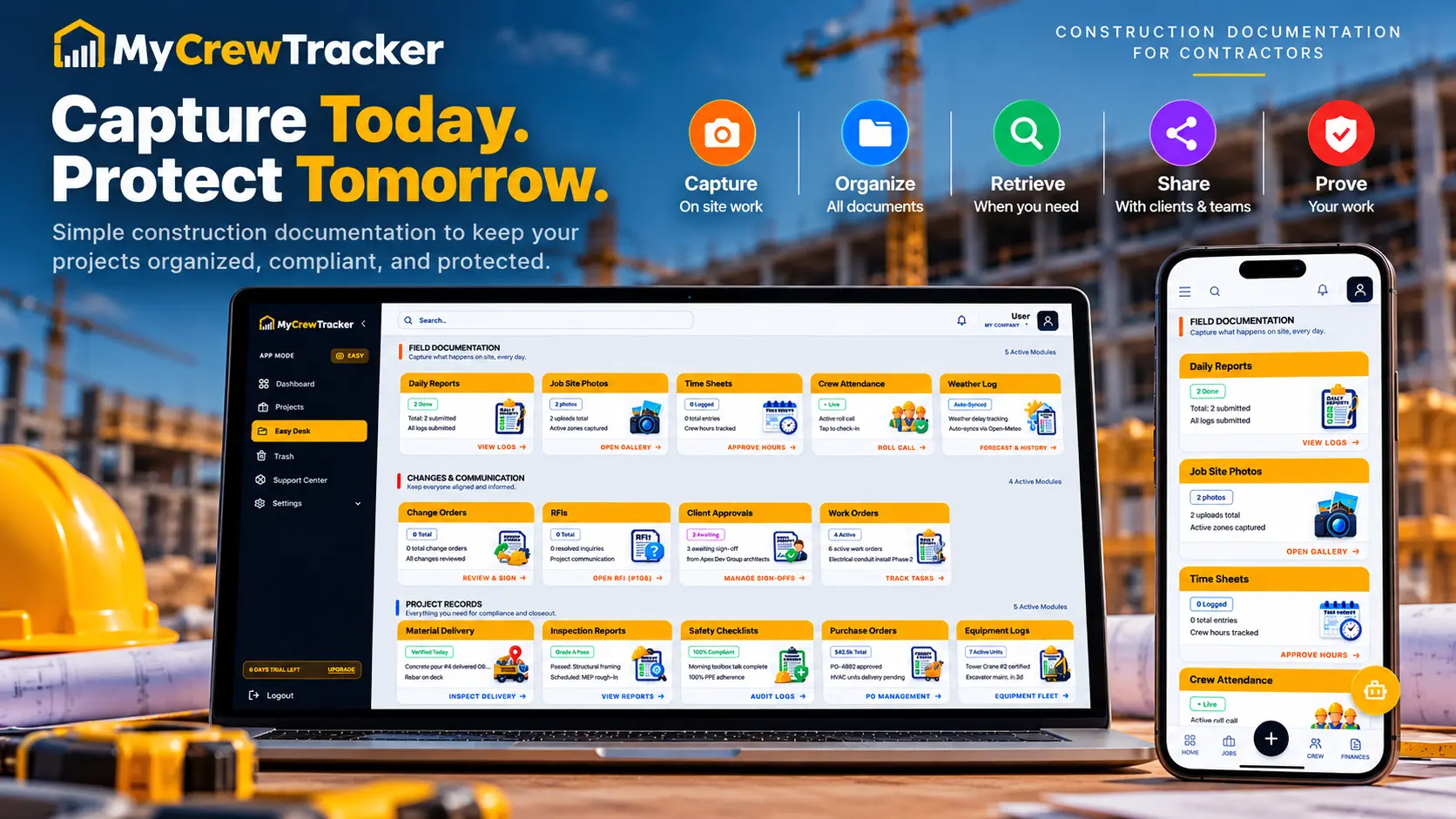
Managing construction projects in New York means navigating one of the most complex regulatory landscapes in the country. From dense urban logistical challenges to rigorous state labor and payment laws, New York contractors need flawless documentation to protect their profit margins. The state imposes aggressive prompt-payment deadlines, a unique trust fund statute that can lead to criminal liability, and a separate body of law governing public works projects that fragments responsibility across multiple prime contractors. MyCrewTracker provides a centralized, cloud-based platform designed to help New York contractors organize, retrieve, and securely retain vital project documentation. By moving away from scattered paper files and disorganized email threads, your team can maintain a single source of truth for all job site records, invoices, and change orders.
New York Prompt Payment Act (GBL § 756-a)
Getting paid on time is a universal challenge, but in New York, it is strictly governed by the Prompt Payment Act, codified at N.Y. General Business Law § 756-a. The Act applies to all private construction contracts exceeding $150,000. It was significantly amended on November 17, 2023, to provide contractors with new rights and impose new burdens on project owners and developers.
The 12-Business-Day Approval Window
Under GBL § 756-a(2)(a)(i), a construction project owner must approve or disapprove all or a portion of a contractor's invoice within 12 business days of receipt of the invoice and all contractually required documentation.
If the owner fails to disapprove the invoice by this strict deadline, the invoice is deemed approved and the owner must tender payment to the contractor "not later than thirty days after approval of the invoice". This "deemed approved" provision is a powerful tool for contractors: if the owner simply does nothing, the invoice becomes payable.
Grounds for Disapproval Are Limited
Under GBL § 756-a(2)(a)(i), an owner may disapprove all or part of a contractor's invoice only for the following reasons:
- Unsatisfactory or disputed job progress
- Defective construction work or material not remedied
- Disputed work materials
- Failure to comply with other material provisions of the construction contract
- Failure of the contractor to make timely payments for labor
- Failure of the owner's architect to certify payment for any of the above reasons
If the owner disapproves an invoice, it must at the same time issue a written statement "describing those items in the invoice that are not approved".
The 30-Day Payment Deadline for Owners
Once an invoice is approved (either explicitly or by operation of the "deemed approved" provision), the owner must pay the contractor within 30 days after approval of the invoice.
The 7-Day Payment Deadline for Contractors
Under GBL § 756-a(3)(a), a contractor or subcontractor must pay its subcontractor within 7 days of receiving payment from the party above it, unless the contract provides otherwise. The statute states: "Unless the provisions of this article provide otherwise, the contractor or subcontractor shall pay the subcontractor strictly in accordance with the terms of the construction contract".
Retainage Limit: 5% Maximum
The 2023 amendments to the Prompt Payment Act also amended GBL § 756-c to limit retainage to 5% of the contract sum. Contractors may submit a final invoice for payment in full upon reaching "substantial completion" of a project, as that phrase is defined in the operative contract.
Interest Penalty for Late Payment
An owner that fails to remit timely payments is required to pay the contractor interest beginning the next day at the rate of 1% per month, or 12% per year.
Right to Suspend Work
Where the owner fails to pay an approved invoice by the statutory deadline, the contractor may suspend contractually required performance so long as it provides the owner with the required statutory notice.
To leverage these statutory protections, contractors must meticulously track the exact dates invoices are submitted and received. MyCrewTracker's Quick Docs feature provides a secure, date-stamped repository for all payment applications and delivery receipts, ensuring your back office has the documented proof needed to enforce prompt payment timelines.
Navigating Wicks Law on Public Works (State Finance Law § 135)
For contractors bidding on New York public works projects exceeding certain thresholds, the Wicks Law — codified at N.Y. State Finance Law § 135 — mandates a unique procurement structure. Rather than awarding a single general contract, the state must prepare separate specifications and award separate contracts for three distinct subdivisions of work:
1. Plumbing and gas fitting
2. Steam heating, hot water heating, ventilating, and air conditioning apparatus
3. Electric wiring and standard illuminating fixtures
The Wicks Law Thresholds
The dollar thresholds at which Wicks Law applies vary by county:
- $3 million in Bronx, Kings, New York, Queens, and Richmond counties
- $1.5 million in Nassau, Suffolk, and Westchester counties
- $500,000 in all other counties within the state
The Document Coordination Challenge
The Wicks Law creates "massive document coordination challenges across independent prime contractors" because there is no single overriding general contractor holding these trades accountable to one another. Each prime contractor must maintain immaculate independent documentation — including RFIs, daily reports, and change orders — to protect against delay claims caused by other trades.
MyCrewTracker helps bridge these gaps by standardizing daily reporting and RFI tracking. Field supervisors can instantly log daily progress, while back-office teams can monitor RFIs that cross over between independent prime scopes, minimizing the risk of uncompensated delays.
New York Mechanics Lien Deadlines
New York's lien law is contained in the N.Y. Lien Law. The deadlines for filing a mechanics lien differ significantly depending on whether the project is a private improvement or a public improvement.
Private Improvement Liens (Lien Law § 10)
Under N.Y. Lien Law § 10, for a private improvement, a notice of lien may be filed at any time during the progress of the work and the furnishing of materials. The outside deadline is 8 months after the completion of the contract, or the final performance of the work, or the final furnishing of materials, dating from the last item of work performed or materials furnished.
For a single-family dwelling, the deadline is shorter: 4 months after completion of the contract, final performance of the work, or final furnishing of materials.
Where the notice of lien is for retainage, the notice may be filed within 90 days after the date the retainage was due to be released.
Public Improvement Liens (Lien Law § 12)
For public improvement projects, the lien must be filed with the bureau in charge of the construction and the public entity's comptroller or financial officer during the progress of the work, but no later than 30 days after acceptance of the performance.
Lien Enforcement (Lien Law § 18)
Under N.Y. Lien Law § 18, no mechanics lien shall be a lien for a longer period than one year after the notice of lien has been filed, unless within that time an action is commenced to enforce the lien and a notice of pendency is filed with the proper financial officer.
New York Lien Deadlines at a Glance
| Action | Deadline | Statute |
|---|---|---|
| Owner approve/disapprove invoice | Within 12 business days of receipt | GBL § 756-a |
| Owner pay approved invoice | Within 30 days of approval | GBL § 756-a |
| Contractor pay subcontractor | Within 7 days of receiving payment | GBL § 756-a |
| File private improvement lien | Within 8 months of last work | Lien Law § 10 |
| File single-family dwelling lien | Within 4 months of last work | Lien Law § 10 |
| File public improvement lien | Within 30 days of project acceptance | Lien Law § 12 |
| Enforce lien | Within 1 year of filing | Lien Law § 18 |
| Wicks Law separate contracts | Required above county thresholds | State Finance Law § 135 |
| Construction defect statute of repose | 10 years for design professionals | CPLR § 214-d |
| Retainage cap (private) | Maximum 5% | GBL § 756-c |
How to File a Mechanics Lien in New York: Step by Step
The process below reflects the standard path for a New York contractor, subcontractor, or material supplier seeking to preserve and enforce lien rights under the New York Lien Law.
1. Log your last day of work. New York's 8-month filing clock (for private improvements) starts from the last item of work performed or materials furnished. MyCrewTracker's Daily Reports timestamp this automatically.
2. Prepare the Notice of Lien. Under Lien Law § 9, the notice must include the name of the lienor, the name of the owner, a description of the property, the amount claimed, and the dates of work.
3. File the Notice of Lien with the County Clerk. For private improvements, file in the clerk's office of the county where the property is situated. For public improvements, file with the bureau in charge of construction and the public entity's financial officer.
4. Serve a copy of the lien on the owner. Within 5 days before or 30 days after filing, serve a copy of the notice of lien on the owner.
5. File suit to enforce within 1 year. Under Lien Law § 18, an action to enforce the lien must be commenced within 1 year of filing the notice of lien, and a notice of pendency must be filed with the proper financial officer.
6. Preserve all project documentation. Daily reports, delivery tickets, change orders, and photos become evidence in the enforcement action.
Documents to Preserve for a New York Lien Claim
New York courts require proof that you furnished labor or materials and that they were incorporated into the property. The following records are what you need:
- Signed contract or purchase order with the prime contractor
- Proof of service of the Notice of Lien
- Delivery tickets signed by an authorized site representative
- Daily reports showing crew on site and work performed
- Photo evidence of installed work (timestamped and geotagged)
- Jobsite sign-in logs and crew attendance records
- Invoices, statements, and payment applications
- Email or text correspondence about scope and payment
- Change orders and extra work authorizations
- Written demand letters and any response
MyCrewTracker stores all of these in one project record. When a lien deadline approaches, the back office can generate the timeline needed to prepare the Notice of Lien without reconstructing months of field activity.
New York Trust Fund Provisions (Lien Law Article 3-A)
New York is among a handful of states where funds paid to a contractor are statutory trust funds. Under N.Y. Lien Law Article 3-A, all funds received by a contractor or subcontractor for a project must be held in trust and first used to satisfy the claims of unpaid laborers, suppliers, and subcontractors.
What the Trust Fund Statute Requires
- Trust assets held by an owner must be held and applied for payment of the cost of improvement
- Trust assets held by a contractor or subcontractor must be held for the benefit of downstream parties
- Trustees may commingle funds but must keep detailed records of all trust fund transactions under § 75
- Diversions of trust funds carry civil and criminal penalties
Why This Matters for Contractors
The trust fund statute creates a powerful tool for subcontractors and suppliers who have not been paid. If a general contractor receives payment but diverts those funds to other uses and fails to pay a subcontractor, the subcontractor can pursue a trust fund action to recover the diverted amounts.
To defend against claims of misappropriation, contractors must maintain immaculate accounting and project documentation. Using MyCrewTracker's Quick Docs system, contractors can securely store properly dated payment applications, lien waivers, and bank disbursement records in the cloud, helping establish a clear paper trail of how project funds were distributed.
New York Construction Defect Statute of Repose (CPLR § 214-d)
Under N.Y. CPLR § 214-d, any person asserting a claim for personal injury, wrongful death, or property damage against a licensed architect, engineer, land surveyor, or landscape architect based upon professional performance occurring more than 10 years prior to the date of the claim must give written notice of the claim at least 90 days before commencing an action.
The notice of claim must identify the performance, conduct, or omissions complained of and include a request for general and special damages. Service of the notice tolls the applicable statute of limitations for 120 days following service.
For contractors (as opposed to design professionals), New York does not have a single comprehensive statute of repose. Instead, a 6-year statute of limitations applies to breach of contract claims, running from the date of completion of the project.
New York-Specific Gotchas
The 12-business-day approval window is strict. Under GBL § 756-a(2)(a)(i), an owner must approve or disapprove an invoice within 12 business days. If the owner fails to respond, the invoice is deemed approved and must be paid.
The 7-day subcontractor payment rule applies unless otherwise agreed. Under GBL § 756-a(3)(a), a contractor must pay its subcontractor within 7 days of receiving payment, unless the contract provides otherwise.
Retainage is capped at 5%. The 2023 amendments to the Prompt Payment Act limit retainage to 5% of the contract sum.
The 8-month private lien deadline is absolute. Lien Law § 10 gives you exactly 8 months from the last item of work to file a private improvement lien. For single-family dwellings, the deadline is 4 months.
The 30-day public lien deadline is short. For public improvement projects, the lien must be filed within 30 days of project acceptance.
The 1-year enforcement deadline is absolute. Lien Law § 18 gives you exactly 1 year from filing the notice of lien to commence an enforcement action. Set two calendar reminders: one at 9 months, one at 11 months.
The Wicks Law fragments responsibility. On public works projects above the county thresholds, there is no single general contractor accountable for all trades. Each prime contractor must maintain independent documentation to protect against delay claims caused by other trades.
The trust fund statute creates criminal liability. Under Lien Law Article 3-A, diversion of trust funds carries civil and criminal penalties. Contractors who receive payment and fail to pay downstream parties can face felony charges.
Interest penalty for late payment. Under GBL § 756-b(1)(a), an owner that fails to pay an approved invoice by the statutory deadline must pay interest at 1% per month, or 12% per year.
Example Scenario: How Documentation Determines the Outcome
*The following is an illustrative scenario, not a specific case. It demonstrates how record-keeping affects outcomes in New York construction disputes.*
Consider a Manhattan mechanical subcontractor on a $2 million commercial office renovation. The sub first furnishes labor on March 1. The sub's last day of substantial work is August 15.
Under GBL § 756-a, the general contractor received a $500,000 progress payment from the owner on July 1. The GC had 7 days to pay the sub — by July 8. The GC failed to pay. Under GBL § 756-b, the sub is entitled to interest at 12% per year on the unpaid amount from July 9 until the check is drawn.
Under Lien Law § 10, the sub has 8 months from August 15 to file a private improvement lien. That deadline is April 15 of the following year. The sub files the notice of lien on March 1 and serves a copy on the owner on March 5.
Under Lien Law § 18, the sub has 1 year from March 1 to file suit to enforce the lien. That deadline is March 1 of the following year. The sub files suit on December 15, well within the window. The lien is enforceable.
Now consider the Wicks Law angle. If this were a public works project above the $3 million threshold in New York County, the state would have awarded separate prime contracts for plumbing, HVAC, and electrical work. The mechanical sub would be a prime contractor, not a subcontractor. There would be no general contractor coordinating the trades. If the electrical prime caused a delay that impacted the mechanical prime's schedule, the mechanical prime would need its own independent daily reports and RFI logs to prove the delay and pursue a claim.
Documentation is what separates these outcomes. MyCrewTracker logs the last day of work, the lien filing date, the service date, and the daily reports that prove performance.
What MyCrewTracker Does (and Does Not Do) in New York
MyCrewTracker is a construction documentation platform, not a legal service. Here is what it does for New York contractors:
- Logs first day and last day of work per project so you can calculate the 8-month lien filing window
- Stores proof of service and Notice of Lien documents in the project file
- Records delivery tickets with photo and signature capture
- Captures timestamped, GPS-tagged site photos that document installation
- Generates daily report PDFs that serve as contemporaneous records
- Tracks payment application dates for Prompt Payment Act compliance
- Tracks trust fund disbursements to demonstrate Lien Law Article 3-A compliance
- Archives project records for 10+ years to support construction defect defense
It does not draft Notices of Lien, file documents with the county clerk, or provide legal advice. Those steps require a New York construction attorney.
❓ Frequently Asked Questions in New York
What is the NY Prompt Payment Act?
The New York Prompt Payment Act (General Business Law § 756-a) is a statute designed to ensure timely payments on private construction projects exceeding $150,000. It establishes strict deadlines, such as requiring owners to pay approved invoices within 30 days, and allowing contractors to suspend work for non-payment if proper statutory notice is provided. Tracking invoice submission dates is critical for enforcement.
How does Wicks Law affect document management?
Wicks Law requires separate prime contracts for plumbing, HVAC, and electrical work on large New York public projects. Because there is no single overriding general contractor holding these trades accountable to one another, each prime contractor must maintain immaculate independent documentation (like RFIs and Daily Reports) to protect against delay claims caused by other trades.
How long do I have to file a mechanics lien in New York?
You have 8 months from your last day of work to file a private improvement lien under Lien Law § 10. For a single-family dwelling, the deadline is 4 months. For public improvement projects, the deadline is 30 days after project acceptance.
How long do I have to sue to enforce a New York lien?
You have 1 year from the date the notice of lien is filed to commence an action to enforce it. This is set by Lien Law § 18.
What is the New York Prompt Pay deadline for subcontractors?
Under GBL § 756-a(3)(a), prime contractors and higher-tier subcontractors must generally pay lower-tier subcontractors within 7 days of receiving payment for their work, unless the contract provides otherwise.
What is the New York retainage limit?
Under GBL § 756-c, as amended in 2023, retainage on private construction contracts is capped at 5% of the contract sum.
What is the New York construction defect statute of repose?
Under CPLR § 214-d, any claim against a licensed architect, engineer, land surveyor, or landscape architect based upon professional performance occurring more than 10 years prior to the date of the claim requires a written notice of claim at least 90 days before commencing an action.
What is the New York trust fund statute?
Under Lien Law Article 3-A, all funds received by a contractor or subcontractor for a project must be held in trust and first used to satisfy the claims of unpaid laborers, suppliers, and subcontractors. Diversion of trust funds carries civil and criminal penalties.
Can I be forced to waive my lien rights in New York?
Under GBL § 757, any contract provision that purports to waive, release, or extinguish rights provided by the Prompt Payment Act is void and unenforceable.
Does MyCrewTracker automatically file New York mechanic's liens?
No. MyCrewTracker is an organizational and document management platform, not a legal service. While our software helps you safely store the project documentation, invoices, and notices required to build a strong lien claim, you must still properly file the lien through a qualified New York attorney or specialized legal service.
Legal Sources & References
-
Prompt Payment Act — Obligations N.Y. General Business Law § 756-a
New York Prompt Payment Act — Owners must approve or disapprove invoices within 12 business days. If approved or deemed approved, payment must be made within 30 days. Contractors must pay subcontractors within 7 days of receiving payment. Retainage capped at 5% (as amended 2023).
-
Prompt Payment Act — Remedies N.Y. General Business Law § 756-b
New York Prompt Payment Remedies — Interest at 1% per month (12% per year) for late payments. Right to suspend work for non-payment.
-
Wicks Law — Separate Specifications for Contract Work N.Y. State Finance Law § 135
New York Wicks Law — Requires separate specifications and separate contracts for plumbing, HVAC, and electrical work on public works projects above county-specific thresholds ($3M in NYC, $1.5M in Nassau/Suffolk/Westchester, $500K elsewhere).
-
Mechanics Lien — Filing of Notice of Lien N.Y. Lien Law § 10
New York Lien Filing — Private improvement lien may be filed within 8 months after completion of the contract. Single-family dwelling: 4 months. Public improvement: within 30 days after acceptance.
-
Mechanics Lien — Duration and Enforcement N.Y. Lien Law § 18
New York Lien Enforcement — No lien shall continue for a longer period than 1 year after filing unless an action is commenced and a notice of pendency is filed within that time.
-
Trust Fund Provisions — Lien Law Article 3-A N.Y. Lien Law §§ 70–79
New York Trust Fund Statute — Funds received by a contractor or subcontractor must be held in trust for the benefit of downstream parties. Diversion carries civil and criminal penalties.
-
Construction Defect Statute of Repose N.Y. CPLR § 214-d
New York Statute of Repose — Claims against licensed architects, engineers, land surveyors, or landscape architects based on professional performance occurring more than 10 years prior require a written notice of claim at least 90 days before commencing an action.
-
New York State Senate — Laws General Reference
Official New York State Senate website — Searchable index of all New York Consolidated Laws.
-
New York Courts — Judicial Opinions General Reference
Official New York Courts website — Published opinions and court rules.
Protect Your Projects & Retain Required New York Records
Defend against back-charges, audit penalties, and mechanic's lien disputes. Keep GPS-timestamped photos, certified timesheets, and signed change orders safely backed up for just $40/month.