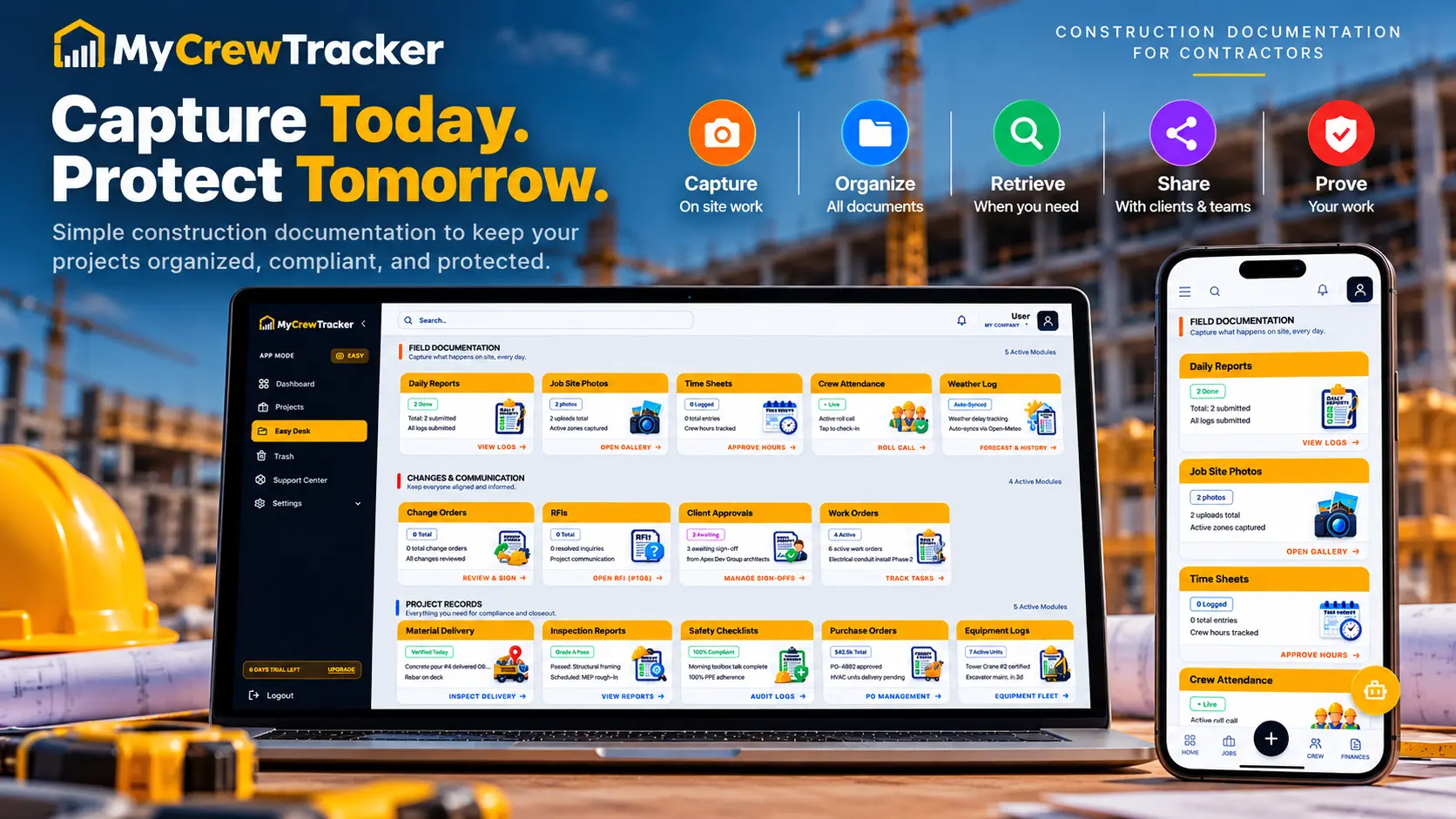
Managing construction projects in Ohio requires strict adherence to statutory deadlines and meticulous record-keeping. Whether you are working on commercial developments in Columbus or infrastructure projects in Cleveland, maintaining a pristine paper trail is the only way to guarantee your right to payment. Ohio operates a dual-notice system: a Notice of Commencement must be recorded by the owner, and any subcontractor or supplier who wishes to preserve lien rights must respond with a Notice of Furnishing within 21 days. Miss that window, and your lien is limited only to the work performed in the 21 days before the late notice. On top of that, Ohio’s Prompt Payment Act imposes strict 10-day payment timelines with an 18% annual interest penalty, and a 10-year statute of repose can bar defect claims after a decade. MyCrewTracker provides a centralized, cloud-based platform designed to help Ohio contractors organize, retrieve, and securely retain vital project documentation. By moving away from scattered paper files and disorganized email threads, your team can maintain a single source of truth for all job site records, Notice of Furnishing filings, and change orders.
Ohio Notice of Commencement (ORC § 1311.04)
Under Ohio Revised Code § 1311.04, an owner, part owner, or lessee who contracts for labor, work, or materials must record a Notice of Commencement in the office of the county recorder for each county where the real property is located. This must be done prior to the performance of any labor or work or the furnishing of any materials for an improvement that may give rise to a mechanics’ lien.
What the Notice of Commencement Must Contain
Under ORC § 1311.04(B), the notice must be in affidavit form and include:
- The legal description of the real property
- A brief description of the improvement
- The name, address, and capacity of the owner, part owner, or lessee contracting for the improvement
- The name and address of the fee owner (if the contracting party is a land contract vendee or lessee)
- The name and address of the owner’s designee, if any
- The name and address of all original contractors
- The date the owner first executed a contract with an original contractor
- The name and address of all lending institutions providing financing
- The name and address of all sureties on any payment bond
The 2025 Amendment
Effective September 30, 2025, House Bill 96 amended ORC § 1311.04 to change the default expiration date of a Notice of Commencement from six years to four years. The notice must now contain the statement: “The expiration date for this notice of commencement is four years from the date of recording unless a different date is specified herein.”
What Happens If No Notice of Commencement Is Recorded
If no Notice of Commencement is recorded, subcontractors and material suppliers are not required to serve a Notice of Furnishing. However, they must still record an Affidavit for Mechanics’ Lien within the statutory deadline to preserve lien rights.
Ohio Notice of Furnishing (ORC § 1311.05)
Under ORC § 1311.05, a subcontractor or material supplier who performs labor or furnishes material in furtherance of an improvement to real property and who wishes to preserve lien rights shall serve a Notice of Furnishing upon the owner’s designee named in the Notice of Commencement and the original contractor.
The 21-Day Deadline
The notice must be served within twenty-one days after performing the first labor or work or furnishing the first materials. If the owner fails to record the Notice of Commencement, the time for serving the Notice of Furnishing is extended until twenty-one days after the Notice of Commencement has been recorded.
Who Is Exempt from Serving a Notice of Furnishing?
Under ORC § 1311.05, the following parties are not required to serve a Notice of Furnishing:
- Original contractors who contract directly with the owner, part owner, or lessee
- Material suppliers in direct privity of contract with the owner, part owner, or lessee
- Subcontractors or material suppliers in direct privity of contract with the original contractor (they do not have to serve the notice on the original contractor, but they may still need to serve the designee)
What Happens If You Miss the 21-Day Deadline
Failing to meet this 21-day deadline limits your lien claim only to the work performed within the 21 days immediately preceding the late notice, plus all future work. Ohio courts strictly enforce this deadline, and a late notice does not void the lien entirely — it simply narrows the scope of work that can be claimed.
Using MyCrewTracker’s Daily Reports, field supervisors generate a verifiable, date-stamped log of when work actually began on site, ensuring your back office accurately tracks the 21-day window and securely archives the certified mail delivery receipts via Quick Docs.
Ohio Lien Deadlines at a Glance
Missing a single deadline in Ohio can void your lien rights entirely. The table below summarizes the statutory deadlines every Ohio contractor, subcontractor, and material supplier must track.
| Action | Deadline | Statute |
|---|---|---|
| Record Notice of Commencement (Owner) | Prior to commencement of work | ORC § 1311.04 |
| Serve Notice of Furnishing (Subcontractor/Supplier) | Within 21 days of first furnishing | ORC § 1311.05 |
| Record Affidavit for Mechanics’ Lien (Residential 1-2 family) | Within 60 days of last furnishing | ORC § 1311.06(B)(1) |
| Record Affidavit for Mechanics’ Lien (Commercial) | Within 75 days of last furnishing | ORC § 1311.06(B)(3) |
| Record Affidavit for Mechanics’ Lien (Special 1311.021) | Within 120 days of last furnishing | ORC § 1311.06(B)(2) |
| Serve copy of affidavit on owner | Within 30 days of recording | ORC § 1311.07 |
| Commence suit to enforce lien | Within 6 years of recording the affidavit | ORC § 1311.13(C) |
| Contractor pay subcontractor (Prompt Payment) | Within 10 calendar days of receiving payment | ORC § 4113.61 |
| Interest penalty for late payment | 18% per annum, beginning on the 11th day | ORC § 4113.61 |
| Construction defect statute of repose | 10 years from substantial completion | ORC § 2305.131 |
How to File a Mechanics’ Lien in Ohio: Step by Step
The process below reflects the standard path for an Ohio subcontractor, material supplier, or laborer seeking to preserve and enforce lien rights under Chapter 1311 of the Ohio Revised Code.
1. Log your first day of work. The 21-day Notice of Furnishing clock starts from your first day of furnishing labor or materials. MyCrewTracker’s Daily Reports timestamp this automatically.
2. Check for a Notice of Commencement. Search the county recorder’s office for a recorded Notice of Commencement. If one exists, you must serve a Notice of Furnishing.
3. Prepare and serve the Notice of Furnishing. Under ORC § 1311.05, serve the notice on the owner’s designee and the original contractor within 21 days of first furnishing. The notice must be in substantially the form specified by statute.
4. Track the last day of work. Ohio’s filing clock starts from the last date you furnished labor or materials. The deadline is 60 days for residential projects, 75 days for commercial projects, and 120 days for projects under § 1311.021.
5. Prepare the Affidavit for Mechanics’ Lien. Under ORC § 1311.06, the affidavit must show the amount due, a description of the property, the name and address of the person for whom the labor was performed, the name of the owner, the name and address of the lien claimant, and the first and last dates of furnishing.
6. Record the affidavit with the County Recorder. Ohio mechanics’ liens are recorded at the county level. File in the office of the county recorder where the improved property is located.
7. Serve a copy of the affidavit on the owner. Under ORC § 1311.07, serve a copy of the recorded affidavit on the owner within 30 days of recording.
8. Commence suit within 6 years. Under ORC § 1311.13(C), liens continue in force for six years after the affidavit is filed. If an action is brought to enforce the lien within that time, the lien continues in force until final adjudication.
9. Preserve all project documentation. Daily reports, delivery tickets, change orders, and photos become evidence in the enforcement action.
Documents to Preserve for an Ohio Lien Claim
Ohio courts require proof that you furnished labor or materials and that they were incorporated into the property. The following records are what you need:
- Signed contract or purchase order with the prime contractor
- Certified mail receipts for the Notice of Furnishing
- Delivery tickets signed by an authorized site representative
- Daily reports showing crew on site and work performed
- Photo evidence of installed work (timestamped and geotagged)
- Jobsite sign-in logs and crew attendance records
- Invoices, statements, and payment applications
- Email or text correspondence about scope and payment
- Change orders and extra work authorizations
- Written demand letters and any response
MyCrewTracker stores all of these in one project record. When a lien deadline approaches, the back office can generate the timeline needed to prepare the affidavit without reconstructing months of field activity.
Ohio-Specific Gotchas
The 21-day Notice of Furnishing is a strict prerequisite. Ohio courts have consistently held that failure to serve the Notice of Furnishing within the 21-day window limits the lien claim to the work performed in the 21 days before the late notice, plus future work. This can eliminate most of the lien claim for a subcontractor who has been on site for months.
Ohio has no pre-lien notice requirement if no Notice of Commencement is recorded. If the owner fails to record a Notice of Commencement, subcontractors and suppliers are not required to serve a Notice of Furnishing. However, they must still record the Affidavit for Mechanics’ Lien within the statutory deadline.
The filing deadline differs by project type. Residential projects have 60 days from last furnishing; commercial projects have 75 days; projects under § 1311.021 have 120 days. There are no extensions.
The 30-day service requirement is often overlooked. After recording the Affidavit for Mechanics’ Lien, you must serve a copy on the owner within 30 days. Failure to do so can dissolve the lien.
The 6-year enforcement deadline is absolute. ORC § 1311.13(C) gives you exactly six years from the date the affidavit is recorded to commence an action. If the owner serves a demand to commence suit, the deadline shortens to 60 days after service. Set calendar reminders at 4 years and 5 years.
Retainage on private projects is not capped by statute. Unlike public projects, Ohio does not impose a statutory cap on retainage for private construction contracts. However, HB 568 has proposed a 5% cap for private projects exceeding $1 million. Contractors should negotiate retainage terms carefully.
Construction defect statute of repose. Ohio’s statute of repose for construction defects is 10 years from substantial completion under ORC § 2305.131. If a defective condition is discovered during the 10-year period but less than two years before expiration, the claimant has two years from discovery to file suit. Retain project records for at least 10 years.
Prompt Payment Act applies only to projects other than 1-3 family dwellings. ORC § 4113.61 does not apply to the construction or improvement of single-, two-, or three-family detached dwelling houses.
Interest penalty is 18% per annum. If a contractor fails to pay a subcontractor within 10 calendar days of receiving payment from the owner, the contractor must pay interest at 18% per annum on the unpaid amount, beginning on the 11th day following receipt of payment.
Example Scenario: How Documentation Determines the Outcome
*The following is an illustrative scenario, not a specific case. It demonstrates how record-keeping affects outcomes in Ohio lien disputes.*
Consider a Columbus mechanical subcontractor on a $500,000 commercial office renovation. The owner records a Notice of Commencement on March 1. The sub first furnishes labor on March 5. Under ORC § 1311.05, the 21-day Notice of Furnishing must be served by March 26. The sub serves it via certified mail on March 20. The green card returns signed on March 24.
The sub’s last day of substantial work is August 15. Under ORC § 1311.06(B)(3), the sub has 75 days from August 15 to record the Affidavit for Mechanics’ Lien with the Franklin County Recorder. That deadline is October 29. The sub records the affidavit on October 20 and serves a copy on the owner on November 15 — within the 30-day service window.
Under ORC § 1311.13(C), the sub has 6 years from October 20 to commence an action to enforce the lien. That deadline is October 20 six years later. The sub files suit on June 15 of the following year, well within the window. The lien is enforceable.
Now consider the Prompt Payment Act side. The general contractor received a $500,000 progress payment from the owner on July 1. Under ORC § 4113.61, the GC had 10 calendar days to pay the sub — by July 11. The GC failed to pay. The sub is entitled to the amount owed plus 18% annual interest from July 12 until the check is drawn.
Documentation is what separates these outcomes. MyCrewTracker logs the first day of work, the Notice of Furnishing service date, the recording date, and the daily reports that prove performance.
Ohio Prompt Payment Act (ORC § 4113.61)
Cash flow delays are heavily regulated in Ohio under the state’s Prompt Payment Act. Under ORC § 4113.61, when a subcontractor or material supplier submits the required payment application, request, or invoice in sufficient time for the contractor to include it in the contractor’s own payment request to the owner, the contractor generally must make the required payment within 10 calendar days after receiving payment from the owner.
What the Ohio Prompt Payment Act Requires
- 10-day payment: Contractors must pay subcontractors and material suppliers within 10 calendar days of receiving payment from the owner
- Interest penalty: If the contractor fails to comply, the contractor must pay interest at 18% per annum on the payment due, beginning on the 11th day following receipt of payment from the owner
- Permitted withholding: The contractor may reduce the amount paid by any retainage provision and may withhold amounts necessary to resolve disputed liens or claims
Exceptions and Limitations
ORC § 4113.61 does not apply to the construction or improvement of single-, two-, or three-family detached dwelling houses. The statute also contains provisions for final retainage and lower-tier subcontractors.
To enforce these rights or defend against claims of payment failure, contractors must maintain flawless documentation. MyCrewTracker offers a secure cloud repository where Ohio contractors can organize dated payment applications, bank disbursement records, and formal communications to prove statutory compliance.
Ohio Lien Discharge Bonds (ORC § 1311.11)
Ohio property owners have a statutory right to discharge a mechanics’ lien by filing a bond or cash deposit with the court. Under ORC § 1311.11, the owner may file a bond, cash deposit, or other acceptable security in an amount equal to one and one-half times the amount of the lien. If the court approves the deposit, the cash deposit is substituted for the security of the lien, and the lien is void and the property wholly discharged from the lien.
Contractors and suppliers should be aware of this process because it can happen without their consent — the property owner simply needs to post the bond. The claim remains enforceable, but against the surety rather than the property.
What MyCrewTracker Does (and Does Not Do) in Ohio
MyCrewTracker is a construction documentation platform, not a legal service. Here is what it does for Ohio contractors:
- Logs first day and last day of work per project so you can calculate the 21-day Notice of Furnishing deadline and the 60/75/120-day filing window
- Stores certified mail receipts and Notice of Furnishing documents in the project file
- Records delivery tickets with photo and signature capture
- Captures timestamped, GPS-tagged site photos that document installation
- Generates daily report PDFs that serve as contemporaneous records
- Tracks payment application dates for Prompt Payment Act compliance
- Archives project records for 10+ years to support construction defect defense
It does not draft Notices of Furnishing, file Affidavits for Mechanics’ Liens with the county recorder, or provide legal advice. Those steps require an Ohio construction attorney.
❓ Frequently Asked Questions in Ohio
What is an Ohio Notice of Furnishing?
Under ORC § 1311.05, if a Notice of Commencement has been filed, an Ohio Notice of Furnishing is a document that subcontractors and suppliers must serve within 21 days of first performing work to fully protect their mechanics lien rights. Tracking project start dates in a system like MyCrewTracker is critical to hitting this 21-day deadline.
What happens if I miss the 21-day Notice of Furnishing deadline?
Failing to meet the 21-day deadline limits your lien claim only to the work performed within the 21 days immediately preceding the late notice, plus all future work. The lien is not void entirely, but the scope of the claim is significantly narrowed.
How long do I have to file a mechanics’ lien in Ohio?
You have 60 days from your last day of furnishing labor or materials to record the Affidavit for Mechanics’ Lien on residential 1-2 family projects, and 75 days on commercial projects. This is set by ORC § 1311.06.
How long do I have to sue to enforce an Ohio lien?
You have 6 years from the date the affidavit is recorded to commence an action to enforce the lien. This is set by ORC § 1311.13(C). If the owner serves a demand to commence suit, the deadline shortens to 60 days.
What is the Ohio Prompt Payment Act deadline?
Under ORC § 4113.61, when a subcontractor submits their payment application in sufficient time, the contractor generally must pay within 10 calendar days of receiving payment from the owner. Failure to comply can result in 18% annual interest.
Does the Ohio Prompt Payment Act apply to residential projects?
No. ORC § 4113.61 does not apply to the construction or improvement of single-, two-, or three-family detached dwelling houses.
What is the Ohio construction defect statute of repose?
Under ORC § 2305.131, no action may be brought for construction defects more than 10 years from substantial completion of the improvement. If a defective condition is discovered during the 10-year period but less than two years before expiration, the claimant has two years from discovery to file suit.
Can I be forced to waive my lien rights in Ohio?
Ohio does not have a statutory prohibition on prospective lien waivers. However, waivers are generally enforceable only to the extent they are supported by consideration. Contractors should never sign an unconditional waiver before receiving and depositing payment.
What is the Ohio retainage limit?
Ohio does not impose a statutory cap on retainage for private construction contracts. On public projects, retainage is generally limited to 5%. HB 568 has proposed a 5% cap for private projects exceeding $1 million.
Does MyCrewTracker automatically file Ohio mechanics liens?
No. MyCrewTracker is a secure document management platform that helps you organize the daily reports, invoices, and delivery receipts you need to prove your case. To officially record a mechanics lien in Ohio, you must use a specialized legal service or a qualified construction attorney.
Legal Sources & References
-
Recording Notice of Commencement ORC § 1311.04
Ohio Mechanics Lien — Owners must record a Notice of Commencement prior to the performance of any labor or work. Effective September 30, 2025, the default expiration is four years. Notice must contain the legal description, names of parties, and other required information.
-
Subcontractor or Materialman to Serve Notice of Furnishing ORC § 1311.05
Ohio Notice of Furnishing — Subcontractors and material suppliers must serve a Notice of Furnishing on the owner’s designee and original contractor within 21 days after first furnishing labor or materials.
-
Affidavit — Time Period for Filing — Contents ORC § 1311.06
Ohio Lien Filing — The Affidavit for Mechanics’ Lien must be filed within 60 days (residential 1-2 family), 75 days (commercial), or 120 days (special 1311.021) from the last date of furnishing. The affidavit must include the amount due, property description, and first and last dates of labor or materials.
-
Notifying Lienholder to Commence Suit — Discharge Bond ORC § 1311.11
Ohio Lien Discharge — An owner may discharge a mechanics’ lien by filing a bond or cash deposit in an amount equal to one and one-half times the amount of the lien. The lien is void and the property wholly discharged.
-
Attaching of Liens — Continuance and Priority ORC § 1311.13
Ohio Lien Enforcement — Liens continue in force for six years after the affidavit is filed. If an action is brought to enforce the lien within that time, the lien continues until final adjudication.
-
Time Limitations for Payments to Subcontractors and Materialmen ORC § 4113.61
Ohio Prompt Payment Act — Contractors must pay subcontractors and material suppliers within 10 calendar days of receiving payment from the owner. Failure to comply results in 18% annual interest. Does not apply to 1-3 family detached dwellings.
-
Ten-Year Statute of Repose for Certain Premises Liability Actions ORC § 2305.131
Ohio Construction Defect Statute of Repose — No action may be brought for construction defects more than 10 years from substantial completion. If a defective condition is discovered during the 10-year period but less than two years before expiration, the claimant has two years from discovery to file suit.
-
Ohio Legislature — Revised Code General Reference
Official Ohio Legislature website — Searchable index of all Ohio Revised Code sections.
-
Ohio Secretary of State — Business and Lien Resources General Reference
Official Ohio Secretary of State website — Business filing and lien resources.
Protect Your Projects & Retain Required Ohio Records
Defend against back-charges, audit penalties, and mechanic's lien disputes. Keep GPS-timestamped photos, certified timesheets, and signed change orders safely backed up for just $40/month.