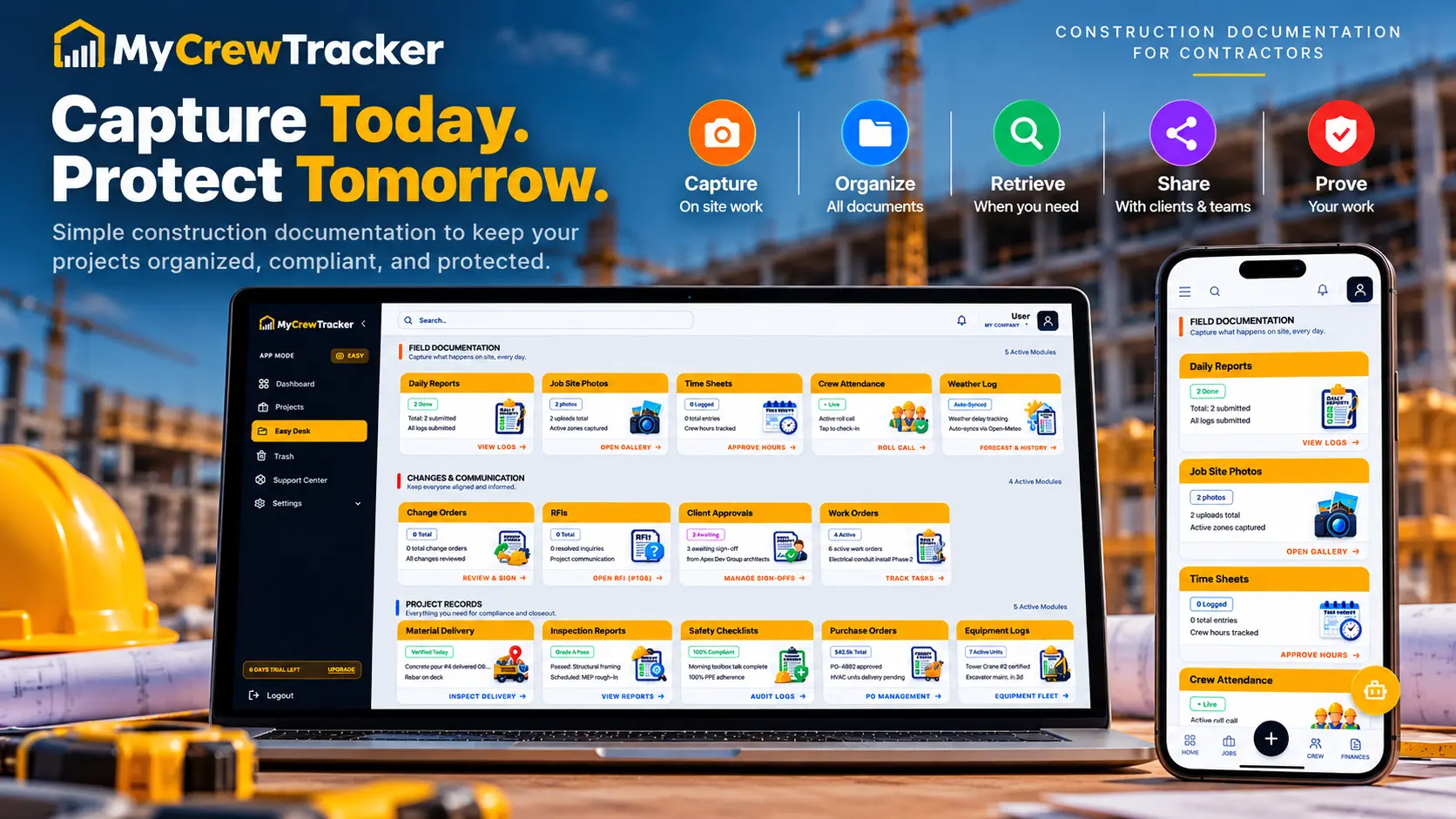
North Carolina’s rapidly expanding construction sector, spanning from Charlotte to the Research Triangle, presents unique regulatory challenges—most notably the state’s Lien Agent requirements. The state operates a dual-lien system that allows claimants to pursue both a lien on real property and a lien on contract funds, and it imposes strict notice deadlines that can subordinate or void your rights if missed. With prompt-pay timelines, retainage rules, and a six-year statute of repose all intersecting, documentation is not just best practice—it is the foundation of every successful payment claim. MyCrewTracker provides North Carolina contractors with a centralized cloud environment to organize daily reports, store lien notices, and protect project profitability.
North Carolina Lien Agent Requirements (N.C. Gen. Stat. § 44A-11.1)
North Carolina has a highly unique system for managing construction liens. Under N.C. Gen. Stat. § 44A-11.1, for most private construction projects where the total cost of improvements is $40,000 or more, the owner must designate a Lien Agent no later than the time the owner first contracts with any person to improve the real property.
Who Is Exempt from the Lien Agent Requirement?
The owner is not required to designate a lien agent for:
- Improvements to an existing single-family residential dwelling unit that is occupied by the owner as a residence
- The addition of an accessory building or accessory structure as defined in the North Carolina Uniform Residential Building Code, the use of which is incidental to that residence
What Is a Lien Agent?
A Lien Agent is a title insurance company or title insurance agency authorized to do business in North Carolina and registered with the Department of Insurance pursuant to G.S. 58-26-45. The lien agent’s role is to receive and track notices from contractors and subcontractors of potential claims of liens. Designation of a lien agent does not make the lien agent an agent of the owner for purposes of receiving a Claim of Lien on Real Property or a Notice of Claim of Lien upon Funds.
The 15-Day Notice to Lien Agent Requirement
Subcontractors and suppliers must serve a Notice to Lien Agent on the designated lien agent. This notice should be served at any time, but no later than 15 days after first furnishing labor or materials to the project site. Service of the Notice to Lien Agent is critical for protecting lien rights against subsequent purchasers and encumbrances.
Missing this 15-day window can subordinate your lien rights. By utilizing MyCrewTracker’s Daily Reports, field supervisors can generate a verifiable, date-stamped log of when work actually began on site, ensuring the back office tracks the 15-day window and securely archives the Notice to Lien Agent receipts via Quick Docs.
Delivery Methods for the Notice to Lien Agent
Under N.C.G.S. § 44A-11.2(f), acceptable methods of delivery include personal delivery, certified mail, and other methods specified by statute. The notice must include the potential lien claimant’s name and address, the name and address of the party with whom the claimant contracted, a description of the real property, and the date of first furnishing.
North Carolina Dual Lien System: Real Property and Funds
North Carolina operates a unique dual-lien system. A claimant may pursue both:
1. A Claim of Lien on Real Property (N.C.G.S. § 44A-8) — a lien against the improved real estate itself
2. A Notice of Claim of Lien upon Funds (N.C.G.S. § 44A-18) — a lien against contract funds owed to the party with whom the claimant contracted
Lien on Funds (N.C.G.S. § 44A-18)
Under N.C.G.S. § 44A-18, a first-tier subcontractor who furnishes labor, materials, or rental equipment at the site of the improvement shall have a lien upon funds that are owed to the contractor with whom the first-tier subcontractor dealt and that arise out of the improvement on which the first-tier subcontractor worked. This lien is perfected upon the giving of a Notice of Claim of Lien upon Funds to the obligor pursuant to G.S. 44A-19.
Duties of the Obligor (N.C.G.S. § 44A-20)
Upon receipt of the Notice of Claim of Lien upon Funds, the obligor (the party who owes money to the lien claimant) is under a duty to retain any funds subject to the lien up to the total amount of such liens as to which notice has been received. If the obligor wrongfully pays out funds after receiving notice, the lien claimant may acquire a lien upon the improved real property by virtue of the owner’s wrongful payment.
North Carolina Lien Deadlines at a Glance
Missing a single deadline in North Carolina can void your lien rights entirely. The table below summarizes the statutory deadlines every North Carolina contractor, subcontractor, and material supplier must track.
| Action | Deadline | Statute |
|---|---|---|
| Serve Notice to Lien Agent | Within 15 days of first furnishing | N.C.G.S. § 44A-11.2 |
| File Claim of Lien on Real Property | Within 120 days of last furnishing | N.C.G.S. § 44A-12(b) |
| Serve Notice of Claim of Lien upon Funds | Upon discovery of nonpayment | N.C.G.S. § 44A-19 |
| Commence enforcement action | Within 180 days of last furnishing | N.C.G.S. § 44A-13 |
| Owner pay contractor (Prompt Pay Act, public) | Within 30 days of receipt of invoice | N.C.G.S. § 143-134.1 |
| Contractor pay subcontractor (Prompt Pay Act) | Within 7 days of receiving payment | N.C.G.S. § 22C-3 |
| Maximum retainage (public projects) | 5% of periodic payments | N.C.G.S. § 143-134.1(b1) |
| Construction defect statute of repose | 6 years from later of last act or substantial completion | N.C.G.S. § 1-50(a)(5) |
How to File a Claim of Lien in North Carolina: Step by Step
The process below reflects the standard path for a North Carolina contractor, subcontractor, or material supplier seeking to preserve and enforce lien rights under Chapter 44A of the North Carolina General Statutes.
1. Log your first day of work. The 15-day Notice to Lien Agent clock starts from your first day of furnishing labor or materials. MyCrewTracker’s Daily Reports timestamp this automatically.
2. Serve the Notice to Lien Agent. Under N.C.G.S. § 44A-11.2, serve the notice on the owner’s designated lien agent within 15 days of first furnishing. The lien agent must be chosen from the list of registered lien agents maintained by the Department of Insurance.
3. Track the last day of work. North Carolina’s 120-day filing clock starts from the last date you furnished labor or materials to the project site.
4. Serve a Notice of Claim of Lien upon Funds. Under N.C.G.S. § 44A-19, serve a written notice on the obligor (the party who owes you money) to perfect your lien on funds. The obligor must then retain the funds subject to the lien.
5. File the Claim of Lien on Real Property. Under N.C.G.S. § 44A-12(b), the claim must be filed in the office of the Clerk of Superior Court in each county where the property is located within 120 days after the last furnishing of labor or materials.
6. Serve the Claim of Lien. The claim of lien must be served on the owner and other parties in accordance with N.C.G.S. § 44A-11.
7. Commence enforcement action within 180 days. Under N.C.G.S. § 44A-13, an action to enforce the claim of lien on real property must be commenced no later than 180 days after the last furnishing of labor or materials at the site of the improvement.
8. Preserve all project documentation. Daily reports, delivery tickets, change orders, and photos become evidence in the enforcement action.
Documents to Preserve for a North Carolina Lien Claim
North Carolina courts require strict compliance with the statutory requirements of Chapter 44A. The following records are what you need:
- Signed contract or purchase order with the prime contractor
- Proof of service of the Notice to Lien Agent
- Delivery tickets signed by an authorized site representative
- Daily reports showing crew on site and work performed
- Photo evidence of installed work (timestamped and geotagged)
- Jobsite sign-in logs and crew attendance records
- Invoices, statements, and payment applications
- Email or text correspondence about scope and payment
- Change orders and extra work authorizations
- Proof of service of the Notice of Claim of Lien upon Funds
MyCrewTracker stores all of these in one project record. When a lien deadline approaches, the back office can generate the timeline needed to prepare the Claim of Lien without reconstructing months of field activity.
North Carolina-Specific Gotchas
The 15-day Notice to Lien Agent is a strict prerequisite. For projects subject to the Lien Agent requirement, failure to serve the Notice to Lien Agent within 15 days of first furnishing may subordinate your lien rights to subsequent purchasers and encumbrances. North Carolina courts require strict compliance with Chapter 44A.
North Carolina has a dual-lien system. You may pursue both a lien on real property and a lien on funds. The lien on funds is perfected by serving a Notice of Claim of Lien upon Funds on the obligor, and the obligor then has a duty to retain the funds.
The 120-day filing deadline is absolute. N.C.G.S. § 44A-12(b) gives you exactly 120 days from your last day of furnishing to file the Claim of Lien on Real Property. There are no extensions.
The 180-day enforcement deadline is absolute. N.C.G.S. § 44A-13 gives you exactly 180 days from your last day of furnishing to commence an enforcement action. Note that this deadline runs from last furnishing, not from the date the lien is filed, so it is possible that the deadline could be as short as 60 days from the filing of the lien itself. Set two calendar reminders: one at 120 days, one at 150 days.
Prospective lien waivers are void. Under N.C.G.S. § 22B-5, provisions in lien waivers or construction agreements purporting to require a promisor to submit a waiver or release of liens as a condition of receiving interim or progress payments are void and unenforceable unless limited to the specific payment actually received. North Carolina law prohibits waiving lien rights for future work.
Retainage on public projects is capped at 5%. Under N.C.G.S. § 143-134.1(b1), the owner shall not retain more than 5% of any periodic payment due a prime contractor on public construction contracts. The percentage of retainage on payments made by the prime contractor to the subcontractor shall not exceed the percentage of retainage on payments made by the owner to the prime contractor.
Construction defect statute of repose. North Carolina’s statute of repose for construction defects is 6 years from the later of the specific last act or omission of the defendant giving rise to the cause of action or substantial completion of the improvement, under N.C.G.S. § 1-50(a)(5). This is an absolute bar regardless of when the defect is discovered. Retain project records for at least 6 years.
Example Scenario: How Documentation Determines the Outcome
*The following is an illustrative scenario, not a specific case. It demonstrates how record-keeping affects outcomes in North Carolina lien disputes.*
Consider a Charlotte mechanical subcontractor on a $600,000 commercial office renovation. The sub first furnishes labor on March 1. Under N.C.G.S. § 44A-11.2, the 15-day Notice to Lien Agent must be served by March 16. The sub serves it on March 10. The lien agent receipt is filed.
The sub’s last day of substantial work is August 15. Under N.C.G.S. § 44A-12(b), the sub has 120 days from August 15 to file the Claim of Lien on Real Property with the Mecklenburg County Clerk of Superior Court. That deadline is December 13. The sub files the claim on December 5 and serves it on the owner on December 8.
Under N.C.G.S. § 44A-13, the sub has 180 days from August 15 to commence an enforcement action. That deadline is February 11. The sub files suit on January 15, well within the window. The lien is enforceable.
Now consider the same sub who also served a Notice of Claim of Lien upon Funds on the general contractor on September 1. Under N.C.G.S. § 44A-20, the GC is now under a duty to retain funds subject to the lien. If the GC pays the sub’s funds to another party after receiving the notice, the sub may acquire a lien on the real property by virtue of the GC’s wrongful payment.
Documentation is what separates these outcomes. MyCrewTracker logs the first day of work, the lien agent notice date, the last day of work, and the daily reports that prove performance.
North Carolina Prompt Pay Act (N.C. Gen. Stat. § 22C-3)
Under N.C. Gen. Stat. § 22C-3, when a subcontractor has performed in accordance with the provisions of their contract, the contractor shall pay to their subcontractor — and each subcontractor shall pay to their subcontractor — within 7 days of receipt by the contractor or subcontractor of each periodic or final payment, the full amount received for such subcontractor’s work and materials based on work completed or service provided under the subcontract.
What the North Carolina Prompt Pay Act Covers
- 7-day payment: Prime contractors and all subcontractors must pay any lower-tier subcontractor within 7 days of receipt of each periodic or final payment
- Retainage limits: Under G.S. 22C-3, the prime contractor shall not withhold retainage from subcontractors in excess of the percentage withheld from the prime by the owner
- Void provisions: A contractual provision postponing payment for more than 30 days after performance in accordance with the contract and billing is void
To defend against claims of payment failure, contractors must maintain flawless documentation. MyCrewTracker offers a secure cloud repository where North Carolina contractors can organize dated payment applications, bank disbursement records, and formal communications to prove statutory compliance.
North Carolina Retainage and Trust Fund Provisions
Public Project Retainage (N.C.G.S. § 143-134.1)
Under N.C.G.S. § 143-134.1, on all public construction contracts, the owner shall not retain more than 5% of any periodic payment due a prime contractor. The percentage of retainage on payments made by the prime contractor to the subcontractor shall not exceed the percentage of retainage on payments made by the owner to the prime contractor.
Lien upon Funds (N.C.G.S. § 44A-18)
North Carolina’s lien upon funds is a powerful tool for subcontractors. Under § 44A-18, a first-tier subcontractor who furnishes labor, materials, or rental equipment at the site of the improvement shall have a lien upon funds owed to the contractor with whom the subcontractor dealt. This lien is perfected upon giving notice to the obligor, and the obligor then has a duty to retain the funds.
To defend against claims of misappropriation, contractors must maintain immaculate accounting and project documentation. Using MyCrewTracker’s Quick Docs system, contractors can securely store properly dated payment applications, lien waivers, and bank disbursement records in the cloud, helping establish a clear paper trail of how project funds were distributed.
What MyCrewTracker Does (and Does Not Do) in North Carolina
MyCrewTracker is a construction documentation platform, not a legal service. Here is what it does for North Carolina contractors:
- Logs first day and last day of work per project so you can calculate the 15-day lien agent notice and the 120-day filing window
- Stores proof of service and Notice to Lien Agent documents in the project file
- Records delivery tickets with photo and signature capture
- Captures timestamped, GPS-tagged site photos that document installation
- Generates daily report PDFs that serve as contemporaneous records
- Tracks payment application dates for Prompt Pay Act compliance
- Tracks retainage and fund disbursements to demonstrate compliance with Chapter 44A
- Archives project records for 6+ years to support construction defect defense
It does not draft Notices to Lien Agent, file Claims of Lien with the Clerk of Superior Court, or provide legal advice. Those steps require a North Carolina construction attorney.
❓ Frequently Asked Questions in North Carolina
What is a North Carolina Lien Agent?
Under N.C. Gen. Stat. § 44A-11.1, a Lien Agent is a designated entity for certain private construction projects over $40,000. Subcontractors and suppliers must serve a Notice to Lien Agent, generally within 15 days of their first day of work, to fully protect their lien rights.
What happens if I miss the 15-day Lien Agent notice deadline?
Missing the 15-day window can subordinate your lien rights to subsequent purchasers and encumbrances. North Carolina courts require strict compliance with Chapter 44A’s notice requirements.
How long do I have to file a Claim of Lien on Real Property in North Carolina?
You have 120 days from your last day of furnishing labor or materials to file the Claim of Lien on Real Property with the Clerk of Superior Court of the county where the property is located. This is set by N.C.G.S. § 44A-12(b).
How long do I have to sue to enforce a North Carolina lien?
You have 180 days from your last day of furnishing labor or materials to commence an enforcement action. This is set by N.C.G.S. § 44A-13.
What is the North Carolina Prompt Pay deadline for subcontractors?
Under N.C. Gen. Stat. § 22C-3, a prime contractor must generally pay a subcontractor within 7 days of receiving payment from the owner for that subcontractor’s work, provided the subcontractor performed in accordance with their contract.
What is the North Carolina retainage limit on public projects?
Under N.C.G.S. § 143-134.1(b1), the owner shall not retain more than 5% of any periodic payment due a prime contractor on public construction contracts.
What is the North Carolina construction defect statute of repose?
Under N.C.G.S. § 1-50(a)(5), no action may be brought for construction defects more than 6 years from the later of the specific last act or omission giving rise to the cause of action or substantial completion of the improvement.
Can I be forced to waive my lien rights in North Carolina?
No. Under N.C.G.S. § 22B-5, prospective lien waivers as a condition of progress payments are void and unenforceable. Any waiver must be limited to the specific payment actually received.
What is the North Carolina lien on funds?
Under N.C.G.S. § 44A-18, a first-tier subcontractor has a lien upon funds owed to the contractor with whom the subcontractor dealt. This lien is perfected by serving a Notice of Claim of Lien upon Funds on the obligor, who then has a duty to retain the funds.
Does MyCrewTracker automatically file my Notice to Lien Agent?
No. MyCrewTracker is a secure document management platform. While it is the perfect place to archive copies of your Notice to Lien Agent and track your first day of work via Daily Reports, you must use the official LiensNC system or an attorney to actually file the notice.
Legal Sources & References
-
Lien Agent — Designation and Duties N.C. Gen. Stat. § 44A-11.1
North Carolina Lien Agent — Owners must designate a lien agent for projects $40,000 or more. Subcontractors and suppliers must serve a Notice to Lien Agent within 15 days of first furnishing labor or materials.
-
Identification of Lien Agent — Notice to Lien Agent N.C. Gen. Stat. § 44A-11.2
North Carolina Notice to Lien Agent — Sets forth the requirements for serving the Notice to Lien Agent, including acceptable delivery methods and the 15-day deadline.
-
Claim of Lien on Real Property — Filing Deadline N.C. Gen. Stat. § 44A-12
North Carolina Lien Filing — The Claim of Lien on Real Property must be filed within 120 days after the last furnishing of labor or materials at the site of the improvement.
-
Action to Enforce Claim of Lien on Real Property N.C. Gen. Stat. § 44A-13
North Carolina Lien Enforcement — An action to enforce a claim of lien on real property must be commenced no later than 180 days after the last furnishing of labor or materials.
-
Grant of Lien upon Funds — Subrogation; Perfection N.C. Gen. Stat. § 44A-18
North Carolina Lien on Funds — A first-tier subcontractor has a lien upon funds owed to the contractor with whom the subcontractor dealt. The lien is perfected upon giving notice to the obligor.
-
Duties and Liability of Obligor N.C. Gen. Stat. § 44A-20
North Carolina Obligor Duties — Upon receipt of a Notice of Claim of Lien upon Funds, the obligor must retain funds subject to the lien. Wrongful payment may give rise to a lien on real property.
-
Prompt Pay Act — Time of Payment to Subcontractors N.C. Gen. Stat. § 22C-3
North Carolina Prompt Pay Act — Contractors must pay subcontractors within 7 days of receiving each periodic or final payment. Retainage withheld from subcontractors cannot exceed the percentage withheld from the prime.
-
Waiver of Liens or Claims as a Condition of Progress Payment Invalid N.C. Gen. Stat. § 22B-5
North Carolina Lien Waiver Law — Prospective lien waivers as a condition of progress payments are void and unenforceable unless limited to the specific payment actually received.
-
Retainage — Public Construction Contracts N.C. Gen. Stat. § 143-134.1
North Carolina Retainage — On public construction contracts, the owner shall not retain more than 5% of any periodic payment due a prime contractor.
-
Construction Defect Statute of Repose N.C. Gen. Stat. § 1-50(a)(5)
North Carolina Statute of Repose — No action may be brought for construction defects more than 6 years from the later of the specific last act or omission or substantial completion of the improvement.
-
North Carolina General Assembly General Reference
Official North Carolina General Assembly website — Searchable index of all North Carolina General Statutes.
Protect Your Projects & Retain Required North Carolina Records
Defend against back-charges, audit penalties, and mechanic's lien disputes. Keep GPS-timestamped photos, certified timesheets, and signed change orders safely backed up for just $40/month.