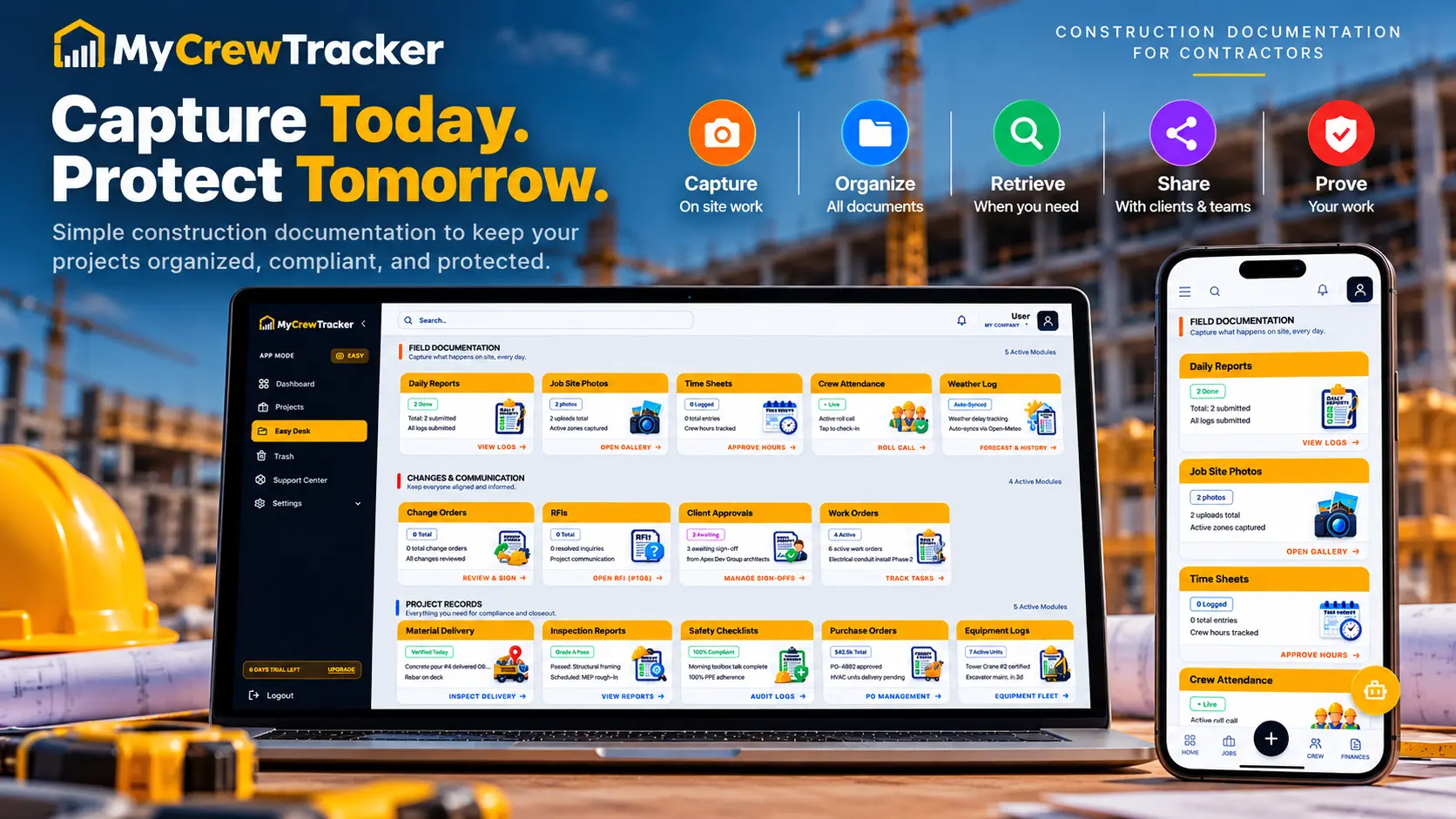
Oregon's fast-paced construction market requires contractors to be exceptionally organized. With some of the shortest preliminary notice deadlines in the country, contractors rely on MyCrewTracker to track job starts and securely archive critical notices.
The 8-Day Notice of Right to a Lien (ORS 87.021)
Oregon possesses one of the most aggressive preliminary notice deadlines in the United States. Under ORS 87.021, any person furnishing materials, equipment, or supplies who does not have a direct contract with the owner must generally deliver a Notice of Right to a Lien to protect their lien rights.
The 8-Day Look-Back Rule
The notice of right to a lien may be given at any time during the progress of the improvement. However, the notice only protects the right to perfect a lien for materials, equipment and labor or services provided after a date which is eight days, not including Saturdays, Sundays and other holidays as defined in ORS 187.010, before the notice is delivered or mailed. This means if you serve the notice late, you lose lien rights for the work performed in the 8 business days preceding the notice.
Who Is Exempt from the Notice Requirement?
Under ORS 87.021(3)(b), a person who performs labor upon a commercial improvement or provides labor and material for a commercial improvement, or who rents equipment used in the construction of a commercial improvement, need not give the notice required by subsection (1) to perfect a lien. A "commercial improvement" is defined as any structure or building not used or intended to be used as a residential building, or other improvements to a site on which such a structure or building is to be located.
What Happens If You Miss the 8-Day Deadline
Failing to meet this incredibly tight 8-day deadline forfeits your lien rights for materials delivered prior to the 8 days preceding a late notice. Oregon courts have consistently held that the notice of right to a lien must be given during the progress of the improvement.
Using MyCrewTracker's Daily Reports, field supervisors generate an instant, verifiable log of when materials arrive on site, ensuring the back office can react immediately to meet the 8-day window.
Oregon Lien Deadlines at a Glance
Missing a single deadline in Oregon can void your lien rights entirely. The table below summarizes the statutory deadlines every Oregon contractor, subcontractor, and material supplier must track.
| Action | Deadline | Statute |
|---|---|---|
| Serve Notice of Right to a Lien | Only protects work performed 8 business days before the notice and after | ORS 87.021 |
| File lien claim (original contractor) | Within 75 days after completion of construction or cessation of work | ORS 87.035 |
| File lien claim (subcontractor/supplier) | Within 75 days after cessation of work or completion, whichever is earlier | ORS 87.035 |
| File suit to enforce lien | Within 120 days after filing the lien claim | ORS 87.060 |
| Owner pay contractor (Prompt Payment Act) | Within 30 days of billing | ORS 701.420 |
| Contractor pay subcontractor | Within 7 days of receiving payment | ORS 701.420 |
| Retainage cap | 5% of contract price | ORS 701.420 |
| Retainage escrow (contracts over $500,000) | Interest-bearing escrow account required | ORS 701.420 |
| Construction defect statute of repose (small commercial/residential) | 10 years from substantial completion | ORS 12.135 |
| Construction defect statute of repose (large commercial) | 6 years from substantial completion | ORS 12.135 |
How to File a Mechanics Lien in Oregon: Step by Step
The process below reflects the standard path for an Oregon contractor, subcontractor, or material supplier seeking to preserve and enforce lien rights under ORS Chapter 87.
1. Log your first day of work. The 8-day look-back period starts from your first day of furnishing labor or materials. MyCrewTracker's Daily Reports timestamp this automatically.
2. Prepare and serve the Notice of Right to a Lien. Under ORS 87.021, serve the notice on the property owner. The notice must be in substantially the form set forth in ORS 87.023.
3. Track the completion date. Oregon's 75-day filing clock starts from the completion of construction or the date you ceased to provide labor, rent equipment, or furnish materials, whichever is earlier.
4. Prepare the lien claim. Under ORS 87.035, the claim must include a statement of the amount due, the property description, and the names of the parties.
5. File the lien claim with the County Clerk. Oregon mechanics liens are filed at the county level. File in the county where the property is located.
6. File suit within 120 days. Under ORS 87.060, an action to enforce the lien must be commenced within 120 days after the lien claim is filed.
7. Preserve all project documentation. Daily reports, delivery tickets, change orders, and photos become evidence in the enforcement action.
Documents to Preserve for an Oregon Lien Claim
Oregon courts require proof that you furnished labor or materials and that they were incorporated into the property. The following records are what you need:
- Signed contract or purchase order with the prime contractor
- Proof of service of the Notice of Right to a Lien
- Delivery tickets signed by an authorized site representative
- Daily reports showing crew on site and work performed
- Photo evidence of installed work (timestamped and geotagged)
- Jobsite sign-in logs and crew attendance records
- Invoices, statements, and payment applications
- Email or text correspondence about scope and payment
- Change orders and extra work authorizations
- Written demand letters and any response
MyCrewTracker stores all of these in one project record. When a lien deadline approaches, the back office can generate the timeline needed to prepare the lien claim without reconstructing months of field activity.
Oregon-Specific Gotchas
The 8-day look-back rule is the biggest trap. Unlike most states where a preliminary notice protects all work from the start of the project, Oregon's Notice of Right to a Lien only protects work performed in the 8 business days before service and all work after. If you serve the notice on day 20, you lose lien rights for the first 12 business days of work.
Commercial improvement work is exempt from the notice requirement. Under ORS 87.021(3)(b), a person who performs labor upon a commercial improvement or provides labor and material for a commercial improvement need not give the notice to perfect a lien.
The 75-day filing deadline is absolute. ORS 87.035 gives you exactly 75 days from the earlier of completion or cessation of work to file the lien claim. There are no extensions.
The 120-day enforcement deadline is absolute. ORS 87.060 gives you exactly 120 days from filing the lien claim to commence an action to enforce it. Set two calendar reminders: one at 90 days, one at 110 days.
Retainage is capped at 5%. Under ORS 701.420, an owner, contractor, or subcontractor may withhold as retainage an amount equal to not more than five percent of the contract price of the work completed.
Retainage escrow required for contracts over $500,000.** Under ORS 701.420(2)(b), if the contract price exceeds **$500,000, the owner, contractor, or subcontractor shall place amounts withheld as retainage into an interest-bearing escrow account.
Construction defect statute of repose. Oregon's statute of repose for construction defects under ORS 12.135 is 10 years from substantial completion for residential structures and small commercial structures, and 6 years for large commercial structures. Retain project records for at least 10 years.
Attorney fees may be recoverable. Under ORS 87.060, the court may award reasonable attorney fees to the prevailing party in a lien foreclosure action.
Example Scenario: How Documentation Determines the Outcome
*The following is an illustrative scenario, not a specific case. It demonstrates how record-keeping affects outcomes in Oregon lien disputes.*
Consider a Portland mechanical subcontractor on a $500,000 commercial office renovation. The sub first furnishes labor on March 1. Under ORS 87.021, the sub serves the Notice of Right to a Lien on March 20. Because the notice only protects work performed in the 8 business days before service, the sub loses lien rights for the work performed from March 1 to March 7. Work from March 8 onward is protected.
The sub's last day of substantial work is August 15. Under ORS 87.035, the sub has 75 days from August 15 to file the lien claim with the Multnomah County Clerk. That deadline is October 29. The sub files the lien claim on October 20.
Under ORS 87.060, the sub has 120 days from October 20 to file suit. That deadline is February 17. The sub files suit on December 15, well within the window. The lien is enforceable.
Now consider the Prompt Payment Act side. The general contractor received a $500,000 progress payment from the owner on July 1. Under ORS 701.420, the GC had 7 days to pay the sub — by July 8. The GC failed to pay. The sub is entitled to interest at 1% per month on the unpaid amount.
Documentation is what separates these outcomes. MyCrewTracker logs the first day of work, the notice service date, the filing date, and the daily reports that prove performance.
Oregon Prompt Payment Act (ORS 701.420)
Cash flow delays are heavily regulated in Oregon. Under ORS 701.420, an owner must generally pay the original contractor within 30 days of receiving a billing. The contractor must then pay their subcontractors within 7 days of receiving those funds.
What the Oregon Prompt Payment Act Requires
- 30-day payment: Owners must pay contractors within 30 days of billing
- 7-day payment: Contractors must pay subcontractors within 7 days of receiving payment
- Interest penalty: Late payments accrue interest at 1% per month on the final payment due
- Notice of completion: The contractor must notify the party to whom they are responsible when work is considered complete; that party has 15 days to accept the work or notify of work yet to be performed
To defend against claims of payment failure, contractors must maintain flawless documentation. MyCrewTracker offers a secure cloud repository where Oregon contractors can organize dated payment applications, bank disbursement records, and formal communications to prove statutory compliance.
Oregon Retainage and Escrow Requirements (ORS 701.420)
Under ORS 701.420, retainage on Oregon construction contracts is capped at 5% of the contract price of the work completed. For contracts exceeding $500,000, the retained amounts must be placed into an interest-bearing escrow account.
What the Retainage Law Requires
- 5% cap: Maximum retainage is 5% of the contract price
- Escrow requirement: Contracts over $500,000 require retainage to be held in an interest-bearing escrow account
- Interest accrual: Interest on the retainage accrues from the date the payment request is approved until the date the retainage is paid
To defend against claims of wrongful withholding, contractors must maintain flawless documentation of retainage applications and approvals. MyCrewTracker offers a secure cloud repository where Oregon contractors can organize dated payment applications and formal communications.
Oregon Construction Defect Statute of Repose (ORS 12.135)
Under ORS 12.135, an action against a person arising from the construction, alteration, or repair of any improvement to real property must be commenced before the earliest of:
- Ten years after substantial completion or abandonment of the construction of a small commercial structure, a residential structure, or a large commercial structure owned by a homeowners association
- Six years after substantial completion or abandonment of the construction of a large commercial structure other than one owned by a homeowners association
What This Means for Oregon Contractors
- Retain project records for at least 10 years to defend against potential defect claims
- The statute applies to claims arising from design, planning, surveying, architectural, or engineering services
- The period runs from substantial completion or abandonment, not from the date of discovery
What MyCrewTracker Does (and Does Not Do) in Oregon
MyCrewTracker is a construction documentation platform, not a legal service. Here is what it does for Oregon contractors:
- Logs first day and last day of work per project so you can calculate the 8-day notice window and the 75-day filing deadline
- Stores proof of service and Notice of Right to a Lien documents in the project file
- Records delivery tickets with photo and signature capture
- Captures timestamped, GPS-tagged site photos that document installation
- Generates daily report PDFs that serve as contemporaneous records
- Tracks payment application dates for Prompt Payment Act compliance
- Tracks retainage and escrow to demonstrate compliance with ORS 701.420
- Archives project records for 10+ years to support construction defect defense
It does not draft Notices of Right to a Lien, file lien claims with the County Clerk, or provide legal advice. Those steps require an Oregon construction attorney.
❓ Frequently Asked Questions in Oregon
What is the Oregon Notice of Right to a Lien?
Under ORS 87.021, a Notice of Right to a Lien is a mandatory preliminary document that material and equipment suppliers must serve to protect their mechanics lien rights. The notice only protects work performed in the 8 business days before the notice is delivered or mailed.
What happens if I miss the 8-day look-back period in Oregon?
You do not lose lien rights entirely, but your lien is limited to the work performed in the 8 business days before the notice and all work after. Work performed more than 8 business days before the notice is not protected.
How long do I have to file a lien claim in Oregon?
You have 75 days from the earlier of completion of construction or cessation of work to file the lien claim. This is set by ORS 87.035.
How long do I have to sue to enforce an Oregon lien?
You have 120 days from the date your lien claim is filed to commence an action to enforce it. This is set by ORS 87.060.
What is the Oregon Prompt Pay deadline?
Under ORS 701.420, owners must generally pay contractors within 30 days of billing, and contractors must pay subcontractors within 7 days of receiving payment.
What is the Oregon retainage limit?
Under ORS 701.420, retainage on construction contracts is capped at 5% of the contract price. For contracts over $500,000, retainage must be held in an interest-bearing escrow account.
What is the Oregon construction defect statute of repose?
Under ORS 12.135, no action may be brought for construction defects more than 10 years after substantial completion for residential structures and small commercial structures, and 6 years for large commercial structures.
Does Oregon require a preliminary notice on commercial projects?
No. Under ORS 87.021(3)(b), a person who performs labor upon a commercial improvement or provides labor and material for a commercial improvement need not give the notice required by subsection (1) to perfect a lien.
Can I be forced to waive my lien rights in Oregon?
Oregon law does not void all prospective lien waivers, but courts scrutinize them closely. Never sign an unconditional waiver before you have received and deposited the payment.
Does MyCrewTracker automatically track my 8-day deadline?
No. MyCrewTracker is a secure document storage and organization platform. It provides the Daily Reporting tools you need to record your material delivery dates, but your back office must calculate the 8 working days and serve the notice.
Legal Sources & References
-
Notice to Owners — Notice of Right to a Lien ORS 87.021
Oregon Mechanics Lien — A person furnishing materials, equipment, services, or labor must give a notice of right to a lien to the owner. The notice only protects work performed in the 8 business days before the notice and after. Commercial improvement work is exempt.
-
Perfecting Lien — Filing Claim of Lien ORS 87.035
Oregon Lien Filing — Every person claiming a lien must perfect the lien not later than 75 days after the person has ceased to provide labor, rent equipment, or furnish materials, or 75 days after completion of construction, whichever is earlier.
-
Foreclosure — Time for Commencement of Action ORS 87.060
Oregon Lien Enforcement — An action to enforce a mechanics lien must be commenced within 120 days after the lien claim is filed.
-
Partial Payment — Retainage — Interest ORS 701.420
Oregon Prompt Payment and Retainage — Partial payment is allowed. Retainage is capped at 5% of the contract price. Contracts over $500,000 require retainage to be held in an interest-bearing escrow account. Interest at 1% per month on final payment due.
-
Action for Damages from Construction — Statute of Repose ORS 12.135
Oregon Construction Defect Statute of Repose — 10 years from substantial completion for residential and small commercial structures; 6 years for large commercial structures.
-
Oregon Legislature — Oregon Revised Statutes General Reference
Official Oregon Legislature website — Searchable index of all Oregon Revised Statutes.
Protect Your Projects & Retain Required Oregon Records
Defend against back-charges, audit penalties, and mechanic's lien disputes. Keep GPS-timestamped photos, certified timesheets, and signed change orders safely backed up for just $40/month.