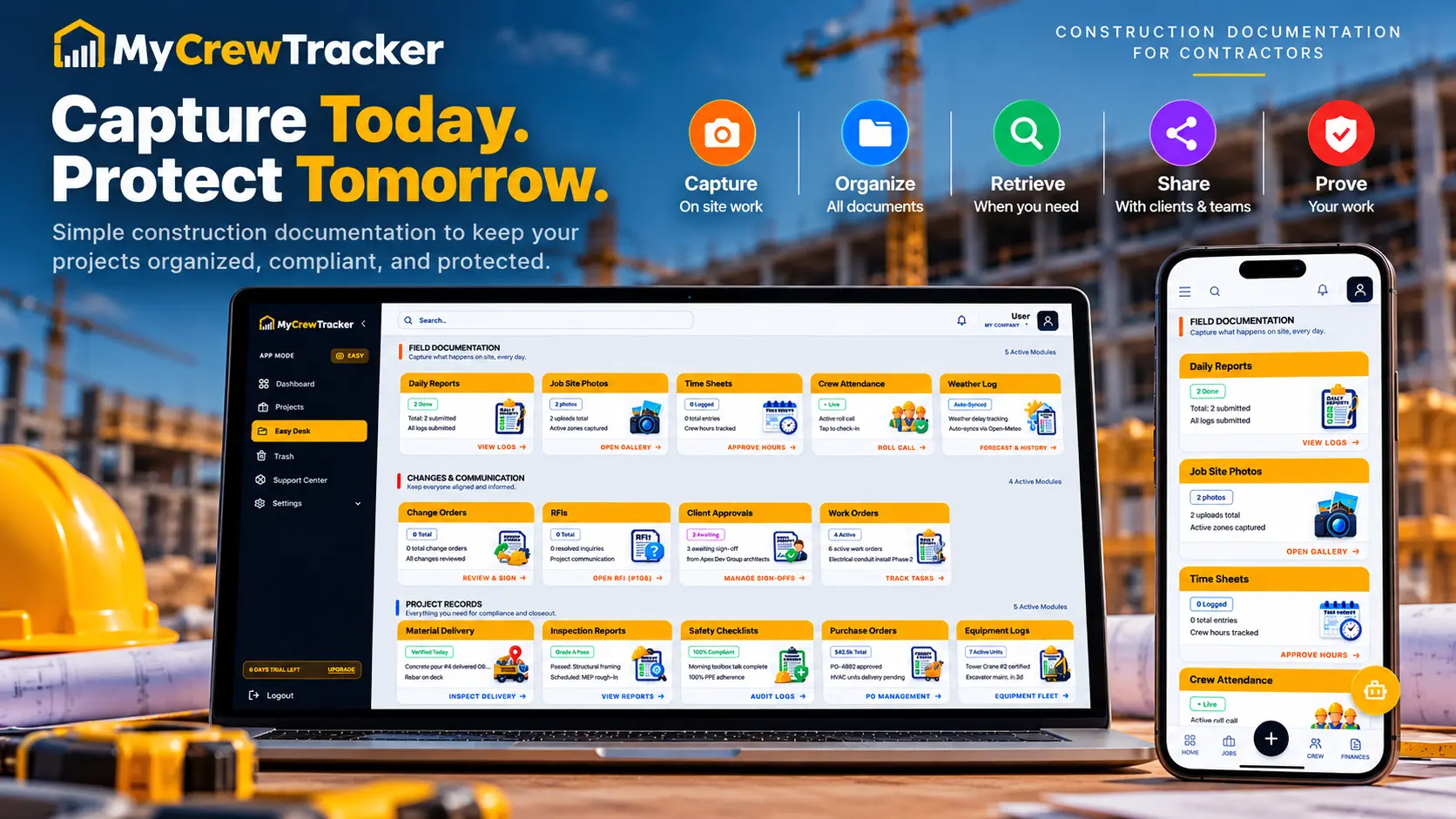
Wisconsin contractors face complex, tiered lien notice requirements depending on their relationship with the property owner. The state operates a dual-notice system: prime contractors must serve a statutory notice within 10 days of first furnishing labor or materials, while subcontractors and suppliers have 60 days to serve their notice. On top of that, Wisconsin's construction trust fund statute carries criminal penalties for misappropriation, public works retainage is capped and held in trust, and a six-year statute of repose bars defect claims. MyCrewTracker helps Wisconsin construction professionals organize their daily reports and statutory notices in a secure, centralized cloud.
Wisconsin Prime and Subcontractor Lien Notices (Wis. Stat. § 779.02)
Securing mechanics lien rights in Wisconsin requires careful tracking of your role on the project. Under Wis. Stat. § 779.02(2), the notice requirements differ significantly depending on whether you are a prime contractor or a subcontractor.
Prime Contractor Notice: The 10-Day Rule
Under Wis. Stat. § 779.02(2)(a), every prime contractor who enters into a contract with the owner for a work of improvement on the owner's land and who has contracted or will contract with any subcontractors, suppliers, or service providers must include a statutory notice in any written contract with the owner, and must provide the owner with a copy of the written contract.
If no written contract exists, the notice must be prepared separately and served on the owner or authorized agent within 10 days after the first labor, services, materials, plans, or specifications are performed, furnished, or procured for the improvement by or pursuant to the authority of the prime contractor. The notice must be in at least 8-point bold type if printed, or in capital letters if typewritten, and must contain specific statutory language warning the owner that persons or companies providing labor or materials may have lien rights.
What Happens If the Prime Contractor Fails to Give Notice
Under Wis. Stat. § 779.02(2)(c), if a prime contractor fails to give the required notice, the prime contractor does not have the lien and remedy provided by the lien subchapter unless the prime contractor pays all of its obligations to subcontractors, suppliers, and service providers within the time periods under § 779.06 and until the time for notice under par. (b) has elapsed. This is a strict forfeiture — the prime contractor loses lien rights for the entire project.
Subcontractor and Supplier Notice: The 60-Day Rule
Under Wis. Stat. § 779.02(2)(b), every person other than a prime contractor who performs, furnishes, or procures labor, materials, plans, or specifications for an improvement shall have the lien and remedy under this subchapter only if within 60 days after performing, furnishing, or procuring the first labor, services, materials, plans, or specifications the person serves a written notice, in two signed copies, on the owner or authorized agent at the last-known post-office address.
The notice must be in substantially the statutory form with blanks accurately filled in, including the date of first furnishing and a description of the real estate. The owner or agent must provide a copy of the notice received, within 10 days after receipt, to any mortgage lender who is furnishing or is to furnish funds for construction.
The 30-Day Notice of Intent to File a Lien Claim
Under Wis. Stat. § 779.06(2), no lien claim may be filed and no action may be brought unless, at least 30 days before timely filing of the lien claim, the lien claimant serves on the owner, personally or by registered mail with return receipt requested, a written notice of intent to file a lien claim. This notice must briefly describe the nature of the claim, its amount, and the land and improvement to which it relates. This 30-day notice is required whether or not the claimant has already given a previous notice under § 779.02.
Wisconsin Lien Deadlines at a Glance
Missing a single deadline in Wisconsin can void your lien rights entirely. The table below summarizes the statutory deadlines every Wisconsin contractor, subcontractor, and material supplier must track.
| Action | Deadline | Statute |
|---|---|---|
| Prime Contractor Notice | Within 10 days of first furnishing | Wis. Stat. § 779.02(2)(a) |
| Subcontractor/Supplier Notice | Within 60 days of first furnishing | Wis. Stat. § 779.02(2)(b) |
| Notice of Intent to File Lien Claim | At least 30 days before filing lien claim | Wis. Stat. § 779.06(2) |
| File Lien Claim with Circuit Court | Within 6 months of last furnishing | Wis. Stat. § 779.06(1) |
| Serve copy of lien claim on owner | Within 30 days of filing the claim | Wis. Stat. § 779.06(1) |
| Commence action to enforce lien | Within 2 years of filing the claim | Wis. Stat. § 779.06(1) |
| Municipal Prompt Payment (owner to prime) | Within 30 days of proper invoice | Wis. Stat. § 66.0135 |
| Municipal Prompt Payment (prime to sub) | Within 7 days of receiving payment | Wis. Stat. § 66.0135 |
| Public Works Retainage Cap | 5% until 50% completion; max 10% thereafter | Wis. Stat. § 66.0901(9) |
| Construction Defect Statute of Repose | 6 years from substantial completion | Wis. Stat. § 893.89 |
How to File a Mechanics Lien in Wisconsin: Step by Step
1. Log your first day of work. The 10-day prime contractor notice and the 60-day subcontractor notice both start from your first day of furnishing labor or materials. MyCrewTracker's Daily Reports timestamp this automatically.
2. Serve the applicable notice. Prime contractors: serve the statutory notice on the owner within 10 days of first furnishing. Subcontractors/suppliers: serve two signed copies of the notice on the owner within 60 days of first furnishing.
3. Track the last day of work. Wisconsin's 6-month filing clock starts from the date you last performed, furnished, or procured labor, services, materials, plans, or specifications for the improvement.
4. Serve the 30-Day Notice of Intent to File Lien Claim. Under § 779.06(2), serve the notice on the owner personally or by registered mail at least 30 days before filing the lien claim.
5. File the Lien Claim with the Circuit Court. Under § 779.06(1), file the claim in the office of the clerk of circuit court of the county where the lands affected by the lien lie, within 6 months of your last day of furnishing. The claim must have attached a copy of any notice given under § 779.02 and a copy of the 30-day notice of intent.
6. Serve a copy of the claim on the owner. Under § 779.06(1), serve a copy of the claim for lien on the owner within 30 days after filing the claim.
7. Commence action to enforce within 2 years. Under § 779.06(1), an action to enforce the lien must be brought and summons and complaint filed within 2 years from the date of filing the claim for lien.
8. Preserve all project documentation. Daily reports, delivery tickets, change orders, and photos become evidence in the enforcement action.
Documents to Preserve for a Wisconsin Lien Claim
Wisconsin courts require strict compliance with the statutory requirements of Chapter 779. The following records are what you need:
- Signed contract or purchase order with the prime contractor
- Proof of service of the prime contractor notice (if applicable)
- Proof of service of the subcontractor notice (two signed copies)
- Proof of service of the 30-day Notice of Intent to File Lien Claim
- Delivery tickets signed by an authorized site representative
- Daily reports showing crew on site and work performed
- Photo evidence of installed work (timestamped and geotagged)
- Jobsite sign-in logs and crew attendance records
- Invoices, statements, and payment applications
- Email or text correspondence about scope and payment
- Change orders and extra work authorizations
- Copy of the filed Lien Claim with circuit court stamp
MyCrewTracker stores all of these in one project record. When a lien deadline approaches, the back office can generate the timeline needed to prepare the lien claim without reconstructing months of field activity.
Wisconsin-Specific Gotchas
The 10-day prime contractor notice is the shortest in the region. Wisconsin gives prime contractors only 10 days from first furnishing to serve the statutory notice. If the notice is not included in the written contract, it must be served separately within this tight window.
The 60-day subcontractor notice is also strict. Subcontractors and suppliers have 60 days from first furnishing to serve two signed copies of the notice on the owner. Missing this deadline forfeits the lien entirely.
The 30-day Notice of Intent is a separate prerequisite. Even if you have served the § 779.02 notice, you must also serve a 30-day Notice of Intent to File Lien Claim under § 779.06(2) before filing the lien claim. This is a common trap for contractors who assume the first notice is sufficient.
The 6-month filing deadline is absolute. Wis. Stat. § 779.06(1) gives you exactly 6 months from your last day of furnishing to file the lien claim with the circuit court. There are no extensions.
The 2-year enforcement deadline is absolute. You have exactly 2 years from filing the claim to commence an action to enforce the lien. Set two calendar reminders: one at 18 months, one at 22 months.
Public works retainage is capped and held in trust. Under Wis. Stat. § 66.0901(9), retainage is limited to 5% of the estimate until 50% of the work is completed. At 50% completion, further partial payments must be made in full, and no additional amounts may be retained unless the architect or engineer certifies that the job is not proceeding satisfactorily, in which case the total retainage may not exceed 10% of the value of the work completed.
Municipal prompt payment deadlines are strict. Under Wis. Stat. § 66.0135, a municipality must pay the prime contractor within 30 days of receipt of a properly completed invoice. The prime contractor must pay subcontractors within 7 days of receiving payment from the agency.
Construction defect statute of repose is six years. Under Wis. Stat. § 893.89, no action may be brought for construction defects more than 6 years after substantial completion of the improvement. Retain project records for at least six years.
Trust fund misappropriation is theft. Under Wis. Stat. § 779.02(5), funds paid by a property owner to a prime contractor are held in trust for the benefit of subcontractors and material suppliers. A contractor who uses these funds for any purpose other than paying downstream parties commits theft by contractor.
Example Scenario: How Documentation Determines the Outcome
*The following is an illustrative scenario, not a specific case. It demonstrates how record-keeping affects outcomes in Wisconsin lien disputes.*
Consider a Milwaukee mechanical subcontractor on a $600,000 commercial office renovation. The sub first furnishes labor on March 1. Under Wis. Stat. § 779.02(2)(b), the sub has 60 days from March 1 to serve two signed copies of the notice on the owner. That deadline is April 30. The sub serves the notice on April 25.
The sub's last day of substantial work is August 15. Under Wis. Stat. § 779.06(2), the sub must serve the 30-day Notice of Intent to File Lien Claim at least 30 days before filing the lien claim. The sub serves the notice on October 15.
Under Wis. Stat. § 779.06(1), the sub has 6 months from August 15 to file the lien claim with the Milwaukee County Circuit Court. That deadline is February 15. The sub files the claim on January 20 and serves a copy on the owner on February 10 — within the 30-day service requirement.
Under Wis. Stat. § 779.06(1), the sub has 2 years from January 20 to commence an action to enforce the lien. That deadline is January 20 two years later. The sub files suit on November 15, well within the window. The lien is enforceable.
Now consider the same sub who fails to serve the 30-day Notice of Intent. Under § 779.06(2), the lien claim cannot be filed and no action can be brought. The sub loses all lien rights, regardless of how much documentation they have.
Documentation is what separates these outcomes. MyCrewTracker logs the first day of work, the notice service dates, the filing date, and the daily reports that prove performance.
Wisconsin Public Prompt Payment (Wis. Stat. § 66.0135)
Under Wis. Stat. § 66.0135, Wisconsin enforces strict payment timelines for municipal projects. The statute establishes the following requirements:
What the Wisconsin Prompt Payment Act Requires
- 30-day payment: A municipality must pay the prime contractor within 30 days of receipt of a properly completed invoice or receipt and acceptance of the property or service, whichever is later
- 7-day payment: If a prime contractor receives payment, they must pay their lower-tier subcontractors within 7 days of receipt of payment from the municipality
- Interest penalty: An agency that does not pay timely must pay interest on the balance due from the 31st day after receipt of a properly completed invoice at the rate specified in Wis. Stat. § 71.82(1)(a), compounded monthly
What Constitutes a "Good Faith Dispute"
Under Wis. Stat. § 66.0135(1)(b), a "good faith dispute" means a contention by an agency, principal contractor, or subcontractor that goods delivered or services rendered were of a lesser quantity or quality than ordered or specified by contract, were faulty, or were installed improperly, or any other reason giving cause for the withholding of payment until the dispute is settled.
To defend against claims of payment failure, contractors must maintain perfect documentation. MyCrewTracker offers a secure cloud repository where Wisconsin contractors can organize dated payment applications and formal communications.
Wisconsin Trust Fund Provisions (Wis. Stat. § 779.02(5))
Wisconsin's construction trust fund statute imposes criminal liability for misappropriation of construction funds. Under Wis. Stat. § 779.02(5), all funds paid by a property owner to a prime contractor or subcontractor constitute a trust fund in the hands of the contractor for the benefit of subcontractors, suppliers, and service providers.
What the Trust Fund Statute Requires
- Trust fund status: Funds received by a contractor on a construction project are held in trust for the payment of downstream parties who contributed labor or materials
- Theft by contractor: A contractor who uses trust funds for any purpose other than paying downstream parties commits theft by contractor
- Criminal penalties: The statute carries criminal penalties, and intent to defraud must be proved when criminal sanctions are sought
To defend against claims of misappropriation, contractors must maintain immaculate accounting and project documentation. Using MyCrewTracker's Quick Docs system, contractors can securely store properly dated payment applications, lien waivers, and bank disbursement records in the cloud, helping establish a clear paper trail of how project funds were distributed.
Wisconsin Lien Waivers (Wis. Stat. § 779.05)
Under Wis. Stat. § 779.05, any document signed by a lien claimant or potential claimant purporting to be a waiver of construction lien rights is valid and binding as a waiver whether or not consideration was paid and whether the document was signed before or after the labor or materials were furnished.
What the Waiver Statute Requires
- Waivers are enforceable: Unlike some states, Wisconsin enforces prospective lien waivers
- Ambiguity construed against signer: Any ambiguity in a waiver document is construed against the person signing it
- Scope of waiver: A waiver document is deemed to waive all lien rights of the signer for all labor and materials furnished or to be furnished, except to the extent the document specifically and expressly limits the waiver to a particular portion of the work
- Right to refuse: A lien claimant of whom a waiver is requested is entitled to refuse to furnish a waiver unless paid in full for the work to which the waiver relates
Critical: Because Wisconsin enforces prospective waivers, never sign a waiver document without carefully reviewing its scope. If the waiver does not specifically limit itself to a particular payment, it may waive all lien rights for the entire project.
What MyCrewTracker Does (and Does Not Do) in Wisconsin
MyCrewTracker is a construction documentation platform, not a legal service. Here is what it does for Wisconsin contractors:
- Logs first day and last day of work per project so you can calculate the 10-day prime contractor notice, 60-day subcontractor notice, and 6-month filing window
- Stores certified mail receipts and notice documents in the project file
- Records delivery tickets with photo and signature capture
- Captures timestamped, GPS-tagged site photos that document installation
- Generates daily report PDFs that serve as contemporaneous records
- Tracks retainage and payment dates for Prompt Payment Act compliance
- Archives project records for 6+ years to support construction defect defense
It does not draft notices, file lien claims with the circuit court, or provide legal advice. Those steps require a Wisconsin construction attorney.
❓ Frequently Asked Questions in Wisconsin
What is the Wisconsin Prime Contractor Notice?
Under Wis. Stat. § 779.02(2)(a), prime contractors must generally provide a specific written notice to the property owner within 10 days of their first day of work to preserve their lien rights.
What is the Wisconsin subcontractor notice deadline?
Under Wis. Stat. § 779.02(2)(b), subcontractors and suppliers have 60 days from their first day of furnishing labor or materials to serve two signed copies of the notice on the owner.
What happens if a prime contractor fails to give the required notice?
Under Wis. Stat. § 779.02(2)(c), the prime contractor does not have the lien and remedy provided by the lien subchapter unless the prime contractor pays all of its obligations to subcontractors and suppliers within the statutory time periods.
How long do I have to file a mechanics lien in Wisconsin?
You have 6 months from your last day of furnishing labor, services, materials, plans, or specifications to file the lien claim with the circuit court. This is set by Wis. Stat. § 779.06(1).
Is there a separate notice of intent to file a lien claim in Wisconsin?
Yes. Under Wis. Stat. § 779.06(2), you must serve a 30-day Notice of Intent to File Lien Claim on the owner at least 30 days before filing the lien claim. This is separate from the notices required under § 779.02.
How long do I have to sue to enforce a Wisconsin lien?
You have 2 years from the date of filing the claim for lien to commence an action to enforce it. This is set by Wis. Stat. § 779.06(1).
What is the Wisconsin municipal Prompt Payment deadline?
Under Wis. Stat. § 66.0135, municipalities must generally pay approved contractor invoices within 30 days, and the contractor must pay their subs within 7 days of receiving those funds.
What is the Wisconsin public works retainage limit?
Under Wis. Stat. § 66.0901(9), retainage is limited to 5% of the estimate until 50% of the work is completed. At 50% completion, further partial payments must be made in full, and no additional amounts may be retained unless the architect or engineer certifies that the job is not proceeding satisfactorily, in which case the total retainage may not exceed 10% of the value of the work completed.
What is the Wisconsin construction defect statute of repose?
Under Wis. Stat. § 893.89, no action may be brought for construction defects more than 6 years after substantial completion of the improvement.
What is the Wisconsin trust fund statute?
Under Wis. Stat. § 779.02(5), funds paid by a property owner to a prime contractor are held in trust for the benefit of subcontractors and material suppliers. A contractor who uses these funds for any purpose other than paying downstream parties commits theft by contractor.
Can I be forced to waive my lien rights in Wisconsin?
Wisconsin enforces prospective lien waivers under Wis. Stat. § 779.05. Any waiver document is valid and binding whether or not consideration was paid. However, you are entitled to refuse to furnish a waiver unless paid in full for the work to which the waiver relates.
Does MyCrewTracker automate Wisconsin lien filings?
No. MyCrewTracker is a secure document management system. While it provides the tools to track your start dates and securely archive your notices, you must manually calculate your deadlines and file the lien with the assistance of a Wisconsin construction attorney.
Legal Sources & References
-
Notice to Owner, Lender, and Supplier Wis. Stat. § 779.02
Wisconsin Construction Lien — Prime contractors must serve notice within 10 days of first furnishing; subcontractors and suppliers within 60 days. Notice must be in at least 8-point bold type or capital letters and contain specific statutory language.
-
Filing Claim and Beginning Action; Notice Required Before Filing Wis. Stat. § 779.06
Wisconsin Lien Filing — No lien exists unless a claim is filed within 6 months from the date the lien claimant performed, furnished, or procured the last labor or materials. A 30-day notice of intent to file a lien claim is required before filing. Action to enforce must be brought within 2 years.
-
Waiver of Lien Rights Wis. Stat. § 779.05
Wisconsin Lien Waiver — Any document signed by a lien claimant purporting to be a waiver is valid and binding whether or not consideration was paid. Ambiguity is construed against the signer. Claimant may refuse to furnish a waiver unless paid in full.
-
Interest on Late Payments — Municipal Prompt Payment Wis. Stat. § 66.0135
Wisconsin Prompt Payment — Municipalities must pay contractors within 30 days of a properly completed invoice. Contractors must pay subcontractors within 7 days of receiving payment. Interest accrues at the rate specified in § 71.82(1)(a), compounded monthly.
-
Retained Percentages — Public Works Retainage Wis. Stat. § 66.0901(9)
Wisconsin Public Works Retainage — Retainage is limited to 5% of the estimate until 50% of the work is completed. At 50% completion, further partial payments must be made in full, and no additional amounts may be retained unless the architect or engineer certifies that the job is not proceeding satisfactorily, in which case the total retainage may not exceed 10% of the value of the work completed.
-
Theft by Contractors — Construction Trust Fund Wis. Stat. § 779.02(5)
Wisconsin Construction Trust Fund — Funds paid by a property owner to a prime contractor constitute a trust fund for the benefit of subcontractors and material suppliers. Misappropriation is theft by contractor.
-
Wisconsin Legislature — Wisconsin Statutes General Reference
Official Wisconsin Legislature website — Searchable index of all Wisconsin Statutes.
Protect Your Projects & Retain Required Wisconsin Records
Defend against back-charges, audit penalties, and mechanic's lien disputes. Keep GPS-timestamped photos, certified timesheets, and signed change orders safely backed up for just $40/month.