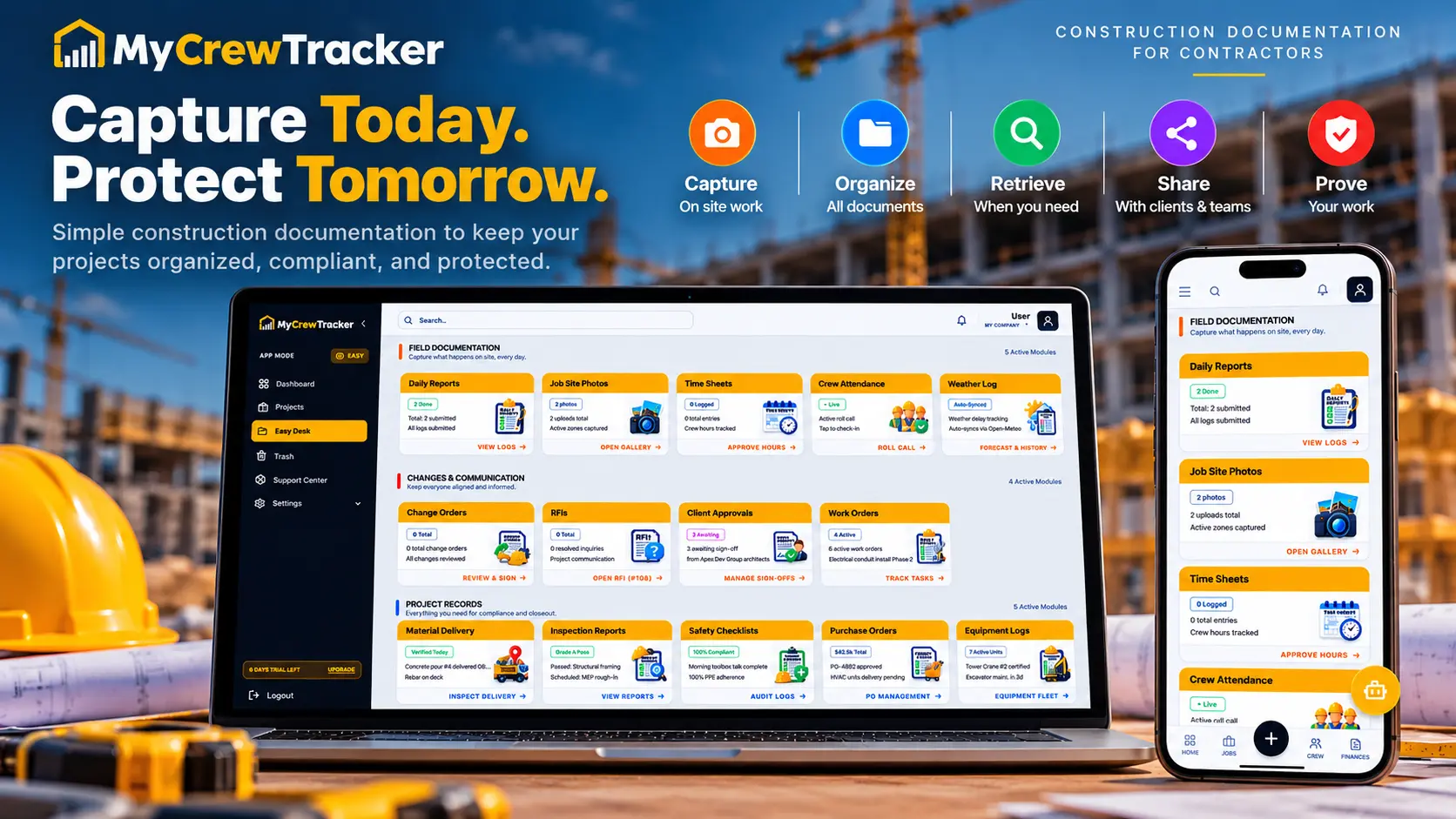
Connecticut's construction sector requires strict adherence to mechanics lien recording deadlines. Unlike many states, Connecticut does not require a preliminary notice at the start of a project — but the state imposes one of the tightest post-work filing windows in the country. Missing the 90-day deadline forfeits your lien rights entirely. MyCrewTracker provides Connecticut contractors with a centralized platform to manage project documents and track these statutory deadlines with precision.
Connecticut Certificate of Mechanic's Lien
Connecticut mechanics lien law contains rigid recording deadlines. Under Conn. Gen. Stat. § 49-34, any person who claims a mechanics lien must generally record a Certificate of Mechanic's Lien within 90 days after they have ceased to perform services or furnish materials. The 90-day period is counted by excluding the last day of work but including the 90th day.
The certificate must be filed with the town clerk of the town where the building or land is situated, and must be recorded with the land records.
What the Certificate Must Contain
Under Conn. Gen. Stat. § 49-34(1), the Certificate of Mechanic's Lien must include specific information:
- A description of the premises — the building, lot, or plot of land being improved
- The amount claimed as a lien thereon
- The name or names of the person against whom the lien is being filed
- The date of commencement of the performance of services or furnishing of materials
- A statement that the amount claimed is justly due, as nearly as the same can be ascertained
- The certificate must be subscribed and sworn to by the claimant — this means an oath must appear in writing on the certificate
Service Requirements After Recording
After lodging the certificate with the town clerk, the lien claimant must serve a true and attested copy of the certificate upon the owner of the building, lot, or plot of land. This service must occur not later than 30 days after lodging the certificate. The service must be made in the same manner as provided for service of notice in § 49-35.
What Happens If You Miss the 90-Day Deadline
Missing the 90-day deadline forfeits the right to claim a mechanics lien entirely. Connecticut courts have consistently held that the time period for filing a certificate of mechanic's lien commences on the last day on which services were performed or materials were furnished. There is no mechanism to revive a lien after this deadline passes.
By utilizing MyCrewTracker's Daily Reports, field supervisors generate a verifiable, date-stamped log of when work actually concluded, ensuring the back office never misses this 90-day window.
Connecticut Lien Deadlines at a Glance
Missing a single deadline in Connecticut can void your lien rights entirely. The table below summarizes the statutory deadlines every Connecticut contractor, subcontractor, and material supplier must track.
| Action | Deadline | Statute |
|---|---|---|
| Lodge Certificate of Mechanic's Lien with town clerk | Within 90 days after ceasing work or furnishing materials | Conn. Gen. Stat. § 49-34 |
| Serve attested copy of certificate on property owner | Within 30 days after lodging certificate | Conn. Gen. Stat. § 49-34 |
| File suit to foreclose lien | Within 1 year after recording lien | Conn. Gen. Stat. § 49-39 |
| Owner pay contractor (private projects) | Within 30 days of written payment request | Conn. Gen. Stat. § 42-158j |
| Contractor pay subcontractor | Within 7 days of receiving payment (or 60 days after performing work) | Conn. Gen. Stat. § 42-158j |
| Construction defect statute of repose (design professionals) | 7 years from substantial completion | Conn. Gen. Stat. § 52-584a |
| Workers' compensation injury records | 5 years (OSHA); 3 years for contested cases | 29 CFR 1904.33; Conn. Gen. Stat. § 31-294b |
How to File a Mechanics Lien in Connecticut: Step by Step
The process below reflects the standard path for a Connecticut contractor, subcontractor, or material supplier seeking to preserve and enforce lien rights under Title 49, Chapter 847 of the Connecticut General Statutes.
- Log your last day of work. The 90-day filing clock starts from your last day of substantial work. MyCrewTracker's Daily Reports timestamp this automatically.
- Prepare the Certificate of Mechanic's Lien. Under Conn. Gen. Stat. § 49-34, the certificate must describe the premises, state the amount claimed, name the person against whom the lien is filed, state the date services or materials commenced, and declare that the amount is justly due.
- Sign and swear to the certificate. The certificate must be subscribed and sworn to by the claimant. An oath must appear in writing on the certificate — a notary block alone is not sufficient without an explicit oath statement.
- Lodge the certificate with the town clerk. File the certificate in the town where the property is located, within 90 days of your last day of work. The town clerk will record it with the land records.
- Serve an attested copy on the property owner. Within 30 days after lodging the certificate, serve a true and attested copy on the owner of the building, lot, or plot of land. Use certified mail or personal service.
- Monitor the 1-year enforcement deadline. Under Conn. Gen. Stat. § 49-39, you must commence an action to foreclose the lien within 1 year after recording. Set two calendar reminders: one at 9 months, one at 11 months.
- Record a notice of foreclosure on the land records. When you file suit, record a notice of the foreclosure on the land records to preserve priority.
- Preserve all project documentation. Daily reports, delivery tickets, change orders, and photos become evidence in the foreclosure action.
- Consider alternative remedies in parallel. Prompt Payment Act claims, contract claims, and payment bond claims can run alongside the lien.
Documents to Preserve for a Connecticut Lien Claim
Connecticut courts require proof that you furnished labor or materials and that they were incorporated into the property. The following records are what you need:
- Signed contract or purchase order with the prime contractor
- Certified mail receipts for the certificate served on the owner
- Delivery tickets signed by an authorized site representative
- Daily reports showing crew on site and work performed
- Photo evidence of installed work (timestamped and geotagged)
- Jobsite sign-in logs and crew attendance records
- Invoices, statements, and payment applications
- Email or text correspondence about scope and payment
- Change orders and extra work authorizations
- Written demand letters and any response
MyCrewTracker stores all of these in one project record. When the 90-day deadline approaches, the back office can generate the timeline needed to prepare the certificate without reconstructing months of field activity.
Connecticut-Specific Gotchas
No preliminary notice required. Unlike many states, Connecticut does not require subcontractors, suppliers, or laborers to serve a preliminary notice at the start of a project. The first required document is the Certificate of Mechanic's Lien itself, filed within 90 days after ceasing work. This is a double-edged sword: less upfront paperwork, but no early warning system if you are not tracking your last day of work carefully.
The 90-day deadline is the shortest in the region. Connecticut's 90-day window is tighter than Massachusetts (90–120 days) and New York (4–8 months). There are no extensions. Set two calendar reminders: one at 60 days, one at 80 days.
The oath requirement is strict. Connecticut courts have held that an oath must appear in writing on the certificate of the mechanic's lien. A notary acknowledgment alone is not sufficient — the certificate must contain an explicit statement that the facts are sworn to be true. A defective oath can invalidate the entire lien.
The 1-year enforcement deadline is absolute. Conn. Gen. Stat. § 49-39 gives you exactly 1 year from recording the lien to commence a foreclosure action. There are no extensions. If the lien expires without action, it is void.
A bond can dissolve the lien. Under Conn. Gen. Stat. § 49-37, any person interested in the real estate may dissolve a mechanic's lien by substituting a bond with surety for the lien. The bond must be in a penal sum of 125% of the amount of the lien. If this happens, your lien shifts from the real property to the bond — the claim remains enforceable, but against the surety rather than the property.
Prompt payment deadlines were tightened in 2025. Under Public Act 25-2 (effective October 1, 2025), the contractor must pay subcontractors within 7 days of receiving payment from the owner that encompasses the subcontractor's work, or within 60 days of the subcontractor performing the work, whichever occurs first. This is significantly shorter than the previous 25-day requirement.
Construction defect statute of repose. For design professionals (architects, engineers, land surveyors), Connecticut imposes a 7-year statute of repose from substantial completion under Conn. Gen. Stat. § 52-584a. For contractors, the general negligence statute of limitations and repose under § 52-577 and § 52-584 apply. Retain project records for at least 7 years.
Example Scenario: How Documentation Determines the Outcome
*The following is an illustrative scenario, not a specific case. It demonstrates how record-keeping affects outcomes in Connecticut lien disputes.*
Consider a Hartford HVAC subcontractor on a $400,000 commercial building renovation. The sub's last day of substantial work is May 20. Under Conn. Gen. Stat. § 49-34, the 90-day deadline to lodge the Certificate of Mechanic's Lien is August 18.
The sub prepares the certificate on August 1, ensuring it includes the property description, the amount claimed ($62,000), the name of the property owner, the date services commenced (January 15), and a statement that the amount is justly due. The certificate is subscribed and sworn to by the sub's president. The sub lodges it with the Hartford town clerk on August 5 and serves an attested copy on the property owner on August 28 — within the 30-day service window.
Under Conn. Gen. Stat. § 49-39, the sub has 1 year from recording to file suit. That deadline is August 5 of the following year. The sub files suit on May 15, well within the window, and records a notice of foreclosure on the land records. The lien is enforceable.
Compare that to the same sub who delays filing the certificate until August 25 — seven days late. Under § 49-34, the lien is void entirely. The sub loses all lien rights, regardless of how much documentation they have. The $62,000 owed becomes significantly harder to collect.
Documentation is what separates these outcomes. MyCrewTracker logs the last day of work, the certificate preparation date, the service date, and the daily reports that prove performance.
Connecticut Prompt Payment Act
For private construction contracts, Conn. Gen. Stat. § 42-158j mandates that each construction contract contain specific payment provisions. Under the statute, the owner must pay all amounts due to any contractor in direct contractual relationship with the owner, or due to any subcontractor or supplier, not later than 30 days after the date any written request for such payment has been made.
The contractor must pay all amounts due any subcontractor or supplier not later than 7 days after the date the contractor receives payment from the owner which encompasses the subcontractor's work, or 60 days after the subcontractor performed the work, whichever occurs first.
What the Connecticut Prompt Payment Act Covers
Conn. Gen. Stat. § 42-158j establishes statutory payment cycles for private construction projects in Connecticut:
- Owners must make progress payments to contractors within 30 days of a written payment request
- Contractors must make progress payments to subcontractors within 7 days of receiving payment from the owner (or 60 days after the sub performed the work, whichever is first)
- If payment is not made, the unpaid party must set forth its claim through notice by registered or certified mail
- The statute prohibits "pay-if-paid" clauses that would condition payment to subcontractors on the contractor's receipt of payment from the owner
To leverage these statutory protections, contractors must maintain flawless records of invoice submission and approval dates. MyCrewTracker provides a centralized repository for Connecticut construction teams to store payment applications, lien waivers, and communication logs to demonstrate strict compliance.
Lien Discharge Bonds in Connecticut
Connecticut property owners have a statutory right to dissolve a mechanic's lien by substituting a bond with surety for the lien. Under Conn. Gen. Stat. § 49-37, any person interested in the real estate may file an application with the court to substitute a bond for the lien. The bond must be in a penal sum of 125% of the amount of the lien.
When a bond is substituted, the effect is to shift the lien from the real property to the bond. The claim remains enforceable, but against the surety rather than the property. Contractors and suppliers should be aware of this process because it can happen without their consent — the property owner simply needs to post the bond.
What MyCrewTracker Does (and Does Not Do) in Connecticut
MyCrewTracker is a construction documentation platform, not a legal service. Here is what it does for Connecticut contractors:
- Logs first day and last day of work per project so you can calculate the 90-day filing window
- Stores certified mail receipts and Certificate of Mechanic's Lien documents in the project file
- Records delivery tickets with photo and signature capture
- Captures timestamped, GPS-tagged site photos that document installation
- Generates daily report PDFs that serve as contemporaneous records
- Tracks payment request dates for Prompt Payment Act compliance
- Archives project records for 7+ years to support construction defect defense
It does not draft lien certificates, file documents with the town clerk, or provide legal advice. Those steps require a Connecticut construction attorney.
❓ Frequently Asked Questions in Alaska
When must a Connecticut Certificate of Mechanic's Lien be recorded?
Under Conn. Gen. Stat. § 49-34, a lien claimant must record the certificate with the town clerk of the town where the property is located within 90 days after ceasing to perform services or furnish materials. The 90-day period is counted by excluding the last day of work but including the 90th day.
What must be included in the Connecticut Certificate of Mechanic's Lien?
Under § 49-34, the certificate must include: (1) a description of the premises, (2) the amount claimed as a lien, (3) the name or names of the person against whom the lien is being filed, (4) the date of commencement of services or materials, (5) a statement that the amount claimed is justly due, and (6) the certificate must be subscribed and sworn to by the claimant.
How soon must the certificate be served on the property owner after recording?
Under § 49-34(2), the lien claimant must serve a true and attested copy of the certificate upon the owner of the building, lot, or plot of land not later than 30 days after lodging the certificate with the town clerk.
How long do I have to enforce a Connecticut mechanics lien?
Under Conn. Gen. Stat. § 49-39, an action to foreclose a mechanics lien must be commenced within 1 year after the lien is recorded. If no action is initiated, the lien expires.
What is the Connecticut Prompt Pay deadline for subcontractors?
Under Conn. Gen. Stat. § 42-158j, prime contractors and higher-tier subcontractors must generally pay lower-tier subcontractors within 7 days of receiving payment from the owner that encompasses the subcontractor's work, or within 60 days of the subcontractor performing the work, whichever occurs first.
Does Connecticut require a preliminary notice?
No. Connecticut does not require subcontractors, suppliers, or laborers to serve a preliminary notice at the start of a project. The first required document is the Certificate of Mechanic's Lien itself, filed within 90 days after ceasing work.
Can a Connecticut mechanics lien be dissolved by a bond?
Yes. Under Conn. Gen. Stat. § 49-37, any person interested in the real estate may dissolve a mechanics lien by substituting a bond with surety for the lien. The bond must be in a penal sum of 125% of the amount of the lien. The lien then shifts from the real property to the bond.
What is the Connecticut statute of repose for construction defects?
For design professionals (architects, engineers, land surveyors), Connecticut imposes a 7-year statute of repose from substantial completion under Conn. Gen. Stat. § 52-584a. For contractors, general negligence statutes of limitation and repose under §§ 52-577 and 52-584 apply.
Can MyCrewTracker calculate my 90-day lien deadline?
No. MyCrewTracker is a secure document storage platform. It helps you definitively prove your last day of work using Daily Reports, but you must manually calculate the 90-day deadline with the assistance of a Connecticut construction attorney.
Legal Sources & References
-
Alaska Mechanics' and Materialmen's Liens AS 34.35.050
Establishes the right to a lien for labor and materials furnished for property improvement.
-
Notice of Right to Lien AS 34.35.064
Explains the optional notice that protects a claimant's standard 120-day lien deadline and shifts the burden of proof to the owner in a foreclosure action.
-
Time for Filing a Claim of Lien AS 34.35.068
Details the 120-day standard deadline for recording a claim of lien and the 15-day shortened deadline when a Notice of Completion is recorded.
-
Notice of Completion AS 34.35.071
Outlines the owner's ability to record a Notice of Completion, shortening the lien deadline to 15 days, and the requirements for advance notice to claimants.
-
Public Contracts Prompt Payment AS 36.90.200
Regulates the payment deadlines and retainage rules for public construction projects in Alaska, including the 30-day and 21-day payment requirements.
-
Statute of Repose for Construction AS 09.10.055
Establishes the 10-year limit on bringing actions related to construction or improvements to real property, including exceptions for intentional acts, fraud, and breach of express warranty.
-
Alaska State Legislature — Alaska Statutes General Reference
Official Alaska State Legislature website — Searchable index of all Alaska Statutes.
Ready to organize your jobs?
Join contractors in Alaska using MyCrewTracker.