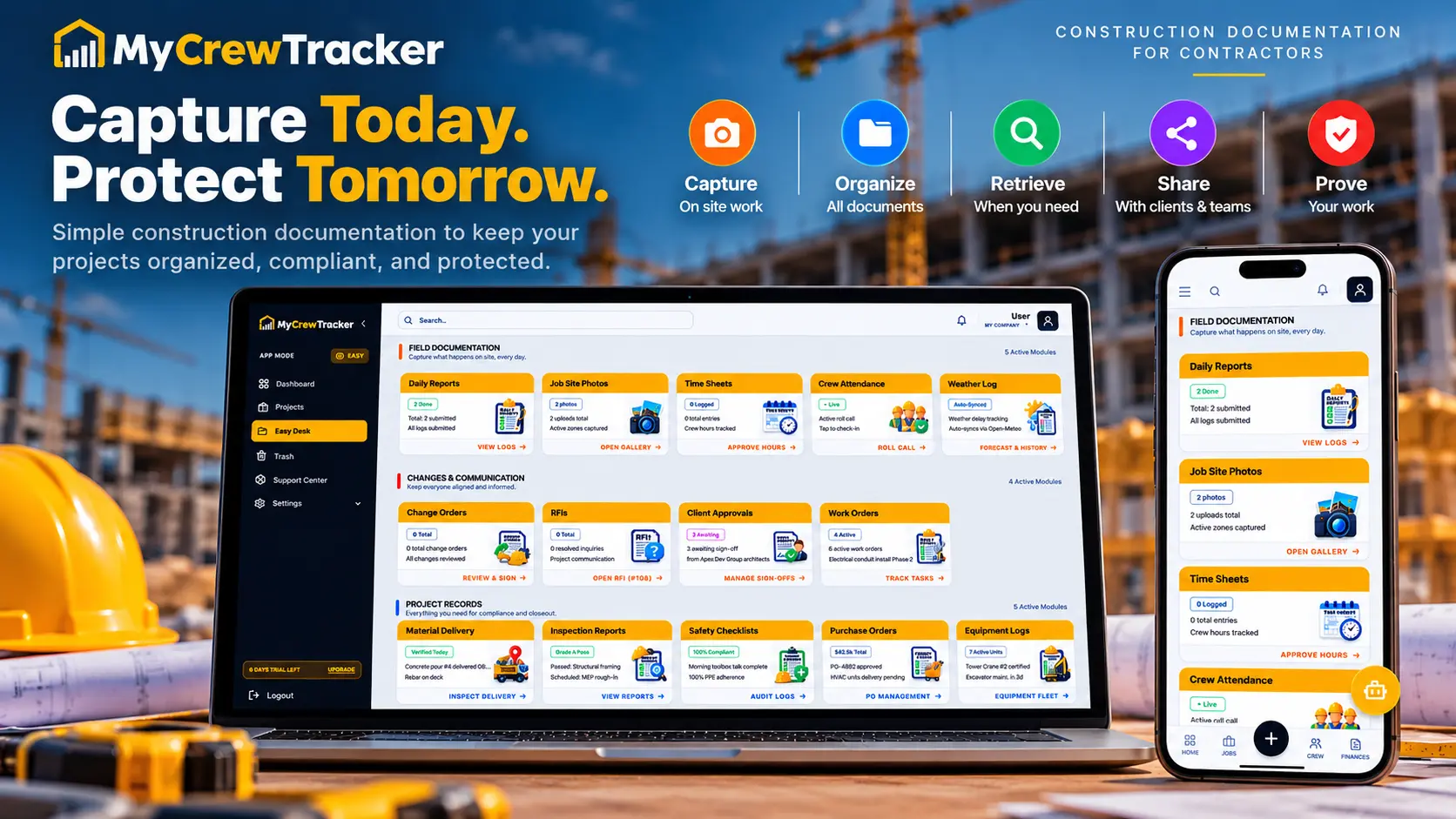
In Maine's distinct construction environment, spanning bustling coastal developments in Portland to expanding projects in rural communities, managing project documentation accurately is critical. Maine's legal framework for construction professionals includes strict deadlines for mechanics liens and unique rules regarding statutes of repose that vary between design professionals and contractors. The state's lien law requires a sworn statement recorded within 90 days of last furnishing, with a 120-day enforcement deadline that runs from the same date. Maine has no statutory preliminary notice requirement, but filing a notice protects against bona fide purchasers and secures full payment rights on owner-occupied residential projects. Add to that a 5% retainage cap on public projects, a 10-year statute of repose for architects and engineers, and the absence of any general statute of repose for contractors, and the compliance burden becomes substantial. Navigating these requirements demands meticulous record-keeping to protect your payment rights and minimize liability. MyCrewTracker provides a centralized, cloud-based platform designed to help Maine contractors organize, retrieve, and securely retain vital project documentation. By moving away from scattered paper files and disorganized email threads, your team can maintain a single source of truth for all job site records, lien notices, and change orders.
Maine Mechanics Lien Law (10 M.R.S. §§ 3251–3269)
Maine mechanics lien laws provide a mechanism for contractors, subcontractors, and suppliers to secure payment on private construction projects. The state enforces strict deadlines that must be adhered to.
1. Right to Lien (10 M.R.S. § 3251)
Under 10 M.R.S. § 3251, a person who performs labor or furnishes labor or materials, including repair parts of machines used, or performs services as a surveyor, an architect, a forester, or an engineer, or as a real estate licensee, or as an owner-renter, owner-lessor, or owner-supplier of equipment used in erecting, altering, moving, or repairing a house, building, or appurtenances, has a lien thereon and on the land on which it stands to secure payment with costs. The lien attaches to the building and land if the owner has a legal interest in the land, and to the building alone if the owner has no legal interest in the land.
2. No Statutory Preliminary Notice Required
Unlike many states, Maine does not require a preliminary notice as a strict prerequisite to filing a mechanics lien. As one construction law compendium explains: "There is no notice required pre-lien. The lien is created as soon as the claimant provides the labor, furnishes the materials, or performs the services".
However, sending and filing a notice is highly recommended for two key reasons:
- Bona Fide Purchasers: Filing a notice with the Registry of Deeds protects your claim against a "bona fide purchaser" who buys the property without knowledge of the potential lien. A bona fide purchaser for value has certain protections under the statute.
- Owner-Occupied Projects: On residential projects where the owner resides on the premises, if you lack a direct contract with the owner, your lien amount may be limited to the balance the owner owes the general contractor when the notice is provided. Under 10 M.R.S. § 3255(3), the lien may only be enforced up to the balance due to the person the owner has contracted with. If the owner did not contract directly with the claimant, the claimant must provide a notice to the owner stating that the owner could be responsible for paying for the services twice if they fail to confirm that the claimant was paid by the party the owner contracted with.
3. Recording the Lien: The 90-Day Deadline (10 M.R.S. § 3253)
Under 10 M.R.S. § 3253, if the claimant is not under contract with the owner, the claimant is required to file a sworn statement in the Registry of Deeds in the county where the property is situated within 90 days after ceasing to provide labor, furnish materials, or perform services. If the claimant fails to file the statement, the lien granted by Section 3251 is dissolved.
The sworn statement must include:
- The net amount due to the claimant
- A description of the property subject to the lien sufficient to identify it
- The names of the owners, if known
- The statement must be subscribed and sworn to by the person claiming the lien, or by someone on the claimant's behalf
A copy of the statement must be mailed to the owner by ordinary mail. Notably, if the labor, materials, or services were furnished by a contract with the owner of the property, the 90-day filing requirement does not apply.
4. Enforcing the Lien: The 120-Day Deadline (10 M.R.S. § 3255)
To enforce the lien, a lawsuit must be filed within 120 days of your last date of furnishing labor or materials. Under 10 M.R.S. § 3255(1), the liens mentioned in sections 3251 to 3254 may be preserved and enforced by action against the debtor and owner of the property affected, filed with the Superior Court or District Court clerk in the county where the house, building, or appurtenances on which a lien is claimed is situated, within 120 days after the last of the labor or services are performed or labor, materials, or services are so furnished, except as provided in section 3256.
This period is extended under limited circumstances, such as when the owner dies or is adjudicated bankrupt. If the labor, materials, or services were not furnished by a contract with the owner, the claimant may not serve the complaint and summons on the owner until 30 days after the date of filing of the complaint.
Important: The 90-day recording deadline and the 120-day enforcement deadline both run from the same event — the date of last furnishing. This means that if you record your lien on day 89, you have only 31 days left to file your enforcement action. This compressed timeline is one of the strictest in the region.
5. Lien Release
Once the underlying debt is satisfied, the lien must be released within 60 days. Failure to release a satisfied lien can expose the claimant to statutory penalties.
Maine Prompt Payment Act (10 M.R.S. § 1111 et seq.)
Maine's Prompt Payment Act governs the timing of payments and retainage release on construction projects.
Private Projects
Maine law does not specify a statutory cap on the percentage of retainage that can be withheld on private projects. The amount is determined by the contract between the parties. However, the Prompt Payment Act does establish payment timelines.
Under 10 M.R.S. § 1116, if payments under a construction contract are subject to retainage, any amounts retained during the performance of the contract and due to be released to the contractor upon completion must be paid within 30 days after final acceptance of the work. If a party retains funds for more than 30 days beyond final completion, they may be liable for interest on overdue amounts at the rate of 1.5% per month.
Public Projects (5 M.R.S. § 1746)
For state-awarded public improvement contracts, the State mandates withholding 5% of the money due to the contractor until project acceptance. Under 5 M.R.S. § 1746, in any contract awarded for any public improvement, the State shall withhold 5% of the money due the contractor until the project under the contract has been accepted by or for the State. When the contract has been substantially completed, the State may, upon request, further reduce the amounts withheld if it deems it desirable and prudent.
The contractor may withdraw the whole or any portion of the amount retained upon depositing with the Treasurer of State certain securities, including negotiable certificates of deposit, U.S. Treasury bonds, or bonds of the State of Maine.
Release Timelines
Any retained amounts must be paid within 30 days after final acceptance of the work. Upon receipt of retainage, contractors must pay their subcontractors within 7 days.
Maine Statute of Repose (14 M.R.S. § 752-A)
Maine has a specific statute of repose that applies exclusively to duly licensed or registered architects and engineers. Under 14 M.R.S. § 752-A, all civil actions for malpractice or professional negligence against architects or engineers duly licensed or registered under Title 32 shall be commenced within 4 years after such malpractice or negligence is discovered, but in no event shall any such action be commenced more than 10 years after the substantial completion of the construction contract or the substantial completion of the services provided, if a construction contract is not involved.
The limitation periods provided by this section shall not apply if the parties have entered into a valid contract which by its terms provides for limitation periods other than those set forth in this section.
Notably, Maine does not have a general statute of repose for builders or contractors. Claims against contractors are instead governed by standard statutes of limitations. Under 14 M.R.S. § 752, all civil actions shall be commenced within 6 years after the cause of action accrues. In Maine, plaintiffs have six years to file any civil action premised upon a breach of contract or unintentional tort, but only four years to file professional negligence actions against architects or engineers.
What this means for Maine contractors: Unlike architects and engineers who have a 10-year absolute outer limit, contractors face a rolling 6-year statute of limitations that runs from when the cause of action accrues. In some cases, this can expose contractors to liability beyond the 10-year period that applies to design professionals. This makes precise project documentation even more critical for contractors.
Maine Lien Deadlines at a Glance
| Action | Deadline | Statute |
|---|---|---|
| Record Sworn Statement of Lien | Within 90 days of last furnishing (if no direct contract with owner) | 10 M.R.S. § 3253 |
| Mail copy of lien statement to owner | By ordinary mail after recording | 10 M.R.S. § 3253(1)(B) |
| File suit to enforce lien | Within 120 days of last furnishing | 10 M.R.S. § 3255 |
| Serve complaint on owner (no direct contract) | No earlier than 30 days after filing complaint | 10 M.R.S. § 3255 |
| Lien release after debt satisfied | Within 60 days | 10 M.R.S. § 3269 |
| Private Retainage Release | Within 30 days of final acceptance | 10 M.R.S. § 1116 |
| Public Works Retainage | 5% of money due contractor | 5 M.R.S. § 1746 |
| Public Retainage Release | Within 30 days of final acceptance | 5 M.R.S. § 1746 |
| Prime Pay Subcontractor (from retainage) | Within 7 days of receipt | 10 M.R.S. § 1111 et seq. |
| Late Payment Interest Penalty | 1.5% per month | 10 M.R.S. § 1116 |
| Design Professional Statute of Repose | 10 years from substantial completion | 14 M.R.S. § 752-A |
| Contractor Statute of Limitations | 6 years from accrual | 14 M.R.S. § 752 |
How to File a Mechanics Lien in Maine: Step by Step
1. Log your first day of work. While there is no mandatory preliminary notice, tracking your first day of furnishing labor or materials is critical for establishing the timeline. MyCrewTracker's Daily Reports timestamp this automatically.
2. Consider filing a Notice of Lien (optional but recommended). Filing a notice with the Registry of Deeds protects your claim against a bona fide purchaser and secures full payment rights on owner-occupied residential projects.
3. Track the last day of work. Maine's 90-day recording clock and 120-day enforcement clock both start from the same event — the date you ceased to furnish labor, materials, or services.
4. Prepare the sworn statement. Under 10 M.R.S. § 3253, the statement must include the net amount due, a property description, and the names of the owners. It must be subscribed and sworn to by the claimant.
5. Record the sworn statement with the Registry of Deeds. File the statement in the Registry of Deeds for the county where the property is located within 90 days of last furnishing. If you have a direct contract with the owner, the 90-day filing requirement does not apply.
6. Mail a copy of the statement to the owner. Under 10 M.R.S. § 3253(1)(B), a copy must be mailed to the owner by ordinary mail.
7. File suit to enforce within 120 days. Under 10 M.R.S. § 3255, a lawsuit to enforce the lien must be filed within 120 days of your last day of furnishing. If you do not have a direct contract with the owner, you may not serve the complaint until 30 days after filing.
8. Preserve all project documentation. Daily reports, delivery tickets, change orders, and photos become evidence in the enforcement action.
Documents to Preserve for a Maine Lien Claim
Maine courts require strict compliance with the statutory requirements of Chapter 603. The following records are what you need:
- Signed contract or purchase order with the prime contractor
- Proof of service of any Notice of Lien (optional but recommended)
- Delivery tickets signed by an authorized site representative
- Daily reports showing crew on site and work performed
- Photo evidence of installed work (timestamped and geotagged)
- Jobsite sign-in logs and crew attendance records
- Invoices, statements, and payment applications
- Email or text correspondence about scope and payment
- Change orders and extra work authorizations
- Copy of the recorded sworn statement with Registry of Deeds stamp
- Proof of mailing the lien statement to the owner
MyCrewTracker stores all of these in one project record. When a lien deadline approaches, the back office can generate the timeline needed to prepare the sworn statement without reconstructing months of field activity.
Maine-Specific Gotchas
No preliminary notice is required — but filing one is still valuable. Maine does not require a preliminary notice to preserve lien rights. However, filing a notice with the Registry of Deeds protects against bona fide purchasers and secures full payment rights on owner-occupied residential projects where the claimant lacks a direct contract with the owner.
The 90-day recording deadline and 120-day enforcement deadline run from the same date. Both deadlines start from the date of last furnishing. This means if you record your lien on day 89, you have only 31 days left to file your enforcement action. This is one of the most compressed timelines in the country.
The sworn statement must be subscribed and sworn to. Unlike some states where a notarized acknowledgment is sufficient, Maine requires the lien statement to be subscribed and sworn to by the claimant. A mere acknowledgment is not sufficient.
The 5% retainage cap applies only to public projects. Maine does not cap retainage on private projects. The amount is strictly governed by the contract between the parties.
Retainage must be released within 30 days of final acceptance. Under 10 M.R.S. § 1116, retained amounts due upon completion must be paid within 30 days after final acceptance.
Late payment interest penalty is 1.5% per month. If a party retains funds for more than 30 days beyond final completion, they may be liable for interest on overdue amounts at the rate of 1.5% per month.
Maine has no general statute of repose for contractors. Maine's 10-year statute of repose under 14 M.R.S. § 752-A applies only to licensed architects and engineers. Contractors face a 6-year statute of limitations under 14 M.R.S. § 752, which runs from when the cause of action accrues. This can expose contractors to liability beyond the 10-year period that applies to design professionals.
The 30-day service delay for non-privity claimants. If you do not have a direct contract with the owner, you may not serve the complaint and summons on the owner until 30 days after filing the complaint. This adds an additional procedural hurdle to the enforcement timeline.
Example Scenario: How Documentation Determines the Outcome
*The following is an illustrative scenario, not a specific case. It demonstrates how record-keeping affects outcomes in Maine lien disputes.*
Consider a Portland mechanical subcontractor on a $600,000 commercial office renovation. The sub first furnishes labor on March 1. The sub's last day of substantial work is August 15.
Under 10 M.R.S. § 3253, the sub has 90 days from August 15 to record the sworn statement with the Cumberland County Registry of Deeds. That deadline is November 13. The sub records the statement on November 5 and mails a copy to the owner on November 7.
Under 10 M.R.S. § 3255, the sub has 120 days from August 15 to file suit to enforce the lien. That deadline is December 13. The sub files suit on December 1 — just 12 days after recording the lien. Because the sub does not have a direct contract with the owner, the sub may not serve the complaint until 30 days after filing, which is December 31.
Now consider the same sub who records the lien on November 13 — the last possible day. The sub then has only until December 13 to file suit, leaving just 30 days to prepare and file the enforcement action. If the sub misses the December 13 deadline, the lien is dissolved.
Documentation is what separates these outcomes. MyCrewTracker logs the first day of work, the last day of work, the recording date, and the daily reports that prove performance.
What MyCrewTracker Does (and Does Not Do) in Maine
MyCrewTracker is a construction documentation platform, not a legal service. Here is what it does for Maine contractors:
- Logs first day and last day of work per project so you can calculate the 90-day recording deadline and the 120-day enforcement window
- Stores certified mail receipts and optional Notice of Lien documents in the project file
- Records delivery tickets with photo and signature capture
- Captures timestamped, GPS-tagged site photos that document installation
- Generates daily report PDFs that serve as contemporaneous records
- Tracks retainage and payment dates for public works retainage compliance
- Archives project records for 6+ years to support construction defect defense
What MyCrewTracker Does NOT Do: We do not provide legal advice, draft, review, or file mechanics liens, preliminary notices, or lawsuits on your behalf. We are not a substitute for a qualified Maine construction attorney. Always consult legal counsel for specific guidance on your rights and obligations.
❓ Frequently Asked Questions in Wyoming
Do I need to send a preliminary notice in Maine to have lien rights?
No, preliminary notices are not strictly mandated by Maine law to establish a mechanics lien. However, they are strongly recommended to protect against bona fide purchasers and to secure rights on owner-occupied residential projects.
How long do I have to file a mechanics lien in Maine?
You must record a sworn lien statement in the appropriate county Registry of Deeds within 90 days of the last date you provided labor or materials to the project. This is set by 10 M.R.S. § 3253.
What is the deadline to enforce a mechanics lien in Maine?
You must file a lawsuit to enforce (foreclose) the lien within 120 days of your last date of furnishing labor, materials, or services. This is set by 10 M.R.S. § 3255.
Does Maine limit the amount of retainage on private projects?
No, Maine law does not cap the percentage of retainage for private construction projects. The retainage amount is dictated by the terms of your construction contract.
How quickly must retainage be released in Maine?
Retainage must be paid within 30 days after final acceptance of the work. Once a contractor receives retainage, they have 7 days to pass the appropriate amount down to their subcontractors.
Does Maine have a statute of repose for general contractors?
No, Maine does not have a specific statute of repose that applies to general builders or contractors. The 10-year statute of repose under 14 M.R.S. § 752-A applies only to licensed architects and engineers. Contractors face a 6-year statute of limitations under 14 M.R.S. § 752.
Can I file a mechanics lien on a public project in Maine?
No, mechanics liens in Maine only apply to private construction projects. For public projects, you must make a claim against the payment bond.
What happens if I miss the 90-day deadline to file my lien?
If you miss the 90-day recording deadline, you generally lose your standard mechanics lien rights. In some complex scenarios, a "lien by attachment" may be sought within 180 days, but this requires court approval.
What is the 5% retainage requirement for public projects?
Under 5 M.R.S. § 1746, the State withholds 5% of the money due the contractor on public improvement contracts until the project is accepted. Contractors may substitute securities in place of the retained cash.
Does MyCrewTracker file Maine mechanics liens?
No. MyCrewTracker is a secure document management platform that helps you organize the daily reports, invoices, and delivery receipts you need to prove your case. To officially record a mechanics lien in Maine, you must use a specialized legal service or a qualified construction attorney.
Legal Sources & References
-
Preliminary Notices — Right to Lien Wyo. Stat. § 29-2-112
Wyoming Lien Law — Establishes the preliminary notice requirement for general contractors, subcontractors, and materialmen. General contractors must send notice prior to receiving any payment; subcontractors and materialmen within 30 days of first furnishing. Failure to send notice bars the right to assert a lien.
-
Notice of Intention to File Lien Wyo. Stat. § 29-2-107
Wyoming Lien Law — Requires a lien claimant to send written notice to the record owner at least 20 days prior to filing a lien statement. The notice must state the amount of the claim and from whom it is due.
-
When Statement Lien to Be Filed Wyo. Stat. § 29-2-106
Wyoming Lien Law — Sets the recording deadline at 150 days for general contractors and 120 days for subcontractors and materialmen from the earlier of last work or substantial completion. Provides for owner-recorded Notice of Substantial Completion and extension by agreement.
-
Limitation of Actions — Duration of Liens Wyo. Stat. § 29-2-109
Wyoming Lien Enforcement — All actions to foreclose or enforce a lien must be commenced within 180 days after the filing of the lien statement. No lien continues for more than 180 days unless an action to foreclose is instituted.
-
Payment of Agency Accounts — Interest Wyo. Stat. § 16-6-602
Wyoming Prompt Payment Act — State agencies must pay the amount due within 45 days after receipt of a correct notice of amount due. Late payments accrue interest at 1.5% per month from the 45th day.
-
Retainage on Public Projects Wyo. Stat. § 16-6-702
Wyoming Public Works Retainage — Public entities may withhold no more than 5% of the calculated value of work completed as retainage. Contractors may submit a bond in lieu of retainage.
-
Statute of Repose — Improvements to Real Property Wyo. Stat. § 1-3-111
Wyoming Statute of Repose — No action for property damage, personal injury, or wrongful death arising from construction defects may be brought more than 10 years after substantial completion. If injury occurs during year 9, one additional year is allowed.
-
Wyoming Legislature — Wyoming Statutes General Reference
Official Wyoming Legislature website — Searchable index of all Wyoming Statutes.
Ready to organize your jobs?
Join contractors in Wyoming using MyCrewTracker.