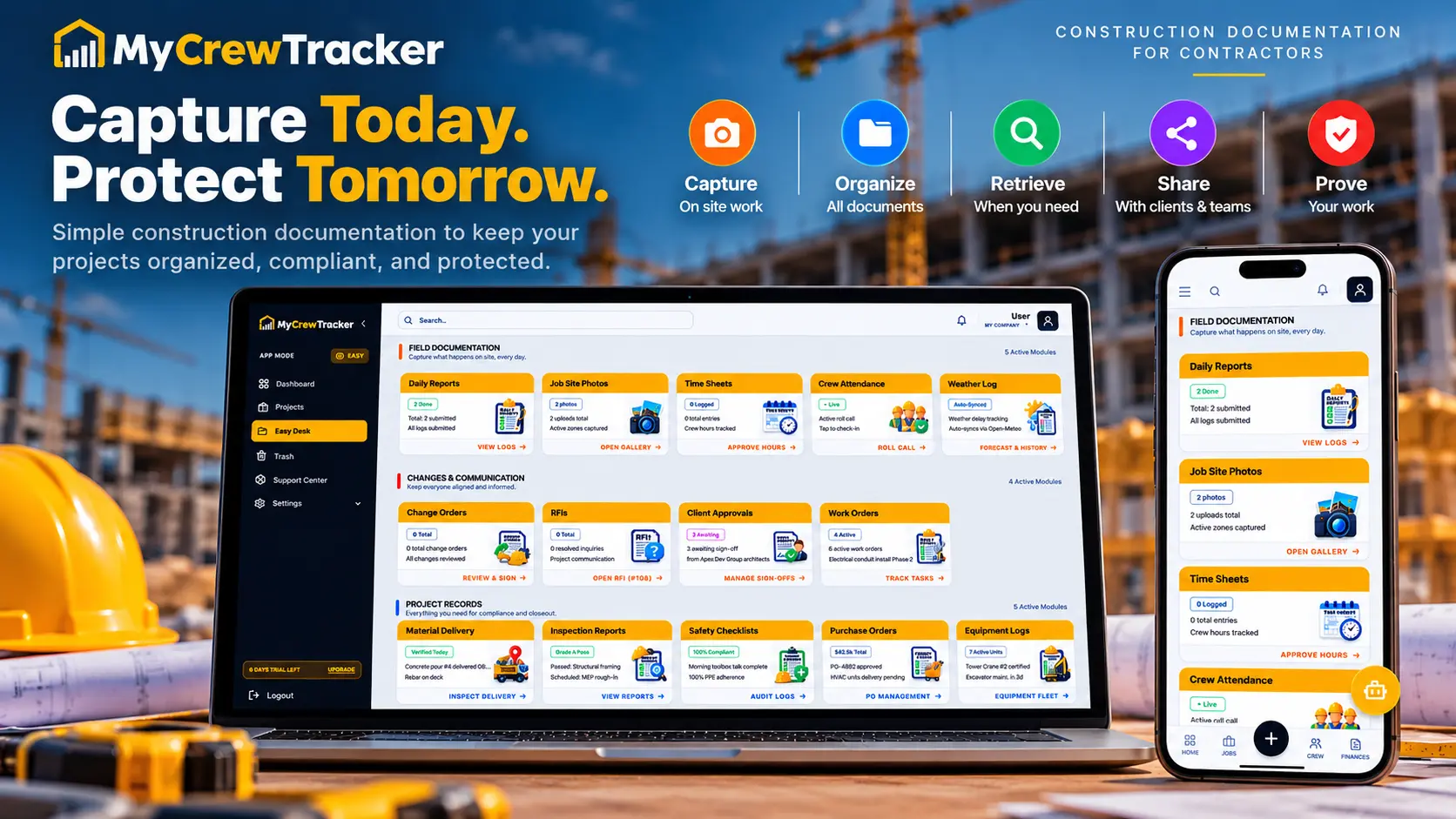
Tennessee utilizes a rigid 90-day Notice of Nonpayment system that demands proactive documentation. Unlike most states where a single preliminary notice protects all work from the start of a project, Tennessee requires remote contractors to serve a monthly Notice of Nonpayment within 90 days of the last day of each month in which unpaid work was performed. Miss a single month, and you lose lien rights for that month's work entirely. On top of that, Tennessee's Prompt Pay Act imposes strict retainage rules, its Trust Fund Statute carries criminal penalties for misappropriation, and a four-year statute of repose can bar defect claims. MyCrewTracker empowers Tennessee contractors to securely store daily reports, manage project communications, and archive statutory notices so that no monthly deadline is ever missed.
Tennessee Notice of Nonpayment (The 90-Day Monthly Rule)
In Tennessee, securing mechanics lien rights requires monthly vigilance. Under Tenn. Code § 66-11-145, on commercial projects, a remote contractor (any contractor who does not have a direct contract with the owner) who has not been paid must serve a Notice of Nonpayment within 90 days of the last day of each month in which labor or materials were provided for which a lien is claimed.
What the Notice Must Include
Under Tenn. Code § 66-11-145(a), the Notice of Nonpayment must contain specific information:
- The name of the remote contractor and the address to which the owner and prime contractor may send communications
- A general description of the work, labor, materials, services, equipment, or machinery provided
- The amount owed as of the date of the notice
- A statement of the last date the claimant performed work or provided labor or materials
- A description sufficient to identify the real property against which a lien may be claimed
The notice must be served on both the owner and the prime contractor in contractual privity with the remote contractor.
What Happens If You Miss the Monthly Deadline
Under Tenn. Code § 66-11-145(b), a remote contractor who fails to provide the Notice of Nonpayment in compliance with this section shall have no right to claim a lien under this chapter. Tennessee courts have consistently held that the notice requirement is a strict condition precedent to the lien right. There is no mechanism to revive a lien for a missed month.
Because these deadlines trigger monthly, establishing a concrete timeline is critical. MyCrewTracker assists Tennessee contractors by using Daily Reports to create a verifiable, date-stamped record of when work commenced and completed each month, ensuring your back office accurately tracks the 90-day windows.
Tennessee Lien Deadlines at a Glance
Missing a single deadline in Tennessee can void your lien rights entirely. The table below summarizes the statutory deadlines every Tennessee contractor, subcontractor, and material supplier must track.
| Action | Deadline | Statute |
|---|---|---|
| Serve Monthly Notice of Nonpayment | Within 90 days of the last day of each month of unpaid work | Tenn. Code § 66-11-145 |
| Record notice of lien (remote contractor) | Within 90 days of the last day of the month of last work | Tenn. Code § 66-11-115 |
| File suit to enforce lien (remote contractor) | Within 90 days of serving and recording the lien | Tenn. Code § 66-11-115 |
| File suit to enforce lien (prime contractor) | Within 1 year of completion of the improvement | Tenn. Code § 66-11-115 |
| Owner release retainage to prime contractor | Within 90 days of completion or substantial completion | Tenn. Code § 66-34-103 |
| Prime contractor pay retainage to remote contractor | Within 10 days of receiving retainage | Tenn. Code § 66-34-103 |
| Retainage cap | 5% of contract amount | Tenn. Code § 66-34-103 |
| Construction defect statute of repose | 4 years from substantial completion | Tenn. Code § 28-3-202 |
| Trust fund misappropriation | Criminal offense | Tenn. Code § 66-11-138 |
How to File a Mechanics Lien in Tennessee: Step by Step
The process below reflects the standard path for a Tennessee remote contractor, subcontractor, or material supplier seeking to preserve and enforce lien rights under Chapter 11 of Title 66 of the Tennessee Code.
1. Log your first day of work. The monthly Notice of Nonpayment clock starts from the last day of each month in which you furnish unpaid labor or materials. MyCrewTracker's Daily Reports timestamp this automatically.
2. Serve the Monthly Notice of Nonpayment. Under Tenn. Code § 66-11-145, serve the notice on both the owner and the prime contractor within 90 days of the last day of each month of unpaid work. Repeat this process for every month you remain unpaid.
3. Track the last day of work. Tennessee's 90-day lien recording clock starts from the last day of the month in which you last furnished labor or materials.
4. Record the notice of lien. Under Tenn. Code § 66-11-115, the notice of lien must be recorded with the Register of Deeds in the county where the property is located within 90 days of the last day of the month of last work.
5. File suit within 90 days. Under Tenn. Code § 66-11-115, a remote contractor must file an action to enforce the lien within 90 days after serving and recording the notice of lien.
6. Preserve all project documentation. Daily reports, delivery tickets, change orders, and photos become evidence in the enforcement action.
Documents to Preserve for a Tennessee Lien Claim
Tennessee courts require proof that you furnished labor or materials and that they were incorporated into the property. The following records are what you need:
- Signed contract or purchase order with the prime contractor
- Proof of service of the Monthly Notices of Nonpayment
- Delivery tickets signed by an authorized site representative
- Daily reports showing crew on site and work performed each month
- Photo evidence of installed work (timestamped and geotagged)
- Jobsite sign-in logs and crew attendance records
- Invoices, statements, and payment applications
- Email or text correspondence about scope and payment
- Change orders and extra work authorizations
- Written demand letters and any response
MyCrewTracker stores all of these in one project record. When a lien deadline approaches, the back office can generate the timeline needed to prepare the notice of lien without reconstructing months of field activity.
Tennessee-Specific Gotchas
The monthly Notice of Nonpayment is the biggest trap. Unlike most states where a single preliminary notice protects all work from the start of a project, Tennessee requires a recurring monthly notice for each month in which unpaid work was performed. If you miss a month, you lose lien rights for that month's work entirely.
The 90-day enforcement deadline is extremely short. Tenn. Code § 66-11-115 gives a remote contractor exactly 90 days from serving and recording the notice of lien to file suit to enforce it. There are no extensions. Set two calendar reminders: one at 60 days, one at 80 days.
Retainage is capped at 5%. Under Tenn. Code § 66-34-103, the retainage amount may not exceed five percent (5%) of the amount of the contract.
Retainage must be escrowed for large contracts. When the prime contract is $500,000 or greater, the Prompt Pay Act mandates that all retained amounts be deposited in a separate, interest-bearing escrow account.
Retainage release deadlines are strict. The owner must release all retainages to the prime contractor within 90 days after completion or substantial completion, and the prime contractor must pay retainages to remote contractors within 10 days of receiving them.
Trust fund misappropriation is a criminal offense. Under Tenn. Code § 66-11-138, any prime contractor or remote contractor who, with intent to defraud, uses funds received for any purpose other than paying downstream parties is subject to criminal penalties.
Construction defect statute of repose is only 4 years. Under Tenn. Code § 28-3-202, all actions to recover damages for any deficiency in the design, planning, supervision, or construction of an improvement to real property must be brought within four (4) years after substantial completion. If the injury occurs in the fourth year, the action must be filed within five years of substantial completion.
The Notice of Completion can shorten your deadline. Under Tenn. Code § 66-11-143, an owner may file a Notice of Completion with the Register of Deeds. If filed, remote contractors must serve a written notice in response within the statutory period, or their lien rights are extinguished.
Example Scenario: How Documentation Determines the Outcome
*The following is an illustrative scenario, not a specific case. It demonstrates how record-keeping affects outcomes in Tennessee lien disputes.*
Consider a Nashville mechanical subcontractor on a $500,000 commercial office renovation. The sub is a remote contractor (not in direct contract with the owner). The sub furnishes labor in March, April, and May, and is not paid for any of those months.
Under Tenn. Code § 66-11-145, the sub must serve a Notice of Nonpayment within 90 days of the last day of each month of unpaid work:
- For March work: notice due by June 29 (90 days after March 31)
- For April work: notice due by July 30 (90 days after April 30)
- For May work: notice due by August 29 (90 days after May 31)
The sub serves all three notices on time. The sub's last day of substantial work is May 31. Under Tenn. Code § 66-11-115, the sub has 90 days from the last day of the month of last work to record the notice of lien. That deadline is August 29. The sub records the lien on August 20.
Under Tenn. Code § 66-11-115, the sub has 90 days from serving and recording the lien to file suit. That deadline is November 18. The sub files suit on October 15, well within the window. The lien is enforceable.
Now consider the same sub who misses the April Notice of Nonpayment. Under Tenn. Code § 66-11-145(b), the sub has no right to claim a lien for the April work. The sub loses lien rights for that month's labor — approximately $28,000 — regardless of how much documentation they have for the other months.
Documentation is what separates these outcomes. MyCrewTracker logs the first day of each month's work, the notice service date, the recording date, and the daily reports that prove performance.
Tennessee Prompt Pay Act (Tenn. Code § 66-34-103)
Under Tenn. Code § 66-34-103, Tennessee law establishes statutory payment cycles for both public and private construction projects.
Retainage Limit: 5% Maximum
Under Tenn. Code § 66-34-103(a), all construction contracts on any project in this state, both public and private, may provide for the withholding of retainage; provided, however, that the retainage amount may not exceed five percent (5%) of the amount of the contract.
Retainage Release Deadlines
Under Tenn. Code § 66-34-103(b):
- The owner must release and pay all retainages to the prime contractor within 90 days after completion of the work or within 90 days after substantial completion of the project, whichever occurs first
- The prime contractor must pay all retainages due any remote contractor within 10 days after receipt of the retainages from the owner
- Any remote contractor receiving retainage must pay lower-tier remote contractors within 10 days after receipt
Penalties for Violation
Under Tenn. Code § 66-34-103(e), it is an offense for any person, firm, or corporation to fail to comply with the retainage requirements. A violation is a Class A misdemeanor, subject to a fine of up to $3,000 per violation. Each day of non-compliance is a separate violation, and the court must order restitution to the owner of the retained funds.
To enforce these rights, contractors must maintain perfect documentation of when invoices were transmitted and received. MyCrewTracker offers a secure cloud repository where Tennessee contractors can organize dated payment applications and formal communications.
Tennessee Trust Fund Statute (Tenn. Code § 66-11-138)
Under Tenn. Code § 66-11-138, any prime contractor or remote contractor who, with intent to defraud, uses funds received for any purpose other than paying downstream parties (laborers, materialmen, subcontractors) is subject to criminal penalties.
What the Trust Fund Statute Requires
- Funds received by a contractor on a construction project must be used for the payment of downstream parties who contributed labor or materials
- The use of funds deposited in a business account for use on multiple construction projects must be based on the allocation of costs and profits in accordance with generally accepted accounting principles for construction projects
- Misappropriation with intent to defraud is a criminal offense
To defend against claims of misappropriation, contractors must maintain immaculate accounting and project documentation. Using MyCrewTracker's Quick Docs system, contractors can securely store properly dated payment applications, lien waivers, and bank disbursement records in the cloud, helping establish a clear paper trail of how project funds were distributed.
What MyCrewTracker Does (and Does Not Do) in Tennessee
MyCrewTracker is a construction documentation platform, not a legal service. Here is what it does for Tennessee contractors:
- Logs first day and last day of work per project so you can calculate the monthly Notice of Nonpayment deadlines and the 90-day filing window
- Stores proof of service and Notice of Nonpayment documents in the project file
- Records delivery tickets with photo and signature capture
- Captures timestamped, GPS-tagged site photos that document installation
- Generates daily report PDFs that serve as contemporaneous records
- Tracks retainage and payment dates for Prompt Pay Act compliance
- Archives project records for 4+ years to support construction defect defense
It does not draft Notices of Nonpayment, file lien notices with the Register of Deeds, or provide legal advice. Those steps require a Tennessee construction attorney.
❓ Frequently Asked Questions in Nebraska
What is the Tennessee Notice of Nonpayment?
Under Tenn. Code § 66-11-145, commercial subcontractors must generally serve a Notice of Nonpayment within 90 days of the end of each month in which they provided unpaid labor or materials to preserve their lien rights.
What happens if I miss a monthly Notice of Nonpayment deadline?
Under Tenn. Code § 66-11-145(b), a remote contractor who fails to provide the Notice of Nonpayment in compliance with the statute has no right to claim a lien for that month's work. The lien right is lost entirely for the missed period.
How long do I have to file a mechanics lien in Tennessee?
As a remote contractor, you have 90 days from the last day of the month of last work to record the notice of lien with the Register of Deeds. This is set by Tenn. Code § 66-11-115.
How long do I have to sue to enforce a Tennessee lien?
As a remote contractor, you have 90 days from serving and recording the notice of lien to file suit to enforce it. As a prime contractor, you have 1 year from completion of the improvement.
What is the Tennessee Prompt Pay deadline?
Under Tenn. Code § 66-34-103, owners must release retainage to prime contractors within 90 days of completion or substantial completion. Prime contractors must pay remote contractors within 10 days of receiving retainage.
What is the Tennessee retainage limit?
Under Tenn. Code § 66-34-103(a), retainage on any construction contract, public or private, is capped at 5% of the contract amount.
What is the Tennessee construction defect statute of repose?
Under Tenn. Code § 28-3-202, all actions for construction defects must be brought within four years after substantial completion. If the injury occurs in the fourth year, the action must be filed within five years.
What is the Tennessee Trust Fund Statute?
Under Tenn. Code § 66-11-138, any contractor who, with intent to defraud, uses funds received for any purpose other than paying downstream parties is subject to criminal penalties.
What is a Notice of Completion in Tennessee?
Under Tenn. Code § 66-11-143, an owner may file a Notice of Completion with the Register of Deeds. If filed, remote contractors must serve a written notice in response within the statutory period, or their lien rights are extinguished.
Does MyCrewTracker serve my Tennessee Notice of Nonpayment?
No. MyCrewTracker is a secure document management platform that helps you organize the daily reports and delivery receipts you need to prove your deadlines. You must manually draft and serve your notices with the assistance of a Tennessee construction attorney.
Legal Sources & References
-
Nebraska Construction Lien Act — Definitions Neb. Rev. Stat. § 52-125
Establishes the definitions and foundational requirements for construction liens in Nebraska, including the right to a lien for persons furnishing services or materials pursuant to a real estate improvement contract.
-
Attachment and Enforcement of Lien — Recording Required Neb. Rev. Stat. § 52-137
Nebraska Lien Recording — A claimant's lien does not attach and may not be enforced unless the claimant records a lien within 120 days after final furnishing of services or materials. A copy must be sent to the owner within 10 days of recording.
-
Duration of Lien — Demand to Institute Judicial Proceedings Neb. Rev. Stat. § 52-140
Nebraska Lien Enforcement — A lien continues enforceable for two years after recording. If the owner serves a written demand to institute a judicial proceeding, the lien lapses unless suit is filed within 30 days.
-
Nebraska Construction Prompt Pay Act — Terms Defined Neb. Rev. Stat. § 45-1202
Nebraska Prompt Pay Act — Defines terms including contractor, owner, subcontractor, and substantially complete for the Nebraska Construction Prompt Pay Act.
-
Contractor Payment; Retainage; Payment Neb. Rev. Stat. § 45-1203
Nebraska Prompt Pay Act — Owner must pay contractor within 30 days of payment request. Contractor must pay subcontractor within 10 days of receipt of payment. Retainage capped at 10%, reduced to 5% after 50% completion. Retainage must be released within 45 days of substantial completion.
-
Action on Breach of Warranty on Improvements to Real Property Neb. Rev. Stat. § 25-223
Nebraska Statute of Repose — 4-year statute of limitations from act or omission; 2 years from discovery if not reasonably discoverable. 10-year absolute statute of repose from the act giving rise to the cause of action.
-
Nebraska Legislature — Nebraska Revised Statutes General Reference
Official Nebraska Legislature website — Searchable index of all Nebraska Revised Statutes.
Ready to organize your jobs?
Join contractors in Nebraska using MyCrewTracker.