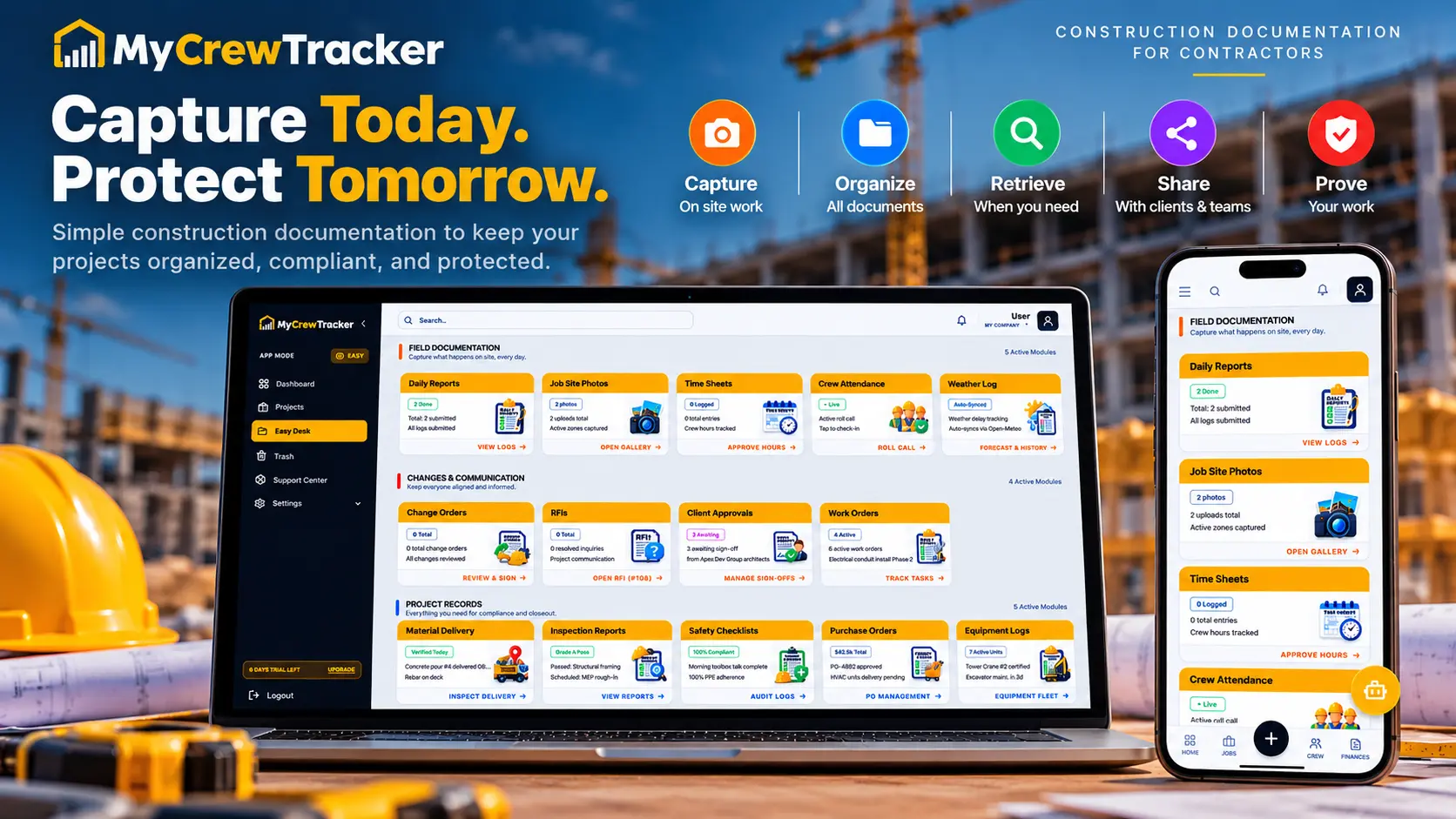
The construction industry in Kansas spans a diverse range of projects, from sprawling agricultural and wind energy developments in the plains to commercial and residential growth in cities like Wichita and the Kansas City metro area. With this growth comes the need for rigorous documentation and compliance with state-specific construction laws. Kansas imposes some of the most tiered lien notice requirements in the region: commercial projects generally require no preliminary notice, but new residential construction requires a Notice of Intent to Perform filed with the district court before the deed is recorded, and existing residential remodels require a Warning Statement before filing any lien. Add to that a three-month subcontractor lien deadline (extendable to five months on commercial), a 10% private retainage cap, an 18% interest penalty for wrongful withholding, and a 10-year statute of repose with a mandatory "right to cure" process, and the compliance burden becomes substantial. General contractors, subcontractors, and suppliers must navigate these intricate rules to ensure they are fairly compensated for their work while minimizing legal disputes. MyCrewTracker provides a centralized, cloud-based platform designed to help Kansas contractors organize, retrieve, and securely retain vital project documentation. By moving away from scattered paper files and disorganized email threads, your team can maintain a single source of truth for all job site records, lien notices, and change orders.
Kansas Mechanics Lien (K.S.A. 60-1101 et seq.)
In Kansas, the mechanics lien process is heavily dependent on the type of project (residential vs. commercial) and the claimant's role on the project.
1. Preliminary Notice Requirements
Unlike some states, Kansas does not require a universal preliminary notice for all construction projects. However, strict notice requirements apply to residential projects (defined as property intended for no more than two families):
Existing Residential Property (Remodels/Improvements)
Subcontractors and suppliers without a direct contract with the owner must serve a Warning Statement on the property owner. This notice must be served before filing the mechanics lien statement. The Warning Statement requirement is waived if the claim is $250 or less.
New Residential Construction
Subcontractors and suppliers must file a Notice of Intent to Perform with the district court clerk in the county where the property is located, and serve it on the owner. Critically, this must be filed and served prior to the recording of the deed passing title to the new owner. The Notice of Intent to Perform remains valid for 18 months.
Commercial Projects
Generally, no preliminary notice is required to preserve lien rights on commercial construction projects.
2. Mechanics Lien Recording Deadlines (K.S.A. 60-1101 and 60-1103)
The deadline to file a mechanics lien in Kansas is strictly calculated from the last date the claimant furnished labor or materials to the project:
- General Contractors (Direct Contract with Owner): Must file their mechanics lien statement within four (4) months of the last date of providing labor or materials under K.S.A. 60-1101.
- Subcontractors and Suppliers: Must file their mechanics lien statement within three (3) months of the last date of providing labor or materials under K.S.A. 60-1103.
- Commercial Extension: On commercial projects, subcontractors and suppliers may file a Notice of Extension to extend their filing deadline to five (5) months.
Once filed, a lawsuit to enforce (foreclose) the mechanics lien must be initiated within one (1) year from the date the lien was filed.
Kansas Prompt Payment and Retainage (K.S.A. 16-1901 et seq.)
Kansas law regulates both prompt payment and the withholding of retainage on construction projects to ensure fair cash flow.
Private Construction Retainage
Under the Kansas Fairness in Private Construction Contract Act (K.S.A. 16-1901 et seq.), retainage withheld by an owner or a general contractor is generally limited to a maximum of 10% of the estimated amount of work completed. The parties may agree in writing to a different retainage percentage, but absent such an agreement, the 10% cap applies.
Public Construction Retainage
On public projects, retainage is typically capped at 5%, though it may be increased to 10% under certain circumstances if necessary to ensure project completion or performance.
Release of Retainage
Owners must generally release undisputed retainage within 30 days after substantial completion of the project. If retainage is not released within the statutory period, the withholding party may be subject to interest penalties.
Late Payment Penalties
If payments or retainage are wrongfully withheld beyond statutory deadlines, the withholding party may be subject to an interest penalty of 18% per annum (1.5% per month) on the unpaid amount.
Kansas Statute of Repose and Construction Defect Act (K.S.A. 60-513(b) and K.S.A. 60-4701 et seq.)
Kansas imposes a 10-year Statute of Repose for construction defect claims based on negligence. Under K.S.A. 60-513(b), no lawsuit may be commenced more than 10 years after the act or omission that caused the defect, regardless of when the defect was discovered. This serves as an absolute outer time limit — a statute of repose, not a statute of limitations. Retain project records for at least 10 years to defend against potential defect claims.
The Kansas Construction Defect Act (Right to Cure)
The Kansas Construction Defect Act (K.S.A. 60-4701 et seq.) mandates a pre-litigation "Right to Cure" process. Before a property owner can file a lawsuit for a construction defect, they must provide the contractor with written notice of the defect and allow the contractor an opportunity to inspect and remedy (cure) the issue. This mirrors similar "notice and opportunity to repair" statutes in other states. Contractors should preserve any documentation related to notice of claim, inspection reports, and repair attempts in case of litigation.
Kansas Lien Deadlines at a Glance
| Action | Deadline | Statute |
|---|---|---|
| Warning Statement (Existing Residential Remodels) | Before filing lien statement (waived if claim ≤ $250) | K.S.A. 60-1103a |
| Notice of Intent to Perform (New Residential) | Before recording the deed to the new owner | K.S.A. 60-1103b |
| File Lien Statement (General Contractor) | Within 4 months of last furnishing | K.S.A. 60-1101 |
| File Lien Statement (Subcontractor/Supplier) | Within 3 months of last furnishing | K.S.A. 60-1103 |
| Notice of Extension (Commercial Projects) | Extends subcontractor deadline to 5 months | K.S.A. 60-1103 |
| File suit to foreclose lien | Within 1 year of filing the lien statement | K.S.A. 60-1101 et seq. |
| Private Retainage Cap | 10% of estimated work (absent written agreement) | K.S.A. 16-1901 et seq. |
| Public Retainage Cap | 5% (may increase to 10% under certain circumstances) | K.S.A. 16-1901 et seq. |
| Retainage Release | Within 30 days of substantial completion | K.S.A. 16-1901 et seq. |
| Wrongful Withholding Interest Penalty | 18% per annum (1.5% per month) | K.S.A. 16-1901 et seq. |
| Construction Defect Statute of Repose | 10 years from act or omission | K.S.A. 60-513(b) |
| Right to Cure Notice | Before filing a defect lawsuit | K.S.A. 60-4701 et seq. |
Documents to Preserve for a Kansas Lien Claim
Kansas courts require proof that you furnished labor or materials and that they were incorporated into the property. The following records are what you need:
- Signed contract or purchase order with the prime contractor
- Warning Statement (existing residential remodels)
- Notice of Intent to Perform (new residential construction)
- Notice of Extension (commercial projects)
- Delivery tickets signed by an authorized site representative
- Daily reports showing crew on site and work performed
- Photo evidence of installed work (timestamped and geotagged)
- Jobsite sign-in logs and crew attendance records
- Invoices, statements, and payment applications
- Email or text correspondence about scope and payment
- Change orders and extra work authorizations
- Copy of the filed Lien Statement with district court clerk stamp
MyCrewTracker stores all of these in one project record. When a lien deadline approaches, the back office can generate the timeline needed to prepare the Lien Statement without reconstructing months of field activity.
Kansas-Specific Gotchas
New residential construction requires a pre-deed notice. Unlike any other state, Kansas requires subcontractors and suppliers on new residential projects to file a Notice of Intent to Perform with the district court before the deed passing title to the new owner is recorded. This means the notice must be filed while the home is still under construction. Missing this deadline forfeits lien rights entirely.
Existing residential remodels require a Warning Statement. Subcontractors and suppliers on existing residential remodels must serve a Warning Statement on the owner before filing any lien. The only exception is a claim of $250 or less.
Commercial projects require no preliminary notice. On commercial projects, Kansas does not require subcontractors or suppliers to serve a preliminary notice to preserve lien rights. The first required document is the Lien Statement itself.
The 3-month subcontractor deadline is the shortest in the region. Subcontractors and suppliers have only 3 months from last furnishing to file the Lien Statement. On commercial projects, this can be extended to 5 months with a Notice of Extension.
The 4-month general contractor deadline is also strict. General contractors who contract directly with the owner have 4 months from last furnishing to file the Lien Statement.
The 1-year enforcement deadline is absolute. After filing the lien statement, you have exactly 1 year to file a lawsuit to foreclose. Set two calendar reminders: one at 9 months, one at 11 months.
Private retainage is capped at 10%. Under the Kansas Fairness in Private Construction Contract Act, retainage is limited to 10% of the estimated amount of work completed unless the parties have agreed otherwise in writing.
Public retainage is capped at 5%. Public construction retainage is typically capped at 5%, with a possible increase to 10% only under specific circumstances.
The 18% interest penalty for wrongful withholding is severe. If payments or retainage are wrongfully withheld, the withholding party may be liable for interest at 18% per annum (1.5% per month).
The Right to Cure process is mandatory. Before filing a construction defect lawsuit, the property owner must serve written notice on the contractor and give an opportunity to inspect and cure. Contractors should preserve all documentation related to notice of claim, inspections, and repair attempts.
The 10-year statute of repose is absolute. Under K.S.A. 60-513(b), no negligence claim may be brought for construction defects more than 10 years after the act or omission, regardless of when the defect was discovered. Retain project records for at least 10 years.
Example Scenario: How Documentation Determines the Outcome
*The following is an illustrative scenario, not a specific case. It demonstrates how record-keeping affects outcomes in Kansas lien disputes.*
Consider a Wichita mechanical subcontractor on a $600,000 commercial office renovation. The sub first furnishes labor on March 1. The sub's last day of substantial work is August 15.
Under K.S.A. 60-1103, the sub has 3 months from August 15 to file the Lien Statement with the Sedgwick County District Court. That deadline is November 15. Because the project is commercial, the sub can extend the deadline to 5 months by filing a Notice of Extension — which would push the deadline to January 15. The sub files the Notice of Extension on October 15 and then files the Lien Statement on December 20.
Under Kansas law, the sub has 1 year from December 20 to file suit to foreclose on the lien. That deadline is December 20 of the following year. The sub files suit on September 15, well within the window. The lien is enforceable.
Now consider the same sub on a new residential project instead. The sub first furnishes labor on March 1. Under K.S.A. 60-1103b, the sub must file a Notice of Intent to Perform with the district court before the deed passing title to the new owner is recorded. If the deed is recorded on June 15 and the sub has not filed the notice, the sub loses all lien rights — regardless of how much documentation they have.
Documentation is what separates these outcomes. MyCrewTracker logs the first day of work, the last day of work, the notice filing dates, and the daily reports that prove performance.
What MyCrewTracker Does (and Does Not Do) in Kansas
MyCrewTracker is a construction documentation platform, not a legal service. Here is what it does for Kansas contractors:
- Logs first day and last day of work per project so you can calculate the 3-month, 4-month, or 5-month lien filing window
- Stores certified mail receipts and Warning Statement or Notice of Intent to Perform documents in the project file
- Records delivery tickets with photo and signature capture
- Captures timestamped, GPS-tagged site photos that document installation
- Generates daily report PDFs that serve as contemporaneous records
- Tracks retainage and payment dates for prompt payment and retainage compliance
- Archives project records for 10+ years to support construction defect defense
What MyCrewTracker Does NOT Do: We do not provide legal advice, draft or file mechanics liens, Warning Statements, Notices of Intent to Perform, or Notices of Extension. We do not act as a substitute for consulting with a qualified Kansas construction law attorney, and we do not automatically calculate or enforce prompt payment interest penalties.
❓ Frequently Asked Questions in West Virginia
Do I need to send a preliminary notice for a commercial project in Kansas?
Generally, no. Kansas does not require subcontractors or suppliers to send a preliminary notice to preserve mechanics lien rights on commercial projects.
When must I file a Notice of Intent to Perform for new residential construction?
The Notice of Intent to Perform must be filed with the district court and served on the owner before the deed passing title to the new homeowner is recorded. It remains valid for 18 months.
What is the deadline to file a mechanics lien as a subcontractor in Kansas?
A subcontractor must file a mechanics lien within three (3) months of the last day they provided labor or materials to the project. On commercial projects, this can be extended to five (5) months by filing a Notice of Extension.
How long does a general contractor have to file a mechanics lien?
A general contractor (someone with a direct contract with the owner) has four (4) months from their last date of furnishing labor or materials to file a mechanics lien under K.S.A. 60-1101.
How long is a mechanics lien valid in Kansas?
A mechanics lien is valid for one (1) year from the date it is filed. To enforce the lien, a foreclosure lawsuit must be filed within this one-year period.
What is the maximum retainage that can be withheld on a private project in Kansas?
On private construction projects, retainage is generally capped at a maximum of 10% of the completed work under the Kansas Fairness in Private Construction Contract Act.
When must retainage be released in Kansas?
Retainage must generally be released within 30 days following the substantial completion of the project.
What happens if an owner or contractor pays late in Kansas?
If a party wrongfully withholds payment or retainage beyond the statutory deadlines, they may be liable for interest at a rate of 18% per year (1.5% per month).
What is the Kansas Construction Defect Act?
It is a law (K.S.A. 60-4701 et seq.) that requires property owners to give contractors written notice of a construction defect and an opportunity to inspect and fix the problem before filing a lawsuit. This is called the "Right to Cure" process.
What is the statute of repose for construction defects in Kansas?
Kansas has a 10-year statute of repose for negligence claims under K.S.A. 60-513(b), meaning no legal action for a construction defect can be brought more than 10 years after the negligent act occurred, regardless of when the defect was discovered.
Does MyCrewTracker file Kansas mechanics liens?
No. MyCrewTracker is a secure document management platform that helps you organize the daily reports, invoices, and delivery receipts you need to prove your case. To officially file a mechanics lien in Kansas, you must use a specialized legal service or a qualified construction attorney.
Legal Sources & References
-
Lien of Contractor W. Va. Code § 38-2-1
West Virginia Mechanics Liens — Every person, firm, or corporation who erects, builds, constructs, alters, removes, or repairs any building under a contract with the owner has a lien upon such building and the owner's interest in the real property.
-
Lien of Subcontractor W. Va. Code § 38-2-2
West Virginia Mechanics Liens — Subcontractors who furnish materials, machinery, equipment, labor, work, or services necessary to complete a general contract have a lien for their compensation.
-
Lien of Materialman Furnishing Supplies to Owner W. Va. Code § 38-2-3
West Virginia Mechanics Liens — Materialmen who furnish supplies to owners have a lien for their compensation.
-
Lien of Materialman Furnishing Supplies to Contractor or Subcontractor W. Va. Code § 38-2-4
West Virginia Mechanics Liens — Materialmen who furnish supplies to general contractors or subcontractors have a lien for their compensation.
-
Notice of Mechanic's Lien — Recording W. Va. Code § 38-2-8
West Virginia Lien Recording — The Notice of Mechanic's Lien must be recorded in the office of the clerk of the county commission where the property is located within 100 days of the completion of the work or the supply of materials. The lien is discharged after 100 days if not recorded.
-
Time Within Which Suit to Enforce Lien May Be Brought W. Va. Code § 38-2-34
West Virginia Lien Enforcement — An action to enforce a mechanics lien must be commenced in circuit court within six months after the notice of lien is filed. If not commenced within that time, the lien is discharged.
-
Prompt Payment Act of 2025 — Payment of Legitimate Uncontested Invoices W. Va. Code § 12-10-2
West Virginia Prompt Payment Act of 2025 — State agencies must pay legitimate, uncontested invoices within 45 days of receipt. Late payments accrue interest at 3% compounded weekly.
-
Retainage on Public Projects W. Va. Code § 21-11-1
West Virginia Public Retainage — Retainage on public projects is limited to a maximum of 10% of the contract price.
-
Deficiencies Resulting from Improvements to Real Property — Limitation of Actions W. Va. Code § 55-2-6a
West Virginia Statute of Repose — No action, whether in contract or tort, may be brought for construction defects more than 10 years after the performance or furnishing of the services or construction. The period does not commence until the improvement has been occupied or accepted by the owner.
-
Notice and Opportunity to Cure Construction Defects — Notice Required W. Va. Code § 21-11A-5
West Virginia Notice and Opportunity to Cure — A homeowner must deliver written notice of an alleged construction defect to the contractor and provide the contractor and any subcontractors, suppliers, or design professionals the opportunity to make an offer to repair or pay for the defects at least 90 days before filing a lawsuit.
-
West Virginia Legislature — West Virginia Code General Reference
Official West Virginia Legislature website — Searchable index of all West Virginia Code sections.
Ready to organize your jobs?
Join contractors in West Virginia using MyCrewTracker.