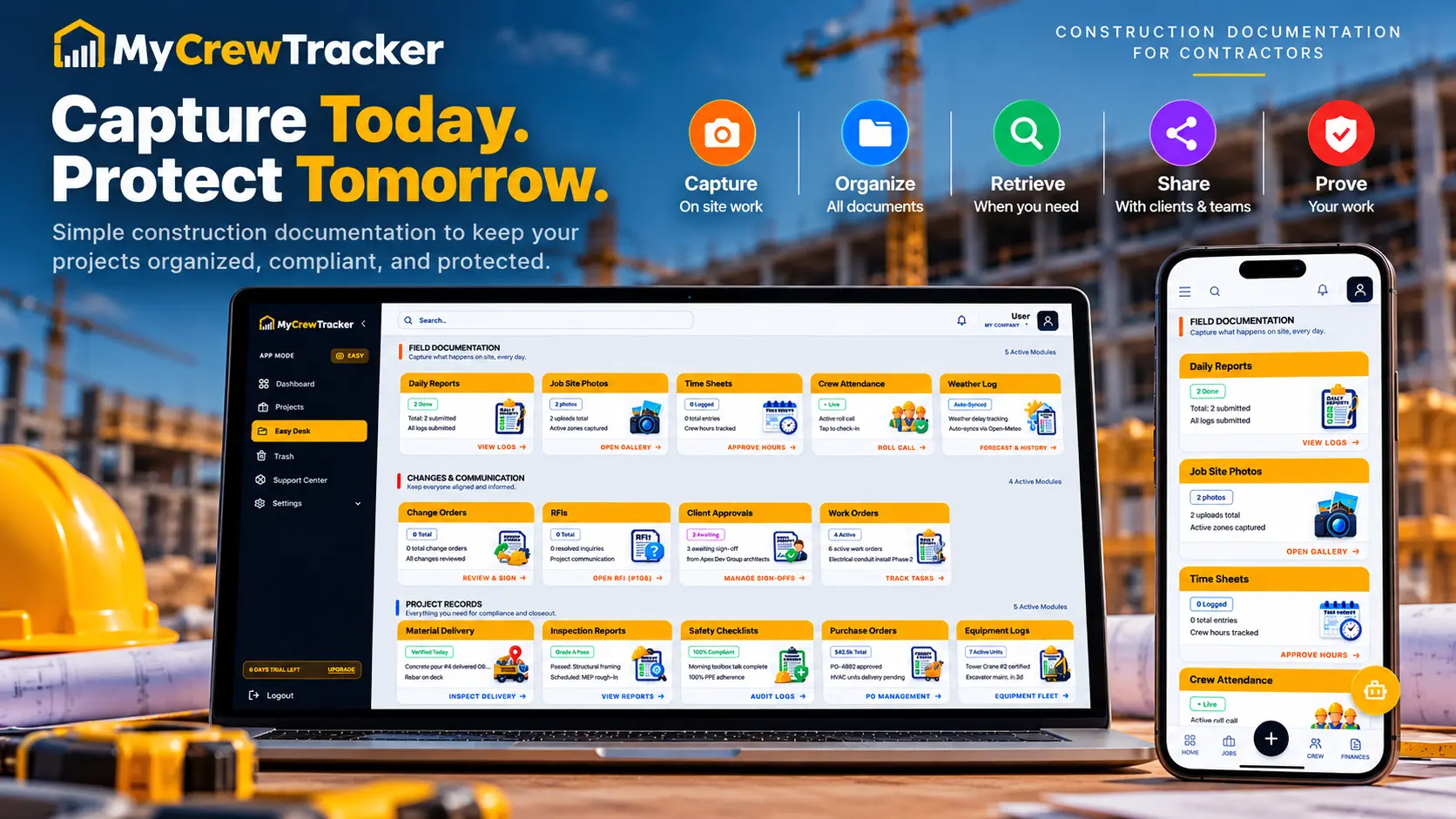
From commercial developments in Boston to public works across the Commonwealth, Massachusetts construction projects are governed by rigorous payment and lien statutes. The state's lien law is notoriously unforgiving: Massachusetts courts have repeatedly held that "failure to comply normally results in dissolution of the lien". Unlike many states where substantial compliance is enough, Massachusetts requires strict adherence to every statutory deadline and procedure. MyCrewTracker provides Massachusetts contractors with a centralized cloud platform to organize critical documentation, track daily progress, and secure their right to payment.
Massachusetts Prompt Pay Act (M.G.L. c. 149, § 29E)
Cash flow delays on large private projects are strictly regulated in Massachusetts. The Prompt Pay Act, enacted in 2010, was designed to address downstream cash flow issues in the construction industry by mandating strict timelines for invoice review and payment.
What the Prompt Pay Act Requires
For private construction contracts with an original value of $3 million or more, the Act imposes the following requirements:
- Approval or rejection within 15 days: Periodic payment applications must generally be approved or rejected within 15 days of submission
- Payment within 45 days of approval: If approved, payment must generally be made within 45 days after approval
- Good-faith certification required: Any rejection must be made in good faith and must include a certification to that effect
The "Deemed Approved" Trap
Massachusetts courts have interpreted the Prompt Pay Act strictly. In the landmark 2026 Supreme Judicial Court decision *J.C. Cannistraro, LLC v. Columbia Construction Co.*, the SJC held that a contractor's failure to timely certify a rejection in good faith resulted in invoices being "deemed to be approved" and immediately payable.
The case involved $951,855.05 in disputed invoices. Although the contractor timely rejected the invoices and provided reasons, its good-faith certification was issued late. The arbitrator found this violated the Act, resulting in the invoices becoming automatically payable.
Key takeaway: Under Massachusetts law, meeting the deadline is not enough. You must also include the required good-faith certification. Without it, the invoice is deemed approved and must be paid.
Documentation Requirements for Prompt Pay Compliance
To enforce these rights, contractors must maintain flawless documentation of when payment applications were submitted. MyCrewTracker offers a secure cloud repository where Massachusetts contractors can organize dated payment applications, formal communications, and approvals to prove statutory compliance.
Massachusetts Mechanics Lien (Notice of Contract)
Securing lien rights in Massachusetts requires meticulous adherence to statutory timelines. The Massachusetts mechanics lien framework is set forth in M.G.L. c. 254, §§ 1 et seq.
The Notice of Contract (M.G.L. c. 254, § 4)
Under M.G.L. c. 254, § 4, subcontractors must generally record a Notice of Contract in the appropriate Registry of Deeds. This notice is a critical first step for perfecting a mechanic's lien.
The Notice of Contract must be recorded by the earliest of:
- 60 days after the filing of a Notice of Substantial Completion
- 90 days after the filing of a Notice of Termination
- 90 days after the last day a person entitled to enforce a lien performed or furnished labor or materials
The Notice of Substantial Completion (M.G.L. c. 254, § 2A)
Under M.G.L. c. 254, § 2A, upon or after substantial completion of any contract, the owner and contractor shall execute and file or record a Notice of Substantial Completion in the appropriate Registry of Deeds.
The statute defines "substantial completion" as the stage when the work under the written contract is sufficiently complete so that it can be occupied or utilized for its intended use.
The Notice of Substantial Completion triggers the 60-day clock for subcontractors to record their Notice of Contract. The owner must serve written notice of the recording of this document on every person who has filed a Notice of Contract. The contractor must serve notice on everyone who has entered into a written contract directly with the contractor.
What Happens If You Miss the Deadline
Massachusetts courts have consistently held that failure to comply with the strict procedural requirements of Chapter 254 results in dissolution of the lien or failure of the lien to attach. Unlike some states where a late filing merely shortens the lien period, Massachusetts treats these deadlines as strict conditions precedent.
Because the 90-day deadline can hinge on the last day of work, establishing exactly when work concluded is critical. MyCrewTracker assists Massachusetts contractors by using Daily Reports to establish a verifiable, date-stamped record of job site activities, ensuring your back office has the accurate dates needed to manage lien claim protections.
Massachusetts Lien Deadlines at a Glance
Missing a single deadline in Massachusetts can dissolve your lien entirely. The table below summarizes the statutory deadlines every Massachusetts contractor, subcontractor, and material supplier must track.
| Action | Deadline | Statute |
|---|---|---|
| Record Notice of Contract (subcontractors) | Earliest of: 60 days after Notice of Substantial Completion, 90 days after Notice of Termination, or 90 days after last work | M.G.L. c. 254, § 4 |
| File Statement of Account | Within 30 days after the date the principal contract is to be performed | M.G.L. c. 254, § 8 |
| Commence enforcement action | Within 90 days after filing Statement of Account | M.G.L. c. 254, § 5 |
| Record attested copy of complaint | Within 30 days of commencement of action | M.G.L. c. 254, § 5 |
| Approve or reject payment application (Prompt Pay Act) | Within 15 days of submission | M.G.L. c. 149, § 29E |
| Pay approved invoice (Prompt Pay Act) | Within 45 days of approval | M.G.L. c. 149, § 29E |
| Retainage cap (private projects over $3M) | Maximum 5% of contract price | M.G.L. c. 149, § 29F |
| Application for retainage payment | Paid not later than 30 days following submission | M.G.L. c. 149, § 29F |
| Construction defect statute of repose | 6 years from earlier of opening for use or substantial completion | M.G.L. c. 260, § 2B |
How to Perfect a Mechanics Lien in Massachusetts: Step by Step
The process below reflects the standard path for a Massachusetts subcontractor, supplier, or laborer seeking to preserve and enforce lien rights under M.G.L. Chapter 254.
1. Log your last day of work. The 90-day Notice of Contract deadline runs from your last day of furnishing labor or materials. MyCrewTracker's Daily Reports timestamp this automatically.
2. Monitor for Notice of Substantial Completion. When the owner and contractor record this document, your 60-day clock starts. You must be prepared to act quickly.
3. Record the Notice of Contract. Under M.G.L. c. 254, § 4, file the notice in the Registry of Deeds for the county where the property is located. The notice must include the names of the parties, a description of the property, and the amount claimed.
4. File the Statement of Account. Under M.G.L. c. 254, § 8, a sworn statement of account must be filed within 30 days after the date the principal contract is to be performed. This must include an itemized account of the amount due.
5. Commence enforcement action within 90 days. Under M.G.L. c. 254, § 5, a civil action to enforce the lien must be commenced within 90 days after filing the Statement of Account.
6. Record an attested copy of the complaint within 30 days. Under M.G.L. c. 254, § 5, an attested copy of the complaint must be filed in the Registry of Deeds and recorded within 30 days of the commencement of the action, or the lien shall be dissolved.
7. Preserve all project documentation. Daily reports, delivery tickets, change orders, and photos become evidence in the enforcement action.
8. Consider alternative remedies in parallel. Contract claims and payment bond claims can run alongside the lien.
Documents to Preserve for a Massachusetts Lien Claim
Massachusetts courts require strict proof that you furnished labor or materials and complied with every statutory step. The following records are what you need:
- Signed contract or purchase order with the prime contractor
- Recorded Notice of Contract with Registry of Deeds stamp
- Certified mail receipts for all statutory notices
- Delivery tickets signed by an authorized site representative
- Daily reports showing crew on site and work performed
- Photo evidence of installed work (timestamped and geotagged)
- Jobsite sign-in logs and crew attendance records
- Invoices, statements, and payment applications
- Email or text correspondence about scope and payment
- Change orders and extra work authorizations
MyCrewTracker stores all of these in one project record. When a lien deadline approaches, the back office can generate the timeline needed to prepare the Statement of Account without reconstructing months of field activity.
Massachusetts-Specific Gotchas
Strict compliance is mandatory. Massachusetts courts have repeatedly held that "failure to comply normally results in dissolution of the lien". Unlike states that allow substantial compliance, Massachusetts requires strict adherence to every statutory deadline and procedural step.
The Notice of Substantial Completion changes everything. Under M.G.L. c. 254, § 2A, the recording of this document shortens the subcontractor's deadline to just 60 days. You must monitor the Registry of Deeds regularly to know when this document is filed.
The "deemed approved" trap under the Prompt Pay Act. As the 2026 SJC decision in *Cannistraro* made clear, failing to include a good-faith certification when rejecting an invoice results in the invoice being automatically approved and payable.
The 30-day recording requirement after filing suit. Under M.G.L. c. 254, § 5, you must record an attested copy of your complaint within 30 days of commencing the enforcement action. Failure to do so dissolves the lien.
The 90-day enforcement deadline is absolute. You must commence a civil action to enforce the lien within 90 days after filing the Statement of Account. Set two calendar reminders: one at 60 days, one at 80 days.
Retainage is capped at 5%. Under M.G.L. c. 149, § 29F, no contract for construction shall include retainage that exceeds 5% of the contract price. This applies to private projects with an original contract price of $3 million or more.
Construction defect statute of repose. Massachusetts's statute of repose for construction defects is 6 years from the earlier of the opening of the improvement to use or substantial completion under M.G.L. c. 260, § 2B. This is an absolute bar with no exceptions.
Example Scenario: How Documentation Determines the Outcome
*The following is an illustrative scenario, not a specific case. It demonstrates how record-keeping affects outcomes in Massachusetts lien disputes.*
Consider a Boston electrical subcontractor on a $5 million commercial office renovation. The sub's last day of substantial work is August 15.
On September 1, the owner and general contractor record a Notice of Substantial Completion in the Suffolk County Registry of Deeds. Under M.G.L. c. 254, § 4, the sub now has 60 days from September 1 to record a Notice of Contract. That deadline is October 31. The sub records the Notice of Contract on October 25.
Under M.G.L. c. 254, § 8, the sub must file a Statement of Account within 30 days after the date the principal contract is to be performed. The contract completion date is November 15. The sub files the Statement of Account on December 10.
Under M.G.L. c. 254, § 5, the sub must commence an enforcement action within 90 days after filing the Statement of Account. That deadline is March 10. The sub files suit on February 15 and records an attested copy of the complaint on March 1 — within the 30-day recording requirement.
The lien is enforceable.
Compare that to the same sub who fails to monitor the Registry of Deeds and misses the 60-day Notice of Contract deadline. Under M.G.L. c. 254, § 4, the lien is dissolved entirely. The sub loses all lien rights, regardless of how much documentation they have. The $185,000 owed becomes significantly harder to collect.
Documentation is what separates these outcomes. MyCrewTracker logs the last day of work, the Notice of Substantial Completion date, the Notice of Contract recording date, and the daily reports that prove performance.
Massachusetts Retainage Law (M.G.L. c. 149, § 29F)
Under M.G.L. c. 149, § 29F, Massachusetts law establishes strict caps on retainage for private construction contracts with an original contract price of $3 million or more (excluding projects with 1–4 dwelling units and certain publicly assisted projects).
What the Retainage Law Requires
- 5% cap: No contract for construction shall include retainage that exceeds 5% of the contract price
- Application for payment: An application for payment of retainage shall be paid not later than 30 days following submission
- Void provisions: Any contract provision that purports to require retainage in excess of 5% is void and unenforceable
To defend against claims of wrongful withholding, contractors must maintain flawless documentation of retainage applications and approvals. MyCrewTracker offers a secure cloud repository where Massachusetts contractors can organize dated payment applications and formal communications.
Massachusetts Prompt Payment Act Enforcement
The Massachusetts Prompt Pay Act has been the subject of significant litigation since its enactment. The Supreme Judicial Court has issued multiple decisions clarifying its scope and requirements.
Key Court Decisions
- Business Interiors Floor Covering Business Trust v. Graycor Constr. Co. — Established the "order of operations" for Prompt Pay Act compliance
- J.C. Cannistraro, LLC v. Columbia Construction Co. (2026) — Held that failure to timely certify a rejection in good faith results in "deemed to be approved" invoices
What This Means for Massachusetts Contractors
- Timely rejection is not enough — the rejection must include a good-faith certification
- If the certification is missing or late, the invoice is deemed approved and payable
- Contractors can still pursue counterclaims for recoupment after paying deemed-approved invoices, but they must pay first
What MyCrewTracker Does (and Does Not Do) in Massachusetts
MyCrewTracker is a construction documentation platform, not a legal service. Here is what it does for Massachusetts contractors:
- Logs first day and last day of work per project so you can calculate the Notice of Contract deadline
- Stores certified mail receipts and Notice of Contract documents in the project file
- Records delivery tickets with photo and signature capture
- Captures timestamped, GPS-tagged site photos that document installation
- Generates daily report PDFs that serve as contemporaneous records
- Tracks payment application dates for Prompt Pay Act compliance
- Archives project records for 6+ years to support construction defect defense
It does not draft Notices of Contract, file documents with the Registry of Deeds, or provide legal advice. Those steps require a Massachusetts construction attorney.
❓ Frequently Asked Questions in Massachusetts
What is the Massachusetts Prompt Pay Act?
Under M.G.L. c. 149, § 29E, for private projects over $3 million, payment applications must generally be approved or rejected within 15 days, and if approved, payment must generally be made within 45 days. Strict documentation of submission dates is highly recommended.
When must a subcontractor record a Notice of Contract in Massachusetts?
Under M.G.L. c. 254, § 4, a Notice of Contract must generally be recorded by the earliest of: 60 days after a Notice of Substantial Completion, 90 days after a Notice of Termination, or 90 days after the last furnishing of labor or materials.
What is a Notice of Substantial Completion in Massachusetts?
Under M.G.L. c. 254, § 2A, a Notice of Substantial Completion is a document that the owner and contractor must execute and record when the work is sufficiently complete to be occupied or utilized for its intended use. Recording this notice shortens the subcontractor's deadline to record a Notice of Contract to 60 days.
How long do I have to enforce a Massachusetts mechanics lien?
Under M.G.L. c. 254, § 5, you must commence a civil action to enforce the lien within 90 days after filing the Statement of Account. You must then record an attested copy of the complaint within 30 days of commencement.
What is the Massachusetts retainage limit?
Under M.G.L. c. 149, § 29F, retainage on private construction contracts over $3 million is capped at 5% of the contract price. Applications for payment of retainage must be paid within 30 days of submission.
What happens if I fail to comply with Massachusetts lien requirements?
Massachusetts courts have consistently held that failure to comply with the strict procedural requirements of Chapter 254 results in dissolution of the lien or failure of the lien to attach.
What is the Massachusetts construction defect statute of repose?
Under M.G.L. c. 260, § 2B, no action may be brought for construction defects more than 6 years after the earlier of the opening of the improvement to use or substantial completion.
Can MyCrewTracker legally enforce a Massachusetts mechanics lien?
No. MyCrewTracker is a document management and project organization platform. It helps you accurately track your last day of work and securely store your payment applications, but you must consult a Massachusetts construction attorney to enforce a mechanics lien.
Legal Sources & References
-
Prompt Pay Act M.G.L. c. 149, § 29E
Massachusetts Prompt Pay Act — For private contracts over $3 million, payment applications must be approved or rejected within 15 days, and approved invoices paid within 45 days. Rejections must include a good-faith certification.
-
Retainage Law M.G.L. c. 149, § 29F
Massachusetts Retainage Law — Retainage on private construction contracts over $3 million is capped at 5% of the contract price. Applications for retainage payment must be paid within 30 days.
-
Mechanics Lien — Notice of Contract M.G.L. c. 254, § 4
Massachusetts Notice of Contract — Subcontractors must record a Notice of Contract by the earliest of 60 days after a Notice of Substantial Completion, 90 days after a Notice of Termination, or 90 days after last work.
-
Mechanics Lien — Enforcement M.G.L. c. 254, § 5
Massachusetts Lien Enforcement — A civil action to enforce a lien must be commenced within 90 days after filing the Statement of Account. An attested copy of the complaint must be recorded within 30 days of commencement.
-
Statement of Account M.G.L. c. 254, § 8
Massachusetts Statement of Account — A sworn statement of account must be filed within 30 days after the date the principal contract is to be performed.
-
Notice of Substantial Completion M.G.L. c. 254, § 2A
Massachusetts Notice of Substantial Completion — The owner and contractor must execute and record a Notice of Substantial Completion when work is sufficiently complete for occupancy or intended use.
-
Construction Defect Statute of Repose M.G.L. c. 260, § 2B
Massachusetts Statute of Repose — No action may be brought for construction defects more than 6 years after the earlier of opening for use or substantial completion.
-
Massachusetts Legislature General Reference
Official Massachusetts General Court website — Searchable index of all Massachusetts General Laws.
Protect Your Projects & Retain Required Massachusetts Records
Defend against back-charges, audit penalties, and mechanic's lien disputes. Keep GPS-timestamped photos, certified timesheets, and signed change orders safely backed up for just $40/month.