Operating a construction business in Florida means managing a fast-paced environment heavily regulated by strict payment and lien laws. For subcontractors, roofers, and specialty trades, staying organized is the only way to ensure you get paid for your hard work.
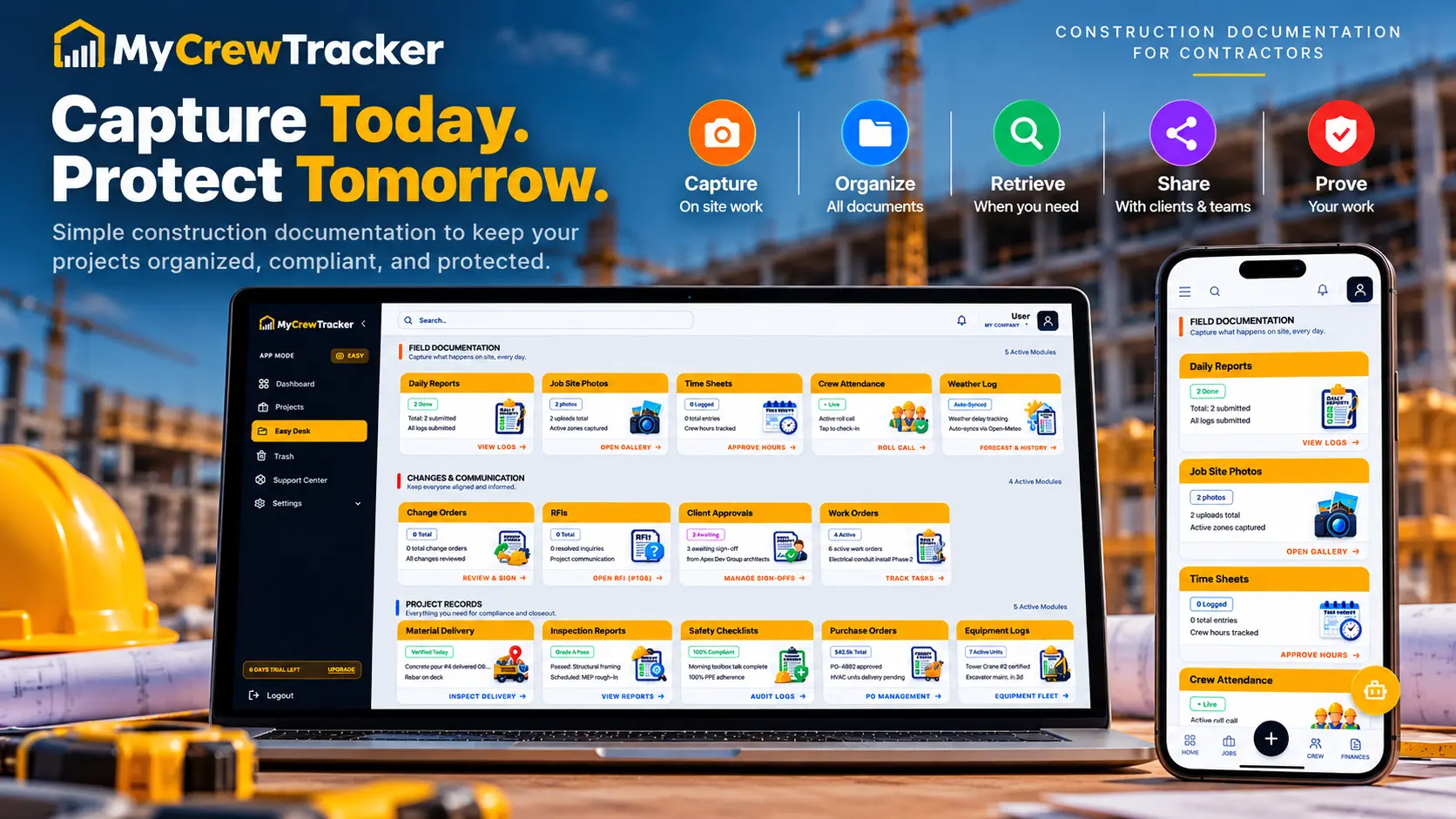
MyCrewTracker provides a centralized, cloud-based platform designed to help Florida contractors organize, retrieve, and securely retain vital project documentation. By moving away from scattered paper files and disorganized email threads, your team can maintain a single source of truth for all job site records, Notice to Owner (NTO) receipts, and RFIs.
Florida Statutes Chapter 713: The Notice to Owner (NTO)
In Florida, securing your right to payment requires strict adherence to statutory deadlines. The most critical of these is the Notice to Owner (NTO). Under Florida Statutes § 713.06(2)(a), any contractor, subcontractor, or material supplier who is not in direct privity (a direct contract) with the property owner must serve a Notice to Owner to preserve their mechanic's lien rights.
This notice must be served within exactly 45 days of first providing labor or materials to the project site. Because Florida courts strictly construe these lien laws, missing this 45-day window by even a single day can completely forfeit your right to claim a lien.
MyCrewTracker assists Florida contractors by providing a secure central repository (Quick Docs) to store copies of sent NTOs, certified mail tracking receipts, and corresponding project start dates, ensuring that proof of your compliance is permanently documented and always accessible.
What the Florida Notice to Owner Must Include
Under Florida Statutes § 713.06(2)(a), the Notice to Owner must contain specific information:
- The name and address of the lienor (the person or company furnishing labor or materials)
- The name and address of the person who contracted with the lienor (usually the general contractor or subcontractor)
- A general description of the labor, services, or materials furnished
- The name and address of the owner of the property
- A statement that the notice is not a lien and is not a reflection on the integrity of any contractor or subcontractor
The notice must be served on the owner, the general contractor (if different), and the construction lender (if any).
Who Is Exempt From Serving a Notice to Owner?
Not every party on a Florida construction project must serve a Notice to Owner. Under Florida Statutes § 713.05 and § 713.04, the following parties are exempt:
- Those with a direct contract with the property owner — General contractors and other parties in direct privity with the owner are exempt from serving an NTO because their lien rights arise automatically from that direct relationship.
- Laborers furnishing only labor — A "laborer" as defined by statute does not need to file a Notice to Owner.
- Licensed professional claimants — Architects, engineers, and surveyors performing professional services are generally exempt.
- Subdivision improvement lienors — Parties performing subdivision improvements (excavation, paving, laying pipes for water and gas, etc.) are not required to serve a Notice to Owner, regardless of privity.
What Happens If You Miss the 45-Day Deadline
If you serve the Notice to Owner late, Florida courts have consistently held that the lien is void entirely for lienors not in privity with the owner. Unlike some states where a late notice merely limits the lien amount, Florida law treats the NTO as a strict condition precedent to lien rights. There is no mechanism to revive a lien after this deadline passes.
For a subcontractor who has been on site for months, this can mean losing the entire lien claim. The 45-day window is strict and unforgiving. MyCrewTracker's Daily Reports give Florida field teams a simple way to date-stamp their first day on the job, ensuring the back office tracks the deadline and securely archives the certified mail receipt.
Florida Lien Deadlines at a Glance
Missing a single deadline in Florida can void your lien rights entirely. The table below summarizes the statutory deadlines every Florida contractor, subcontractor, and material supplier must track.
| Action | Deadline | Statute |
|---|---|---|
| Serve Notice to Owner (non-privity lienors) | Within 45 days of first furnishing labor or materials | Fla. Stat. § 713.06(2)(a) |
| Record Claim of Lien | Within 90 days after last furnishing labor or materials | Fla. Stat. § 713.08 |
| Serve copy of Claim of Lien on owner | Within 15 days of recording | Fla. Stat. § 713.08 |
| File suit to enforce lien | Within 1 year of recording (or 60 days if Notice of Contest served) | Fla. Stat. § 713.22 |
| Owner pay contractor | Within 30 days of written payment request | Fla. Stat. § 713.06(3)(c) |
| Contractor pay subcontractor | Within 30 days of receiving payment | Fla. Stat. § 713.06(3)(c) |
| Construction defect statute of repose | 7 years from substantial completion (reduced from 10 years, effective 2023) | Fla. Stat. § 95.11(3)(c) |
| Contractor business record retention | 3 years after project completion | Fla. Stat. § 489.141 |
How to File a Mechanics Lien in Florida: Step by Step
The process below reflects the standard path for a Florida subcontractor, supplier, or laborer seeking to preserve and enforce lien rights under Chapter 713, Part I of the Florida Statutes.
- Serve the Notice to Owner. On non-privity projects, send within 45 days of first furnishing labor or materials via certified mail, return receipt requested, to the owner, general contractor, and construction lender (if any). Keep the green card and a copy of the notice.
- Log your first day of work. The 45-day notice clock starts on the day you first furnish labor or materials. MyCrewTracker's Daily Reports timestamp this automatically.
- Track the last day of work. Florida's 90-day filing clock starts from your last day of substantial work. Returning to the site to perform minor repairs does not extend the window.
- Prepare the Claim of Lien. Under Fla. Stat. § 713.08, the claim must be signed and verified by the lienor or their agent, must state the amount owed, describe the property, and identify the owner and contractor.
- Record the Claim of Lien with the Clerk of Court. Florida mechanics liens are recorded at the county level, not the state. File in the county where the property is located.
- Serve a copy of the Claim of Lien on the property owner. Florida requires that a copy of the recorded lien be served on the owner within 15 days of recording.
- File suit within 1 year. Under Fla. Stat. § 713.22, you have 1 year from recording the lien to file suit to enforce it. If the owner serves a Notice of Contest of Lien, the enforcement deadline shortens to 60 days.
- Record a notice of lis pendens. When you file suit, record a notice of pendency of action to protect priority.
- Preserve all project documentation. Daily reports, delivery tickets, change orders, and photos become evidence in the foreclosure action.
- Consider alternative remedies in parallel. Prompt Payment Act claims, contract claims, and payment bond claims can run alongside the lien.
Documents to Preserve for a Florida Lien Claim
Florida courts require proof that you furnished labor or materials and that they were incorporated into the property. The following records are what you need:
- Signed contract or purchase order with the prime contractor
- Certified mail receipts for the Notice to Owner
- Delivery tickets signed by an authorized site representative
- Daily reports showing crew on site and work performed
- Photo evidence of installed work (timestamped and geotagged)
- Jobsite sign-in logs and crew attendance records
- Invoices, statements, and payment applications
- Email or text correspondence about scope and payment
- Change orders and extra work authorizations
- Written demand letters and any response
MyCrewTracker stores all of these in one project record. When a lien deadline approaches, the back office can generate the timeline needed to prepare the claim of lien without reconstructing months of field activity.
Florida-Specific Gotchas
The 45-day Notice to Owner is the most critical deadline. Unlike some states where preliminary notice is only required for certain claimants, Florida requires the NTO for all subcontractors, material suppliers, and laborers on non-privity projects. Missing it voids the lien entirely. Send it. Every job. Even if the general contractor tells you it is not needed.
The 90-day filing clock is strict. Under Fla. Stat. § 713.08, the Claim of Lien must be recorded within 90 days after the last furnishing of labor, services, or materials. Returning to the site to perform minor repairs or punch list items does not extend the window. The clock starts from the last day of substantial work.
15-day service requirement after recording. Florida requires that a copy of the recorded Claim of Lien be served on the property owner within 15 days. Failure to serve the claim of lien before recording or within 15 days after recording renders the claim voidable to the extent that the failure is shown to have been prejudicial to any person entitled to rely on the service.
1-year enforcement deadline is absolute. Fla. Stat. § 713.22 gives you exactly 1 year from recording the lien to file suit. If the owner serves a Notice of Contest of Lien, that deadline shrinks to 60 days. If the owner serves a 20-day Summons to Show Cause, suit must be filed within 20 days. Set two calendar reminders: one at 9 months, one at 11 months.
Statutory lien waiver forms are mandatory. Florida Statutes § 713.20 prescribes four statutory forms for lien waivers: conditional progress, unconditional progress, conditional final, and unconditional final. A person may not require a lienor to furnish a lien waiver that is different from the statutory forms. Never sign an unconditional waiver before you have received and deposited the payment.
Construction defect statute of repose was shortened. Effective April 13, 2023, Senate Bill 360 reduced Florida's construction defect statute of repose from 10 years to 7 years under Fla. Stat. § 95.11(3)(c). The clock starts earlier than under the old law. Retain project records for at least 7 years—preferably longer.
Construction business records must be kept for 3 years. Under Florida law, contractors must keep business and financial records for at least 3 years. However, to defend against potential construction defect claims, contractors should retain critical project documents for at least 7 years.
Example Scenario: How Documentation Determines the Outcome
*The following is an illustrative scenario, not a specific case. It demonstrates how record-keeping affects outcomes in Florida lien disputes.*
Consider a Tampa roofing subcontractor on a $350,000 commercial building renovation. The sub first furnishes labor on March 1. Under Fla. Stat. § 713.06(2)(a), the Notice to Owner must be served by April 15 — 45 days later. The sub serves it via certified mail on April 10. The green card returns signed on April 14.
The project completes on October 15. Under Fla. Stat. § 713.08, the sub has 90 days from completion to record a Claim of Lien. That deadline is January 13. The sub records the lien on January 5 and serves a copy on the owner on January 18 — within the 15-day service window.
Under Fla. Stat. § 713.22, the sub has 1 year from recording to file suit. That deadline is January 5 of the following year. The sub files suit on November 15, well within the window. The lien is enforceable.
Compare that to the same sub who serves the Notice to Owner on April 20 — five days late. Under § 713.06(2)(a), the lien is void entirely. The sub loses all lien rights, regardless of how much documentation they have. The $42,000 owed becomes significantly harder to collect.
Documentation is what separates these outcomes. MyCrewTracker logs the first day of work, the notice service date, the completion date, and the daily reports that prove performance.
Florida Prompt Payment Act
Florida's Prompt Payment Act, codified at Fla. Stat. § 713.06(3)(c) and § 713.06(3)(d), establishes statutory payment cycles for private construction projects.
Under the statute, when a contractor receives payment from the owner, the contractor must pay all lienors under direct contract with the contractor within 30 days of receiving payment. Similarly, when a subcontractor receives payment from the contractor, the subcontractor must pay all lienors under direct contract with them within 30 days of receiving payment.
To leverage these statutory protections, contractors must maintain flawless records of invoice submission and approval dates. MyCrewTracker provides a centralized repository for Florida construction teams to store payment applications, lien waivers, and communication logs to demonstrate strict compliance.
Florida Lien Waivers: Statutory Forms
Florida Statutes § 713.20 prescribes four statutory lien waiver forms. A person may not require a lienor to furnish a lien waiver that is different from the forms prescribed by statute.
The four forms are:
- Conditional Waiver and Release of Lien Upon Progress Payment — becomes effective when payment is received. This waiver does not cover retention or labor, services, or materials furnished after the date specified.
- Unconditional Waiver and Release of Lien Upon Progress Payment — effective immediately, even if payment has not been received. This form should not be signed before payment is in hand.
- Conditional Waiver and Release of Lien Upon Final Payment — becomes effective when final payment is received.
- Unconditional Waiver and Release of Lien Upon Final Payment — effective immediately, even if final payment has not been received.
Critical: Never sign an unconditional waiver before you have received and deposited the payment. Florida courts strictly enforce the statutory forms, and an unconditional waiver waives your lien rights immediately.
What MyCrewTracker Does (and Does Not Do) in Florida
MyCrewTracker is a construction documentation platform, not a legal service. Here is what it does for Florida contractors:
- Logs first day and last day of work per project so you can calculate the 45-day notice deadline and the 90-day filing window
- Stores certified mail receipts and Notice to Owner documents in the project file
- Records delivery tickets with photo and signature capture
- Captures timestamped, GPS-tagged site photos that document installation
- Generates daily report PDFs that serve as contemporaneous records
- Tracks lien waiver forms to ensure the correct statutory form is used
- Archives project records for 7+ years to support construction defect defense
It does not draft lien notices, record documents with the Clerk of Court, or provide legal advice. Those steps require a Florida construction attorney.
❓ Frequently Asked Questions in Florida
What is the Notice to Owner (NTO) deadline in Florida?
Under Florida Statutes Section 713.06, anyone who does not have a direct contract with the property owner must serve a Notice to Owner within 45 days of first providing labor, services, or materials to the job site. This is a strict deadline required to preserve your mechanic's lien rights in Florida.
What happens if I miss the 45-day notice deadline in Florida?
On non-privity projects, missing the 45-day deadline voids your lien rights entirely. Unlike some states where a late notice merely shortens the lien period, Florida courts have held that the NTO is a strict condition precedent to the lien.
Who is exempt from serving a Notice to Owner in Florida?
Parties with a direct contract with the property owner, laborers furnishing only labor, licensed professional claimants, and parties performing subdivision improvements are generally exempt from serving a Notice to Owner under Florida law.
How long do I have to file a mechanics lien in Florida?
You have 90 days from your last day of substantial work to record a Claim of Lien with the Clerk of Court of the county where the property is located. This is set by Fla. Stat. § 713.08.
How long do I have to sue to enforce a Florida lien?
You have 1 year from the date your lien is recorded to file suit to enforce it. This is set by Fla. Stat. § 713.22. If the owner serves a Notice of Contest of Lien, the enforcement deadline shortens to 60 days.
Why do I need to track certified mail receipts for an NTO?
Florida law requires proof that your Notice to Owner was actually served to the property owner and other required parties. Using document management software like MyCrewTracker to store copies of your certified mail receipts or delivery logs ensures you have irrefutable proof of compliance if your lien rights are ever challenged in court.
Do I still need to send an NTO if I have a direct contract with the owner?
Generally, if you are in "direct privity" (have a direct contract) with the property owner, you are not required to send a Notice to Owner under Florida Chapter 713 to secure your lien rights. However, you must still comply with other statutory requirements, such as providing a Contractor's Final Payment Affidavit before filing a lien or filing a lawsuit.
What is the Florida statute of repose for construction defects?
Effective April 13, 2023, Florida's construction defect statute of repose was reduced from 10 years to 7 years under Fla. Stat. § 95.11(3)(c). The clock starts earlier than under the old law. Retain project records for at least 7 years.
How long must Florida contractors keep business records?
Under Florida law, contractors must keep business and financial records for at least 3 years. However, to defend against construction defect claims, contractors should retain critical project documents for at least 7 years.
Can MyCrewTracker generate my Florida lien notices?
No. MyCrewTracker is a document organization platform. It helps you track your project start dates, store notices, and preserve the records you will need. You must manually draft and serve your notices with the assistance of a licensed Florida construction attorney.
Legal Sources & References
-
Notice to Owner — Non-Privity Lienors Fla. Stat. § 713.06
Florida Mechanics Lien — Subcontractors, material suppliers, and laborers not in privity with the owner must serve a Notice to Owner within 45 days of first furnishing labor or materials.
-
Claim of Lien — Recording and Service Fla. Stat. § 713.08
Florida Lien Filing — The Claim of Lien must be recorded with the Clerk of Court within 90 days after last furnishing labor or materials. A copy must be served on the owner within 15 days of recording.
-
Lien Enforcement Deadline Fla. Stat. § 713.22
Florida Lien Enforcement — Suit to enforce a construction lien must be filed within 1 year of recording. A Notice of Contest shortens the deadline to 60 days.
-
Lien Waiver — Statutory Forms Fla. Stat. § 713.20
Florida Lien Waiver Law — Prescribes the four statutory forms for conditional and unconditional lien waivers on progress and final payments. A person may not require a lienor to furnish a waiver different from the statutory forms.
-
Construction Defect Statute of Repose Fla. Stat. § 95.11(3)(c)
Florida Statute of Repose — Construction defect claims must be brought within 7 years of substantial completion (reduced from 10 years effective April 13, 2023).
-
Florida Legislature — Online Sunshine
Official Florida Legislature website — Searchable index of all Florida Statutes, including Chapter 713.
Protect Your Projects & Retain Required Florida Records
Defend against back-charges, audit penalties, and mechanic's lien disputes. Keep GPS-timestamped photos, certified timesheets, and signed change orders safely backed up for just $40/month.