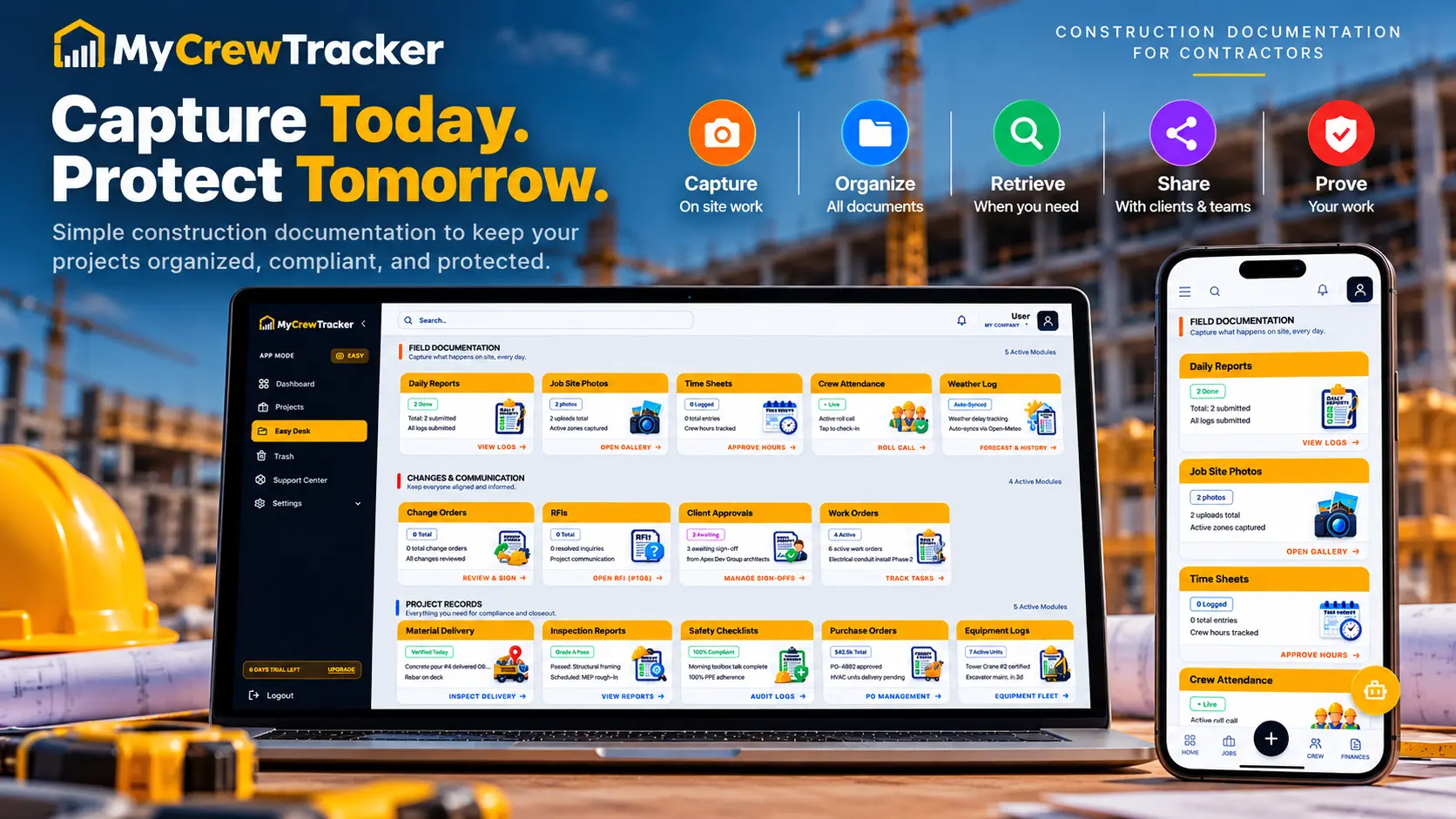
Managing construction projects in Colorado requires extraordinary administrative discipline, largely due to the state's uniquely aggressive financial regulations. For general contractors, poor record-keeping doesn't just result in lost profits—it can result in criminal liability. Colorado is one of the few states where a contractor who fails to pay subcontractors after being paid by the owner can face felony theft charges and treble damages under the Construction Trust Fund Statute. MyCrewTracker provides a centralized, cloud-based platform designed to help Colorado contractors organize, retrieve, and securely retain vital project documentation, establishing a clear paper trail that demonstrates compliance.
The Colorado Construction Trust Fund Statute (C.R.S. § 38-22-127)
The most critical law for Colorado contractors to understand is the Colorado Construction Trust Fund Statute, codified at C.R.S. § 38-22-127. This statute imposes a statutory trust on all funds disbursed to any contractor or subcontractor under any building, construction, or remodeling contract. Those funds must be held in trust for the payment of subcontractors, laborers, and material suppliers who furnished services or supplies on the project.
What This Means in Practice
When an owner pays a general contractor, that money is not the contractor's unrestricted property. It is trust money. It must be used to pay the subcontractors and suppliers who contributed to the project. If a contractor diverts trust funds to other uses—paying overhead, funding a different project, or personal expenses—and then fails to pay a subcontractor, the contractor has committed a violation of the trust fund statute.
Penalties for Violation
The consequences of a trust fund statute violation in Colorado are severe:
- Treble damages — Under C.R.S. § 38-22-127(5), any person who violates the trust fund statute commits theft as defined in C.R.S. § 18-4-401. This exposes the violator to civil liability for three times the amount of the misappropriated funds, plus attorney fees.
- Criminal liability — The theft classification can result in criminal charges depending on the amount involved. Colorado courts have upheld felony theft convictions based solely on trust fund statute violations.
- Non-dischargeable in bankruptcy — Debts arising from trust fund violations are generally non-dischargeable in bankruptcy under 11 U.S.C. § 523(a)(4), meaning the obligation survives even if the contractor files for bankruptcy.
Defenses and Exceptions
The statute contains specific exceptions, including:
- A good-faith belief that a lien or claim is invalid
- Good-faith setoffs
- Circumstances involving qualifying payment or performance bonds
- Written releases from the subcontractor
To navigate these requirements and protect against claims of misappropriation, contractors must maintain immaculate accounting and project documentation. MyCrewTracker's Quick Docs system empowers Colorado contractors to securely store properly dated payment applications, lien waivers, and bank disbursement records in the cloud, helping establish a clear, irrefutable paper trail of how project funds were distributed.
Notice of Intent to File a Lien (C.R.S. § 38-22-109)
Before a mechanics lien can be officially filed in Colorado, the claimant must first serve a formal warning. Under C.R.S. § 38-22-109, a "Notice of Intent to File a Lien Statement" must be served upon the owner (or reputed owner) of the property and the principal contractor at least 10 days before the actual mechanics lien statement is recorded.
What the Notice Must Contain
The notice must be served by certified mail, return receipt requested, and must include:
- A statement that the notice is given pursuant to C.R.S. § 38-22-109(3)
- The name and address of the claimant
- The name and address of the owner or reputed owner
- The name and address of the principal or prime contractor
- A general description of the work performed or materials furnished
- The amount claimed
What Happens If You Miss the 10-Day Window
Because this 10-day notice period must completely expire before the overarching lien filing deadline, timing is critical. If you serve the notice late, you may not have enough time to record the lien statement before the 4-month deadline expires. Unlike some states where a late notice merely shortens the lien period, in Colorado, strict compliance is required. Courts have consistently held that failure to comply strictly with the notice requirement defeats the lien.
Using MyCrewTracker's Daily Reports, contractors can create a verifiable, date-stamped historical record of their last day on the job site, ensuring back-office teams can accurately calculate lien deadlines and securely archive the certified mail receipts for their Notice of Intent.
Colorado Lien Deadlines at a Glance
Missing a single deadline in Colorado can void your lien rights entirely. The table below summarizes the statutory deadlines every Colorado contractor, subcontractor, and material supplier must track.
| Action | Deadline | Statute |
|---|---|---|
| Serve Notice of Intent to File Lien | At least 10 days before recording lien statement | C.R.S. § 38-22-109 |
| Record lien statement (all claimants except day laborers) | Within 4 months after last labor or materials furnished | C.R.S. § 38-22-109 |
| Record lien statement (day laborers) | Within 2 months after last work performed | C.R.S. § 38-22-109 |
| File suit to foreclose lien | Within 6 months after last work performed or completion | C.R.S. § 38-22-110 |
| Retainage cap (private projects over $150,000) | Maximum 5% of completed work | C.R.S. § 38-22-101 |
| Record retention for injury records | 5 years (OSHA); 180 days after injury (workers' comp) | 8 CCR 1507-1; C.R.S. § 8-43-101 |
How to File a Mechanics Lien in Colorado: Step by Step
The process below reflects the standard path for a Colorado subcontractor, supplier, or laborer seeking to preserve and enforce lien rights under Article 22 of Title 38 of the Colorado Revised Statutes.
- Log your last day of work. The 4-month filing clock starts from your last day of substantial work. MyCrewTracker's Daily Reports timestamp this automatically.
- Prepare the Notice of Intent to File a Lien Statement. Include the required content under C.R.S. § 38-22-109(3): claimant name, owner name, contractor name, description of work, and amount claimed.
- Serve the Notice of Intent. Send via certified mail, return receipt requested, to both the property owner (or reputed owner) and the principal contractor. The notice must be served at least 10 days before recording the lien.
- Wait the full 10 days. The 10-day waiting period must completely expire before you can record the lien statement.
- Prepare the verified lien statement. The statement must be sworn and must include: the name of the claimant, the name of the owner, a description of the property, the amount claimed, and the dates labor or materials were furnished.
- Record the lien statement with the County Clerk and Recorder. Colorado mechanics liens are recorded at the county level, not the state. Record in the county where the property is located.
- Serve a copy of the recorded lien on the property owner. Certified mail is recommended.
- File suit to foreclose within 6 months. Under C.R.S. § 38-22-110, you must commence an action to foreclose the lien within 6 months after the last work or labor is performed, or after completion of the building, whichever is later. Record a notice of lis pendens at the same time.
- Preserve all project documentation. Daily reports, delivery tickets, change orders, and photos become evidence in the foreclosure action.
- Consider alternative remedies in parallel. Trust fund statute claims, contract claims, and payment bond claims can run alongside the lien.
Documents to Preserve for a Colorado Lien Claim
Colorado courts require proof that you furnished labor or materials and that they were incorporated into the property. The following records are what you need:
- Signed contract or purchase order with the prime contractor
- Certified mail receipts for the Notice of Intent to File Lien
- Delivery tickets signed by an authorized site representative
- Daily reports showing crew on site and work performed
- Photo evidence of installed work (timestamped and geotagged)
- Jobsite sign-in logs and crew attendance records
- Invoices, statements, and payment applications
- Email or text correspondence about scope and payment
- Change orders and extra work authorizations
- Trust fund accounting records (bank statements, disbursement logs, lien waivers)
- Written demand letters and any response
MyCrewTracker stores all of these in one project record. When a lien deadline approaches, the back office can generate the timeline needed to prepare the verified statement without reconstructing months of field activity.
Colorado-Specific Gotchas
- The Trust Fund Statute is criminal, not just civil. C.R.S. § 38-22-127(5) explicitly states that a violation constitutes theft under C.R.S. § 18-4-401. This is not a technical compliance issue—it is a criminal matter. Contractors have been convicted of felony theft for diverting trust funds. Keep immaculate records of every dollar received and every dollar disbursed.
- The 10-day Notice of Intent is a strict prerequisite. Colorado courts require strict compliance with the notice requirement. Serving the notice late—even by one day—can defeat the lien entirely. Send it early. Send it certified. Keep the green card.
- The 4-month filing deadline is absolute. C.R.S. § 38-22-109 gives you exactly 4 months from your last day of work to record the lien statement. Day laborers have only 2 months. There are no extensions.
- The 6-month foreclosure deadline is absolute. C.R.S. § 38-22-110 gives you exactly 6 months from your last day of work (or completion) to file suit. Set two calendar reminders: one at 4 months, one at 5 months.
- Retainage on private projects is capped at 5%. Under C.R.S. § 38-22-101, as amended by HB 26-1311, private property owners cannot retain more than 5% of a construction contract as retainage if the contract is at least $150,000. Contractors may submit a retainage bond in lieu of having retainage withheld.
- Colorado has a 6-year statute of repose for construction defects. Under C.R.S. § 13-80-104, all actions against contractors, architects, and engineers for construction defects must be brought within 6 years of substantial completion of the improvement. For subcontractors, the clock starts when their scope of work ends. Retain project records for at least 6 years—preferably longer.
- Workers' compensation injury records must be kept. Under C.R.S. § 8-43-101, every employer must keep a record of all employee injuries that result in fatality, permanent physical impairment, lost time from work exceeding 3 shifts or calendar days, or active medical treatment for more than 180 calendar days.
Example Scenario: How Documentation Determines the Outcome
The following is an illustrative scenario, not a specific case. It demonstrates how record-keeping affects outcomes in Colorado lien and trust fund disputes.
Consider a Denver electrical subcontractor on a $500,000 commercial office renovation. The sub's last day of substantial work is July 15. Under C.R.S. § 38-22-109, the sub has 4 months to record a lien. That deadline is November 15. The sub must serve the Notice of Intent to File Lien at least 10 days before recording—so by November 5 at the latest.
The sub serves the Notice of Intent on October 20 via certified mail. The green card returns signed on October 23. The 10-day waiting period expires on November 2. The sub records the lien statement on November 4. A copy is served on the owner on November 6.
Under C.R.S. § 38-22-110, the sub must file suit to foreclose within 6 months of the last day of work. That deadline is January 15. The sub files suit and records a lis pendens on December 10, well within the window. The lien is enforceable.
Now consider the trust fund angle. The general contractor received $450,000 from the owner but only paid the sub $75,000. The GC used the remaining $375,000 to pay overhead on other projects. Under C.R.S. § 38-22-127, the GC held those funds in trust for the sub. The GC's diversion of trust funds to pay unrelated expenses constitutes theft under § 38-22-127(5). The sub can pursue treble damages—$375,000 × 3 = $1,125,000—plus attorney fees. And because the debt arises from a trust fund violation, it is non-dischargeable in bankruptcy.
Documentation is what separates these outcomes. MyCrewTracker logs the last day of work, the notice service date, the disbursement records, and the daily reports that prove performance. When the 4-month deadline approaches, the back office has the complete timeline needed to prepare and record the lien.
How MyCrewTracker Supports Colorado Contractors
Beyond state-specific compliance, general industry practice in Colorado demands rigorous daily documentation to protect your business. MyCrewTracker provides standard tools to help:
- Quick Docs — Upload, organize, and store project files, contracts, trust fund accounting records, and lien notices in one secure cloud environment.
- Daily Reports — Log unpredictable mountain weather, crew size, and site conditions directly from a mobile device.
- RFI & Change Order Tracking — Keep a clear, accessible record of client approvals and RFIs to ensure you get paid for out-of-scope work.
- Photo Management — Capture and date-stamp progress photos to document work quality and site conditions.
- Trust Fund Documentation — Archive bank statements, disbursement logs, and lien waivers to demonstrate compliance with C.R.S. § 38-22-127.
What MyCrewTracker Does (and Does Not Do) in Colorado
MyCrewTracker is a construction documentation platform, not a legal service. Here is what it does for Colorado contractors:
- Logs first day and last day of work per project so you can calculate the 4-month filing window
- Stores certified mail receipts and Notice of Intent documents in the project file
- Records delivery tickets with photo and signature capture
- Captures timestamped, GPS-tagged site photos that document installation
- Generates daily report PDFs that serve as contemporaneous records
- Archives project records for 6+ years to support construction defect defense
- Stores trust fund accounting records to demonstrate compliance with C.R.S. § 38-22-127
It does not draft lien notices, file documents with the County Clerk and Recorder, or provide legal advice. Those steps require a Colorado construction attorney.
❓ Frequently Asked Questions in Colorado
What is the Colorado Construction Trust Fund Statute?
C.R.S. § 38-22-127 generally requires funds disbursed to contractors under building contracts to be held in trust for qualifying subcontractors, laborers, and material suppliers. Violation constitutes theft under C.R.S. § 18-4-401 and exposes the violator to treble damages, attorney fees, and criminal liability. The statute contains specific exceptions, including good-faith setoffs or when payment bonds are present.
What is a Notice of Intent to Lien in Colorado?
Under C.R.S. § 38-22-109, before you can officially record a mechanics lien in Colorado, you must serve a Notice of Intent to File a Lien Statement on the property owner and general contractor at least 10 days prior to filing. The notice must be served by certified mail, return receipt requested. Proper documentation of service dates is critical to preserving your lien rights.
How long do I have to file a mechanics lien in Colorado?
You have 4 months from your last day of work to record a lien statement, except day laborers who have only 2 months. This is set by C.R.S. § 38-22-109.
How long do I have to sue to foreclose an Colorado lien?
You have 6 months from your last day of work (or completion of the building, whichever is later) to file suit to foreclose the lien. This is set by C.R.S. § 38-22-110.
What is the retainage limit in Colorado?
Under C.R.S. § 38-22-101, private property owners cannot retain more than 5% of a construction contract as retainage if the contract is at least $150,000. Contractors may submit a retainage bond in lieu of having retainage withheld.
Does Colorado have a statute of repose for construction defects?
Yes. Under C.R.S. § 13-80-104, all actions against contractors, architects, and engineers for construction defects must be brought within 6 years of substantial completion of the improvement. For subcontractors, the clock starts when their scope of work ends.
What injury records must I keep in Colorado?
Under C.R.S. § 8-43-101, every employer must keep a record of all employee injuries that result in fatality, permanent physical impairment, lost time from work exceeding 3 shifts or calendar days, or active medical treatment for more than 180 calendar days. OSHA also requires Forms 300, 300A, and 301 to be retained for 5 years.
Can I file a Colorado lien without a written contract?
Yes, but the burden of proof is higher. You must demonstrate that you furnished labor or materials that were incorporated into the property, and that the owner consented to the improvement. Daily reports, delivery tickets, and signed site logs become your primary evidence.
Does MyCrewTracker automate Trust Fund accounting?
No. MyCrewTracker is a secure document storage and project organization platform. While it is the perfect place to archive copies of your invoices, lien waivers, and payment applications to demonstrate compliance with the Trust Fund statute, you must still use dedicated accounting software (like QuickBooks) to manage the actual financial ledgers.
Can MyCrewTracker generate my Colorado lien notices?
No. MyCrewTracker is a document organization platform. It helps you track your project start dates, store notices, and preserve the records you will need. You must manually draft and serve your notices with the assistance of a licensed Colorado construction attorney.
Legal Sources & References
-
Construction Trust Fund Statute C.R.S. § 38-22-127
Colorado Trust Fund Statute — Funds disbursed to contractors must be held in trust for subcontractors, laborers, and material suppliers. Violation constitutes theft under C.R.S. § 18-4-401, exposing the violator to treble damages and criminal liability.
-
Notice of Intent to File Lien Statement C.R.S. § 38-22-109
Colorado Mechanics Lien — Notice of Intent must be served on the owner and principal contractor at least 10 days before recording the lien statement. Lien statement must be recorded within 4 months (2 months for day laborers) after last work.
-
Lien Foreclosure Deadline C.R.S. § 38-22-110
Colorado Lien Enforcement — Suit to foreclose a mechanics lien must be commenced within 6 months after the last work or labor is performed, or after completion of the building, whichever is later.
-
Retainage Limit on Private Projects C.R.S. § 38-22-101
Colorado Retainage Law — Private property owners cannot retain more than 5% of a construction contract as retainage if the contract is at least $150,000. Contractors may submit a retainage bond in lieu of having retainage withheld.
-
Construction Defect Statute of Repose C.R.S. § 13-80-104
Colorado Statute of Repose — All actions against contractors, architects, and engineers for construction defects must be brought within 6 years of substantial completion of the improvement.
-
Record of Injuries C.R.S. § 8-43-101
Colorado Workers' Compensation — Every employer must keep a record of all employee injuries resulting in fatality, permanent impairment, lost time exceeding 3 shifts, or medical treatment exceeding 180 days.
-
Colorado General Assembly General Reference
Official Colorado General Assembly website — Searchable index of all Colorado Revised Statutes.
Protect Your Projects & Retain Required Colorado Records
Defend against back-charges, audit penalties, and mechanic's lien disputes. Keep GPS-timestamped photos, certified timesheets, and signed change orders safely backed up for just $40/month.