

Understanding Requests for Information (RFIs)
A Request for Information (RFI) is a formal document used to clarify design intent, specifications, or unforeseen site conditions. It bridges the gap between the field team and the design team (the Architect of Record or Engineers), ensuring work proceeds accurately and safely without guesswork. Instead of informal texts or phone calls, an RFI provides a legal paper trail protecting contractors from liability if a design change impacts the budget or schedule. If an architect delays their response, this formal documentation is critical for issuing a Notice of Delay and protecting your project timeline.
Key Information to Include
A well-drafted RFI eliminates ambiguity. When creating an RFI, ensure your team includes the following standard fields:
Standard RFI Form Structure
- Project Name & Address: _______________________
- RFI Number: #_______ Date Submitted: _________
- To (Architect/Engineer): _______________________
- Reference Material: (Drawing #, Detail #, or Spec Section)
- Question / Issue: (A clear, concise description of the conflict or missing information.)
- Proposed Solution: (Suggesting a fix saves time and shows proactive management.)
- Schedule / Cost Impact: (Will this delay the job or cost extra? Check Yes/No)
- Response Date Required By: _________
- Official Response: _______________________
- Signatures: (Submitted by, Responded by)
✨ Benefits of Digital Tracking
- Faster Answers: Structured questions lead to quicker, clearer responses from the design team.
- Clear Liability Documentation: Maintains a legal record of design clarifications, protecting you from disputes.
- Change Order Prevention: Clarifying details early can prevent the need for costly change orders later. If an RFI does increase scope, it serves as the foundation for that change order.
Best Practices & Workflow
The Standard RFI Workflow
The lifecycle of an RFI follows a strict sequence: the subcontractor or field superintendent identifies an issue and submits the RFI to the General Contractor. The GC reviews it and forwards it to the Architect or Engineer of Record. The design team provides a resolution, which flows back down to the field. If this resolution alters the contract scope, a Change Order Request (COR) must be generated.
Managing an RFI Log
While drafting a single RFI is straightforward, tracking 50 open RFIs across multiple projects is where contractors lose money. An RFI Log is a master tracking sheet used to monitor the status, response deadlines, and cost impacts of all open RFIs on a project. Without an organized RFI Log, overdue responses slip through the cracks, delaying field crews and eating into your profit margins.
The MyCrewTracker Advantage
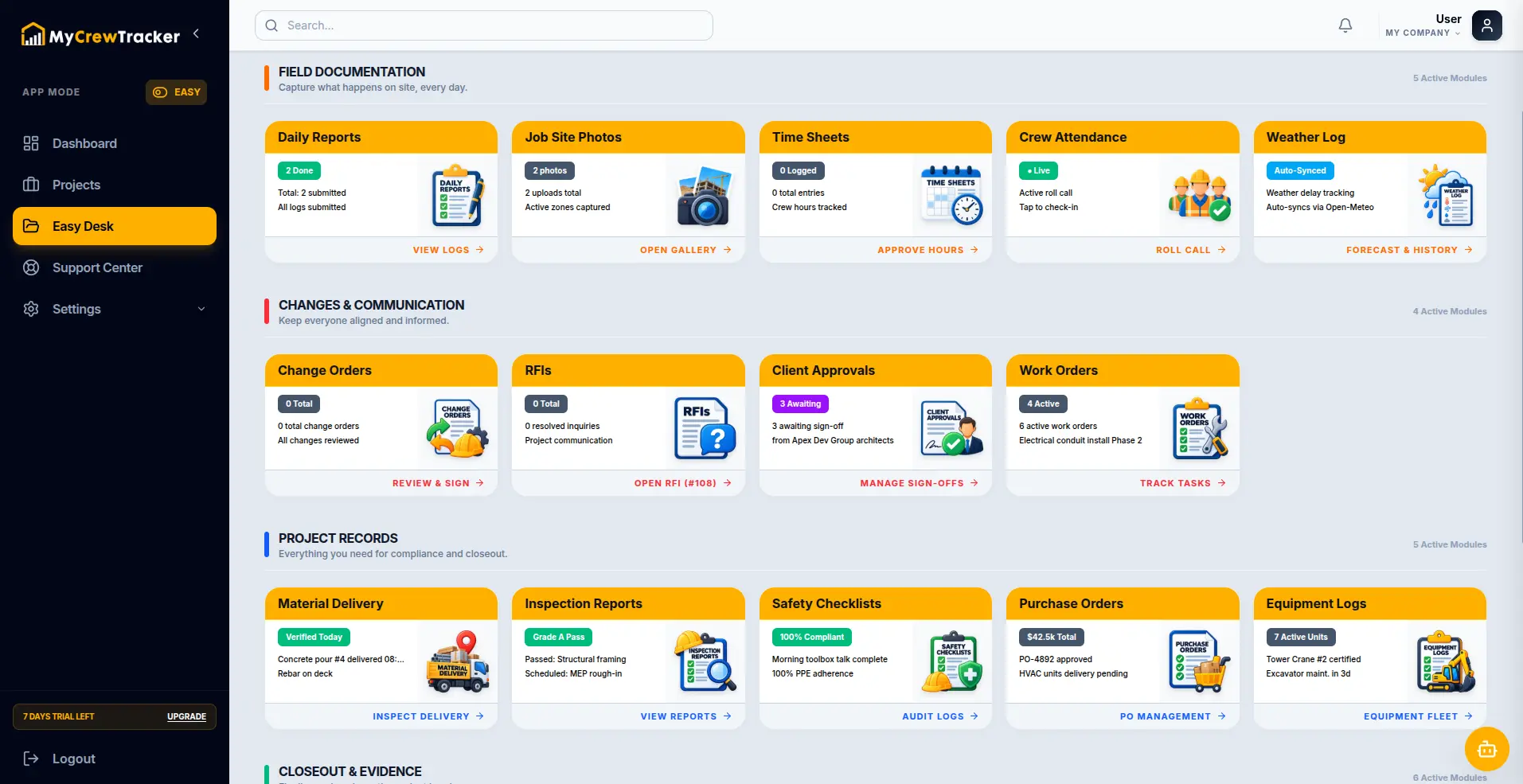
While the downloadable template works for very small jobs, manually managing an RFI Log in Excel quickly becomes a nightmare. MyCrewTracker digitizes this entire RFI management workflow.
Instead of losing questions in email threads, field crews can draft an RFI on-site directly from their mobile device, attach photos of the field condition, and automatically log the status in a centralized dashboard. This ensures nothing falls through the cracks and seamlessly connects with your document management hub.
Download Templates
 Download PDF Template
 Download Excel Log
❓ Frequently Asked Questions
What is an RFI in construction?
An RFI (Request for Information) is a formal document used in construction to clarify missing, conflicting, or ambiguous information in the project blueprints or specifications.
How do you write a construction RFI?
To write an effective RFI, clearly state the problem, reference the specific drawing or specification, suggest a practical field solution, and request a deadline for the response to avoid schedule delays.
What is the standard RFI process?
The process typically flows from the subcontractor or field team to the general contractor, who then submits it to the architect or engineer for a formal design clarification.
Are RFIs considered contract documents?
No, an RFI itself is typically not a contract document. However, if the answer to an RFI changes the scope of work, cost, or schedule, it must be formalized into a Change Order to become part of the binding contract.
What is the difference between an RFI and a Submittal?
An RFI asks a question about the design or seeks clarification. A Submittal provides material samples, product data, or shop drawings to prove that the contractor's planned work matches the design specifications.
What is a construction RFI Log?
A construction RFI Log is a master tracking sheet used by project managers to monitor the status, response deadlines, and potential cost impacts of all open RFIs on a project to prevent schedule delays.