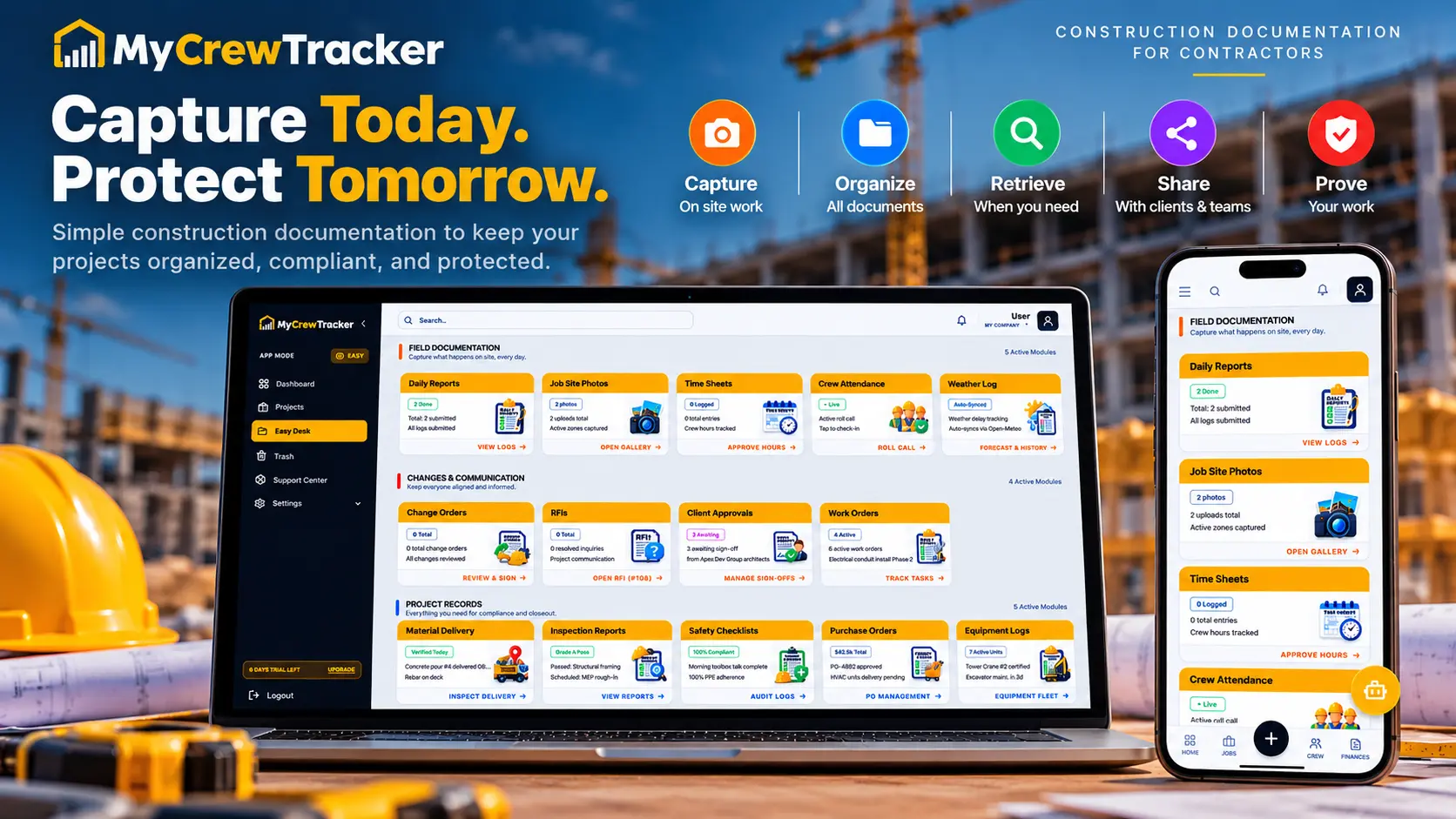
Delaware's construction industry is experiencing steady growth, with significant activity in commercial developments, infrastructure projects, and residential expansions. Managing documentation for these projects—such as tracking mechanics liens, navigating retainage requirements, and handling prompt payment terms—can quickly become complex. Delaware does not require a preliminary notice, but its 120-day and 180-day lien filing deadlines are strict, its Prompt Payment Act imposes a 30-day owner deadline and 15-day subcontractor deadline, and a construction trust fund statute creates fiduciary duties for funds received. Missing a deadline can jeopardize legal rights and payments. MyCrewTracker provides a centralized, cloud-based platform designed to help Delaware contractors organize, retrieve, and securely retain vital project documentation. By moving away from scattered paper files and disorganized email threads, your team can maintain a single source of truth for all job site records, invoices, and change orders.
Delaware Mechanics Lien Act (25 Del. C. § 2701 et seq.)
1. No Statutory Preliminary Notice Required
Unlike many other states, Delaware does not have a statutory requirement for contractors, subcontractors, or suppliers to send a formal preliminary notice to preserve mechanics lien rights. No party in Delaware is legally required to serve a Notice of Intent to Lien prior to recording a mechanics lien.
However, under 25 Del. C. § 2705, property owners have the right to request a written list of all persons who have furnished labor or materials from the general contractor or subcontractor. If requested, this list must be provided within 10 days, or the contractor/subcontractor risks losing their lien rights.
2. Mechanics Lien Filing Deadlines
Delaware mechanics lien laws enforce strict deadlines based on the party's relationship to the project:
- General/Prime Contractors (Direct Contract with Owner): Must file their statement of claim within 180 days after the completion of the structure. The 180-day period is measured from any of nine alternative triggering events, including the date of purported completion as provided in the contract, the date payment of 90% of the contract price is received, the date the contractor submits its final invoice, the date a certificate of occupancy is issued, or the date permanent financing is completed.
- Subcontractors and Suppliers (No Direct Contract with Owner): Must file their statement of claim within 120 days from the date of completion of the labor performed or from the last delivery of materials furnished. The 120-day period is measured from either the date final payment (including retainage) is due, or the date final payment is made to the contractor with whom the subcontractor has a contract.
Delaware courts strictly construe mechanics lien statutes, so exact compliance with procedures and deadlines is mandatory. A statement of claim for mechanics lien that fails to comply with the technical requirements of 25 Del. C. Chapter 27 may be dismissed.
3. Lien Enforcement Deadline
An action to enforce a mechanics lien in Delaware is incorporated with the lien filing itself. Filing the Statement of Claim in Superior Court commences the action. The claimant must then furnish a Writ of Scire Facias, which the sheriff serves on the owner along with a copy of the Statement of Claim. The enforcement deadline for prime or direct contractors is the same 180 days as the filing deadline, and for subcontractors and suppliers it is 120 days.
Delaware Prompt Payment Act (6 Del. C. § 3501 et seq.)
Delaware distinguishes between private and public projects regarding retainage and prompt payment.
Private Projects
The Delaware Prompt Payment Act (6 Del. C. § 3501 et seq.) requires owners to pay prime contractors within 30 days of the end of the billing period or 30 days after delivery of the invoice, whichever is later. Contractors must pay subcontractors within 15 days of receiving payment. The Act provides that interest and legal fees may be awarded where payments are not made promptly.
Importantly, under 6 Del. C. § 3502, all moneys or funds received by a contractor in connection with a contract for the erection, construction, completion, alteration, or repair of any building are trust funds in the hands of the contractor. These funds must be applied first to the payment of all moneys due and owing to persons furnishing labor or material. A general contractor holds payments covering subcontracting work as a trustee and is prohibited from using the funds for its own purposes.
Public Projects
Under Delaware procurement law (29 Del. C. § 6962), retainage is generally capped at 5%. When the project reaches 50% completion, the contractor may request that the retainage be reduced to 2% after an interim evaluation. Progress payments are typically due 21 days after a work estimate is certified, and final payment is due 60 days after final completion. Once a prime contractor is paid, they must pay subcontractors within 21 days.
Delaware Statute of Repose (10 Del. C. § 8127)
Delaware's Statute of Repose provides a definitive cutoff for construction-related claims. Under 10 Del. C. § 8127, claims related to deficiencies in construction, design, planning, or supervision must be brought within 6 years after the applicable triggering date.
The statute eliminates a cause of action after six years from substantial completion of construction, regardless of whether an action has accrued. This acts as an absolute bar to claims beyond the 6-year period, regardless of when the defect was discovered. This differs from a statute of limitations, which may dictate a shorter window to sue once an issue is actually discovered.
Delaware Lien Deadlines at a Glance
| Action | Deadline | Statute |
|---|---|---|
| Owner Request List of Laborers/Suppliers | Within 10 days of request | 25 Del. C. § 2705 |
| File Statement of Claim (Prime Contractor) | Within 180 days of completion | 25 Del. C. § 2711(a) |
| File Statement of Claim (Subcontractor/Supplier) | Within 120 days of last furnishing | 25 Del. C. § 2711(b) |
| Enforce Lien (Writ of Scire Facias) | Same as filing deadline (120/180 days) | 25 Del. C. § 2711 |
| Private Project — Owner Pay Prime Contractor | Within 30 days of billing period/invoice | 6 Del. C. § 3501 |
| Private Project — Prime Pay Subcontractor | Within 15 days of receiving payment | 6 Del. C. § 3501 |
| Public Project — Progress Payments | Within 21 days of certified estimate | 29 Del. C. § 6962 |
| Public Project — Final Payment | Within 60 days of final completion | 29 Del. C. § 6962 |
| Public Project — Prime Pay Subcontractor | Within 21 days of receiving payment | 29 Del. C. § 6962 |
| Public Project Retainage Cap | 5% (reduced to 2% at 50% completion) | 29 Del. C. § 6962 |
| Construction Defect Statute of Repose | 6 years from substantial completion | 10 Del. C. § 8127 |
Documents to Preserve for a Delaware Lien Claim
Delaware courts require strict compliance with the statutory requirements of Chapter 27. The following records are what you need:
- Signed contract or purchase order with the prime contractor
- Proof of service of any Notice of Intent to Lien (optional but recommended)
- Delivery tickets signed by an authorized site representative
- Daily reports showing crew on site and work performed
- Photo evidence of installed work (timestamped and geotagged)
- Jobsite sign-in logs and crew attendance records
- Invoices, statements, and payment applications
- Email or text correspondence about scope and payment
- Change orders and extra work authorizations
- Copy of the filed Statement of Claim with Superior Court stamp
MyCrewTracker stores all of these in one project record. When a lien deadline approaches, the back office can generate the timeline needed to prepare the Statement of Claim without reconstructing months of field activity.
Delaware-Specific Gotchas
No preliminary notice is required — but optional notice is still valuable. Unlike most states where a preliminary notice protects all work from the start of a project, Delaware does not require any pre-lien notice. However, serving a Notice of Intent to Lien is still a best practice that can encourage payment before filing a formal lien.
The 120-day and 180-day deadlines differ by role. Prime contractors who contract directly with the owner have 180 days from completion to file. Subcontractors and suppliers have only 120 days from last furnishing. Confusing these two deadlines is one of the most common errors.
The 180-day period has nine alternative triggers. Under 25 Del. C. § 2711(a), the 180-day clock can start from any of nine events, including the date of purported completion, the date 90% of the contract price is received, the date the final invoice is submitted, the date a certificate of occupancy is issued, or the date permanent financing is completed. Determining which trigger applies requires careful review of the contract.
The writ of scire facias is mandatory. Filing the Statement of Claim commences the action, but the claimant must also furnish a Writ of Scire Facias for the sheriff to serve on the owner. Failure to properly serve the writ can invalidate the lien.
Construction trust funds create fiduciary duties. Under 6 Del. C. § 3502, funds received by a contractor are trust funds. Misappropriation of these funds can result in a constructive trust being imposed on the contractor's property and may constitute a breach of fiduciary duty.
Public works retainage is capped at 5%. Under 29 Del. C. § 6962, retainage on public works contracts is generally capped at 5%, with an option to reduce to 2% after 50% completion.
Private projects have no statutory retainage cap. Delaware does not provide a retainage statute for private projects, so the amount is strictly governed by the contract between the parties.
Construction defect statute of repose is six years. Under 10 Del. C. § 8127, no action may be brought for construction defects more than 6 years after substantial completion. This is an absolute bar to claims. Retain project records for at least 6 years.
Example Scenario: How Documentation Determines the Outcome
*The following is an illustrative scenario, not a specific case. It demonstrates how record-keeping affects outcomes in Delaware lien disputes.*
Consider a Wilmington mechanical subcontractor on a $600,000 commercial office renovation. The sub first furnishes labor on March 1. The sub's last day of substantial work is August 15.
Under 25 Del. C. § 2711(b), the sub has 120 days from August 15 to file the Statement of Claim with the Superior Court. That deadline is December 13. The sub files the Statement of Claim on December 5 and furnishes the Writ of Scire Facias for service on December 8.
Under 6 Del. C. § 3501, the general contractor received a $500,000 progress payment from the owner on July 1. The GC had 15 days to pay the sub — by July 16. The GC failed to pay. The sub is entitled to interest and legal fees under the Prompt Payment Act.
Now consider the same sub who also recorded a construction lien. Under 6 Del. C. § 3502, the funds received by the GC for the sub's work were held in trust. The GC's failure to pay the sub constitutes a breach of fiduciary duty, and the sub can pursue a constructive trust claim in addition to the mechanics lien.
Documentation is what separates these outcomes. MyCrewTracker logs the first day of work, the last day of work, the filing date, and the daily reports that prove performance.
What MyCrewTracker Does (and Does Not Do) in Delaware
MyCrewTracker is a construction documentation platform, not a legal service. Here is what it does for Delaware contractors:
- Logs first day and last day of work per project so you can calculate the 120-day or 180-day lien filing window
- Stores certified mail receipts and optional Notice of Intent to Lien documents in the project file
- Records delivery tickets with photo and signature capture
- Captures timestamped, GPS-tagged site photos that document installation
- Generates daily report PDFs that serve as contemporaneous records
- Tracks payment application dates for Prompt Payment Act compliance
- Archives project records for 6+ years to support construction defect defense
What MyCrewTracker Does NOT Do: We do not provide legal advice, draft mechanics liens, or file legal documents on your behalf. Corporations must generally be represented by an attorney in Delaware Superior Court.
❓ Frequently Asked Questions in Rhode Island
Do I need to send a preliminary notice in Delaware?
No, Delaware does not require a standard preliminary notice. However, if a property owner demands a list of all laborers and suppliers, you must provide it within 10 days to protect your lien rights.
How long do I have to file a mechanics lien as a subcontractor?
Subcontractors and suppliers must file their statement of claim within 120 days of the last date they provided labor or materials.
What is the mechanics lien deadline for general contractors?
General contractors have up to 180 days after the completion of the structure to file a lien. The 180-day period is measured from any of nine alternative triggering events.
How long do I have to enforce a mechanics lien in Delaware?
The enforcement deadline is incorporated with the lien filing itself. You must file the Statement of Claim within the applicable deadline (120 or 180 days) and then furnish a Writ of Scire Facias for service on the owner.
Can I include retainage in my mechanics lien claim?
Yes, if retainage was withheld and you are owed the funds upon completion of your work, you can typically include the unpaid retainage in your mechanics lien claim.
What is the maximum retainage allowed on private projects in Delaware?
There is no statutory cap on retainage for private construction projects in Delaware. The retainage amount is strictly governed by the contract between the parties.
What are the prompt payment requirements for private projects?
Owners must pay prime contractors within 30 days of the end of the billing period or delivery of the invoice, whichever is later. Prime contractors must pay subcontractors within 15 days of receiving the owner's payment.
What are the prompt payment requirements for public projects?
Progress payments are due within 21 days of a certified estimate. Final payment is due within 60 days of final completion. Prime contractors must pay subcontractors within 21 days of receiving payment.
How long is Delaware's statute of repose for construction defects?
Delaware has a 6-year statute of repose under 10 Del. C. § 8127. Lawsuits for construction defects must be brought within 6 years of substantial completion.
Does Delaware have a construction trust fund statute?
Yes. Under 6 Del. C. § 3502, all moneys received by a contractor on a construction project are trust funds held for the benefit of subcontractors and suppliers. Misappropriation can result in a constructive trust and breach of fiduciary duty claims.
Can MyCrewTracker automatically calculate my Delaware lien deadlines?
No. MyCrewTracker is a secure document storage and organization platform. While it provides the tools you need to record your project start dates and store your certified mail receipts, you must manually calculate your deadlines or consult with a Delaware construction attorney to ensure compliance.
Legal Sources & References
-
Mechanics' Liens — Improvements by Consent of Owner R.I. Gen. Laws § 34-28-1
Rhode Island Mechanics' Lien Act — Establishes the right to a lien for labor and materials furnished for property improvement. Contract provisions barring enforcement of lien rights are void as against public policy.
-
Notice of Intention to Claim Lien R.I. Gen. Laws § 34-28-4
Rhode Island Lien Filing — The notice of intention must be mailed by certified mail and recorded in the land evidence records within 200 days of doing work or furnishing materials. The lien is effective only for work done within the 200 days prior to filing.
-
Contractors — Notice of Possible Mechanic's Lien R.I. Gen. Laws § 34-28-4.1
Rhode Island Notice of Possible Mechanic's Lien — Contractors contracting directly with the owner must give notice prior to commencing work or delivery of materials, either incorporated in the written contract or sent by certified mail.
-
Complaint to Enforce Lien — Lis Pendens Notice R.I. Gen. Laws § 34-28-10
Rhode Island Lien Enforcement — The complaint and notice of lis pendens must be filed within 40 days of recording the notice of intention. The complaint must be filed on the same day as the lis pendens or within 7 days thereafter.
-
Retainers Relating to Contracts for Public Works R.I. Gen. Laws § 37-12-10
Rhode Island Public Works Retainage — The awarding authority may deduct a retention not exceeding 5% of the contract price to secure satisfactory performance of the contractual work.
-
Prompt Payment by Department of Administration — Determination of Eligibility for Payment of Interest R.I. Gen. Laws § 42-11.1-5
Rhode Island Prompt Payment Act — State agencies must make contract payments within 30 working days after receipt of an invoice, with interest accruing on late payments.
-
Constructors of Improvements to Real Property — Immunity from Liability R.I. Gen. Laws § 9-1-29
Rhode Island Statute of Repose — No tort action may be brought against architects, engineers, contractors, subcontractors, or material suppliers more than 10 years after substantial completion of the improvement.
-
Contractors' Registration and Licensing Board R.I. Gen. Laws § 5-65-1
Rhode Island Contractors' Registration — Defines retainage and claim for retainage for construction contracts.
-
Rhode Island General Assembly — General Laws General Reference
Official Rhode Island General Assembly website — Searchable index of all Rhode Island General Laws.
Ready to organize your jobs?
Join contractors in Rhode Island using MyCrewTracker.