Contractors operating in Washington State face a unique set of regulatory challenges, particularly regarding mechanics liens and public works retainage. The state’s lien law is built around a 60-day look-back rule for commercial projects and a 10-day look-back rule for new single-family residential construction. Public works projects impose a mandatory 5% retainage held in trust, and a six-year statute of repose bars construction defect claims. Successfully managing these projects requires aggressive document organization and meticulous tracking of site activities.
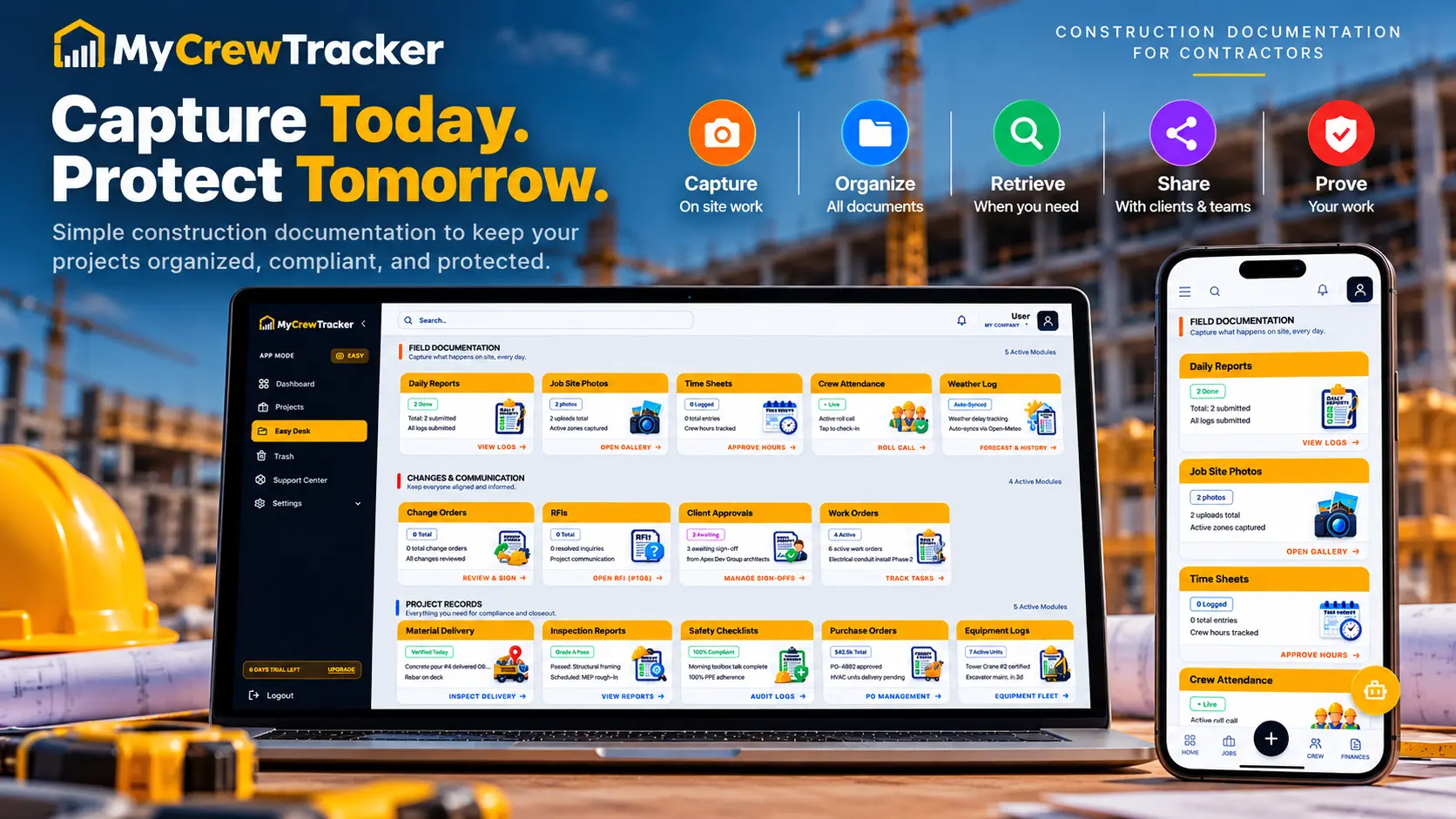
MyCrewTracker provides a centralized, cloud-based platform designed to help Washington contractors organize, retrieve, and securely retain vital project documentation. By moving away from scattered paper files and disorganized email threads, your team can maintain a single source of truth for all job site records, lien notices, and change orders.
Notice of Right to Claim Lien Requirements (RCW 60.04.031)
In Washington State, preserving your right to file a mechanics lien requires proactive documentation. Under RCW 60.04.031, every person furnishing professional services, materials, or equipment for the improvement of real property shall give the owner or reputed owner notice in writing of the right to claim a lien. If the prime contractor is in compliance with RCW 19.27.095, 60.04.230, and 60.04.261, this notice shall also be given to the prime contractor unless the potential lien claimant has contracted directly with the prime contractor.
The 60-Day Commercial Look-Back Rule
For most commercial and new residential projects, the notice may be given at any time, but only protects the right to claim a lien for professional services, materials, or equipment supplied after the date which is sixty days before the notice is mailed or personally served. This means if you serve the notice late, you lose lien rights for the work performed in the 60 days preceding the notice. The notice must be sent by certified or registered mail to the owner or reputed owner, or delivered personally with evidence of delivery in the form of a receipt or other acknowledgment signed by the owner or an affidavit of service.
The 10-Day Residential Look-Back Rule
In the case of new construction of a single-family residence, the notice of a right to claim a lien may be given at any time but only protects the right to claim a lien for professional services, materials, or equipment supplied after a date which is ten days before the notice is given. This 10-day window is significantly shorter than the commercial 60-day rule and requires immediate action from residential contractors.
Who Is Exempt From the Notice Requirement?
Under RCW 60.04.031(2), notices of a right to claim a lien shall not be required of: (a) persons who contract directly with the owner or the owner’s common law agent; (b) laborers whose claim of lien is based solely on performing labor; or (c) subcontractors who contract for the improvement of real property directly with the prime contractor, except as provided in subsection (3)(b).
Because the timing of the notice dictates which prior work is protected, establishing exactly when work occurred is critical. MyCrewTracker assists Washington contractors by using Daily Reports to establish a verifiable, date-stamped record of job site activities, ensuring your back office has the accurate dates needed to manage lien claim protections and store delivery receipts securely.
Washington Lien Deadlines at a Glance
Missing a single deadline in Washington can void your lien rights entirely. The table below summarizes the statutory deadlines every Washington contractor, subcontractor, and material supplier must track.
| Action | Deadline | Statute |
|---|---|---|
| Serve Notice of Right to Claim Lien (commercial) | Protects work performed 60 days before notice and after | RCW 60.04.031 |
| Serve Notice of Right to Claim Lien (new single-family residential) | Protects work performed 10 days before notice and after | RCW 60.04.031 |
| Record Notice of Claim of Lien | Within 90 days after ceasing to furnish labor, materials, or equipment | RCW 60.04.091 |
| File suit to foreclose lien | Within 8 calendar months after recording the lien claim | RCW 60.04.141 |
| Serve foreclosure action on property owner | Within 90 days of filing the action | RCW 60.04.141 |
| Public works retainage | 5% of moneys earned, held in trust | RCW 60.28.011 |
| Public works retainage release | 60 days after completion of all contract work | RCW 60.28.011 |
| Notice of lien against retainage fund | Within 45 days after completion of project | RCW 60.28.011 |
| Construction defect statute of repose | 6 years from substantial completion | RCW 4.16.310 |
How to File a Mechanics Lien in Washington: Step by Step
1. Log your first day of work. The 60-day commercial or 10-day residential look-back period starts from your first day of furnishing labor or materials. MyCrewTracker’s Daily Reports timestamp this automatically.
2. Serve the Notice of Right to Claim Lien. Under RCW 60.04.031, serve the notice on the owner or reputed owner by certified mail or personal delivery. Remember: the notice only protects work performed in the 60 days (commercial) or 10 days (new single-family residential) before service and after.
3. Track the last day of work. Washington’s 90-day recording clock starts from the date you cease to furnish labor, professional services, materials, or equipment.
4. Record the Notice of Claim of Lien with the County Recorder. Under RCW 60.04.091, the claim must include the name, phone number, and address of the claimant; the first and last date of furnishing; the name of the person indebted; a property description; the name of the owner; and the principal amount claimed.
5. File suit to foreclose within 8 months. Under RCW 60.04.141, an action to enforce the lien must be filed in the superior court within eight calendar months after the claim of lien has been recorded.
6. Serve the foreclosure action on the property owner within 90 days. Under RCW 60.04.141, service must be made upon the owner of the subject property within ninety days of the date of filing the action.
7. Preserve all project documentation. Daily reports, delivery tickets, change orders, and photos become evidence in the enforcement action.
Documents to Preserve for a Washington Lien Claim
Washington courts require proof that you furnished labor or materials and that they were incorporated into the property. The following records are what you need:
- Signed contract or purchase order with the prime contractor
- Proof of service of the Notice of Right to Claim Lien
- Delivery tickets signed by an authorized site representative
- Daily reports showing crew on site and work performed
- Photo evidence of installed work (timestamped and geotagged)
- Jobsite sign-in logs and crew attendance records
- Invoices, statements, and payment applications
- Email or text correspondence about scope and payment
- Change orders and extra work authorizations
- Copy of the recorded Claim of Lien with county recorder stamp
MyCrewTracker stores all of these in one project record. When a lien deadline approaches, the back office can generate the timeline needed to prepare the lien claim without reconstructing months of field activity.
Washington-Specific Gotchas
The 60-day commercial look-back rule is the biggest trap. Unlike most states where a preliminary notice protects all work from the start of the project, Washington’s Notice of Right to Claim Lien only protects work performed in the 60 days before service and all work after. If you serve the notice on day 90, you lose lien rights for the first 30 days of work.
The 10-day residential rule is even shorter. For new construction of a single-family residence, the look-back period is only 10 days. This requires immediate action from residential contractors who may not have even mobilized fully before the notice deadline passes.
The 90-day recording deadline is absolute. RCW 60.04.091 gives you exactly 90 days from your last day of furnishing to record the Notice of Claim of Lien with the county recorder. There are no extensions.
The 8-month foreclosure deadline is absolute. RCW 60.04.141 gives you exactly eight calendar months from recording the lien to file suit to foreclose. You must also serve the property owner within 90 days of filing the action. Set two calendar reminders: one at 6 months, one at 7 months.
Public works retainage is 5% and held in trust. Under RCW 60.28.011, public improvement contracts must reserve a retainage not to exceed 5% of the moneys earned by the contractor as a trust fund for the protection and payment of claims.
Retainage must be released within 60 days. Under RCW 60.28.011(3)(a), sixty days after completion of all contract work, the public agency must release and pay in full the amounts retained.
Lien against retainage requires 45-day notice. If a subcontractor or supplier has a claim against the retainage, it must provide written notice to the public agency holding the funds no later than 45 days after completion of the project.
Construction defect statute of repose is six years. Under RCW 4.16.310, all claims or causes of action arising from construction, design, or engineering of any improvement upon real property that have not accrued within six years after substantial completion of construction shall be barred. Retain project records for at least six years.
Trust funds for residential construction. Under Washington law, for the construction, alteration, or repair of any single-family residence or garage, funds received by an owner from a construction lender or by a contractor or subcontractor from an owner or general contractor are held in trust for the benefit of contractors, subcontractors, laborers, or suppliers until payment is made.
Example Scenario: How Documentation Determines the Outcome
*The following is an illustrative scenario, not a specific case. It demonstrates how record-keeping affects outcomes in Washington lien disputes.*
Consider a Seattle mechanical subcontractor on a $600,000 commercial office renovation. The sub first furnishes labor on March 1. The sub serves the Notice of Right to Claim Lien on April 15. Under RCW 60.04.031, the notice only protects work performed in the 60 days before April 15 — that is, from February 14 onward — plus all future work. The sub loses lien rights for the work performed from March 1 to March 15, a total of 15 days.
If the sub had served the notice on March 10, the notice would have protected work from January 9 onward — covering the entire project from day one.
Now consider the same sub who records the Claim of Lien on August 15. Under RCW 60.04.141, the sub has eight months from August 15 to file suit to foreclose. That deadline is April 15 of the following year. The sub files suit on February 1 and serves the property owner on March 1 — well within the 90-day service requirement. The lien is enforceable.
Documentation is what separates these outcomes. MyCrewTracker logs the first day of work, the notice service date, the recording date, and the daily reports that prove performance.
Washington Public Works Retainage Rules (RCW 60.28.011)
Washington has strict regulations governing retainage on public works projects. Under RCW 60.28.011, public agencies are required to reserve a contract retainage not to exceed 5% of the moneys earned by the contractor. These funds are held in trust to ensure the completion of the project and the payment of all subcontractors, suppliers, and state taxes.
What the Retainage Law Requires
- 5% cap: Retainage on public improvement contracts is capped at 5% of moneys earned
- Trust fund status: Retainage funds are held in trust for the protection and payment of subcontractors and suppliers
- 60-day release: The public agency must release and pay in full the amounts retained sixty days after completion of all contract work
- 45-day notice for claims: A subcontractor or supplier with a claim against the retainage must provide written notice to the public agency no later than 45 days after completion of the project
- Four-month foreclosure deadline: A claimant has four months from providing notice to file suit to foreclose on the lien against the retainage fund
General contractors must diligently track when a public project reaches final acceptance to petition for the release of these retained funds. Relying on disorganized spreadsheets to track 5% holdbacks across dozens of active projects often leads to delayed cash flow. MyCrewTracker offers a secure cloud repository where Washington contractors can organize payment applications, final acceptance certificates, and subcontractor releases to expedite the retainage recovery process.
Washington Construction Trust Fund Provisions
Washington law imposes trust fund obligations on construction payments in specific circumstances. Under Washington’s trust fund provisions, for the construction, alteration, or repair of any single-family residence or garage, funds received by an owner from a construction lender or by a contractor or subcontractor from an owner or general contractor are held in trust for the benefit of contractors, subcontractors, laborers, or suppliers they employ or from whom they receive material until payment is made according to the contract price.
What the Trust Fund Statute Requires
- Construction funds received for single-family residential projects must be used for the payment of downstream parties
- The funds are not part of the estate of the person or entity holding them as a trustee
- Corporate officers of the prime contractor are personally liable for indemnification of owners in the event a lien claim is made against the property as a result of the prime contractor’s failure to pay amounts due
To defend against claims of misappropriation, contractors must maintain immaculate accounting and project documentation. Using MyCrewTracker’s Quick Docs system, contractors can securely store properly dated payment applications, lien waivers, and bank disbursement records in the cloud, helping establish a clear paper trail of how project funds were distributed.
Washington Construction Defect Statute of Repose (RCW 4.16.310)
Under RCW 4.16.310, all claims or causes of action arising from construction, design, or engineering of any improvement upon real property that have not accrued within six years after substantial completion of construction shall be barred. This is an absolute bar — it is a statute of repose, not a statute of limitations.
What This Means for Washington Contractors
- The six-year period runs from substantial completion of the project, not from the date of discovery of the defect
- If a cause of action does not accrue within the six-year period, no lawsuit can ever be brought — the statute of limitations never even begins to run
- Retain project records for at least six years to defend against construction defect claims
What MyCrewTracker Does (and Does Not Do) in Washington
MyCrewTracker is a construction documentation platform, not a legal service. Here is what it does for Washington contractors:
- Logs first day and last day of work per project so you can calculate the 60-day commercial or 10-day residential look-back period and the 90-day recording window
- Stores certified mail receipts and Notice of Right to Claim Lien documents in the project file
- Records delivery tickets with photo and signature capture
- Captures timestamped, GPS-tagged site photos that document installation
- Generates daily report PDFs that serve as contemporaneous records
- Tracks retainage and payment dates for public works retainage compliance
- Archives project records for 6+ years to support construction defect defense
It does not draft Notices of Right to Claim Lien, record Claims of Lien with the county recorder, or provide legal advice. Those steps require a Washington construction attorney.
❓ Frequently Asked Questions in Washington
What is the Notice of Right to Claim Lien in Washington?
Under Washington RCW 60.04.031, the notice may be given at any time, but generally protects the right to claim a lien for services or materials supplied after the date 60 days before the notice is given. For new construction of a single-family residence, it protects services or materials supplied after the date 10 days before the notice is given.
What happens if I miss the 60-day look-back period in Washington?
You do not lose lien rights entirely, but your lien is limited to the work performed in the 60 days before the notice and all work after. Work performed more than 60 days before the notice is not protected.
How long do I have to record a Claim of Lien in Washington?
You have 90 days from your last day of furnishing labor, professional services, materials, or equipment to record the Notice of Claim of Lien with the county recorder.
How long do I have to sue to foreclose a Washington lien?
You have eight calendar months from the date your Claim of Lien is recorded to file suit to foreclose, and you must serve the property owner within 90 days of filing the action.
What is the maximum retainage on Washington public works?
According to RCW 60.28.011, public improvement contracts in Washington State must reserve a contract retainage not to exceed 5% of the moneys earned by the contractor. These funds are held in a trust fund to protect against unpaid subcontractors, suppliers, and state taxes.
How quickly must retainage be released on Washington public works?
Under RCW 60.28.011(3)(a), the public agency must release and pay in full the amounts retained sixty days after completion of all contract work.
What is the Washington construction defect statute of repose?
Under RCW 4.16.310, all claims arising from construction, design, or engineering of an improvement to real property that have not accrued within six years after substantial completion are barred.
Does Washington have a construction trust fund statute?
Washington law imposes trust fund obligations for single-family residential construction. Funds received by an owner from a construction lender or by a contractor from an owner are held in trust for the benefit of downstream contractors, subcontractors, laborers, and suppliers.
Can MyCrewTracker automatically calculate my Washington lien deadlines?
No. MyCrewTracker is a secure document storage and organization platform. While it provides the tools you need to record your project start dates and store your certified mail receipts, you must manually calculate your deadlines or consult with a Washington construction attorney to ensure compliance.
Can MyCrewTracker generate my Washington lien notices?
No. MyCrewTracker is a document organization platform. It helps you track your project start dates, store notices, and preserve the records you will need. You must manually draft and serve your notices with the assistance of a licensed Washington construction attorney.
Legal Sources & References
-
Notice of Right to Claim Lien — Requirements and Exceptions RCW 60.04.031
Washington Mechanics Lien — Every person furnishing professional services, materials, or equipment must give the owner notice of the right to claim a lien. The notice protects work performed 60 days before mailing (commercial) or 10 days before notice (new single-family residential). Exemptions apply for those in direct contract with the owner, laborers, and first-tier subcontractors.
-
Recording — Time — Contents of Lien RCW 60.04.091
Washington Lien Recording — Every person claiming a lien must file a notice of claim of lien not later than 90 days after ceasing to furnish labor, professional services, materials, or equipment. The notice must include the claimant’s information, first and last dates of furnishing, property description, and principal amount claimed.
-
Lien — Duration — Procedural Limitations RCW 60.04.141
Washington Lien Enforcement — No lien binds the property for longer than eight calendar months after recording unless an action is filed within that time and service is made upon the owner within 90 days of filing the action.
-
Retained Percentage — Public Transportation Projects RCW 60.28.011
Washington Public Works Retainage — Public improvement contracts must reserve a retainage not to exceed 5% of moneys earned as a trust fund for the protection and payment of claims. Release is required 60 days after completion of all contract work.
-
Foreclosure of Lien — Limitation of Action — Release of Funds RCW 60.28.030
Washington Retainage Foreclosure — A claimant filing a claim against the reserve fund has four months from the time of filing to bring an action to foreclose the lien.
-
Actions or Claims for Construction Defects — Statute of Repose RCW 4.16.310
Washington Construction Defect Statute of Repose — All claims arising from construction, design, or engineering of any improvement upon real property that have not accrued within six years after substantial completion shall be barred.
-
Washington State Legislature — Revised Code of Washington General Reference
Official Washington State Legislature website — Searchable index of all Revised Code of Washington sections.
Protect Your Projects & Retain Required Washington Records
Defend against back-charges, audit penalties, and mechanic's lien disputes. Keep GPS-timestamped photos, certified timesheets, and signed change orders safely backed up for just $40/month.