North Dakota's construction industry spans diverse sectors, from booming energy projects in the Bakken shale formation to vital infrastructure and commercial developments across the state. In this environment, contractors, subcontractors, and suppliers must navigate strict statutory deadlines to ensure they are paid for their hard work. With the state's severe weather often accelerating project timelines, missing a critical lien or notice deadline can be a costly mistake that jeopardizes payment and disrupts business operations.
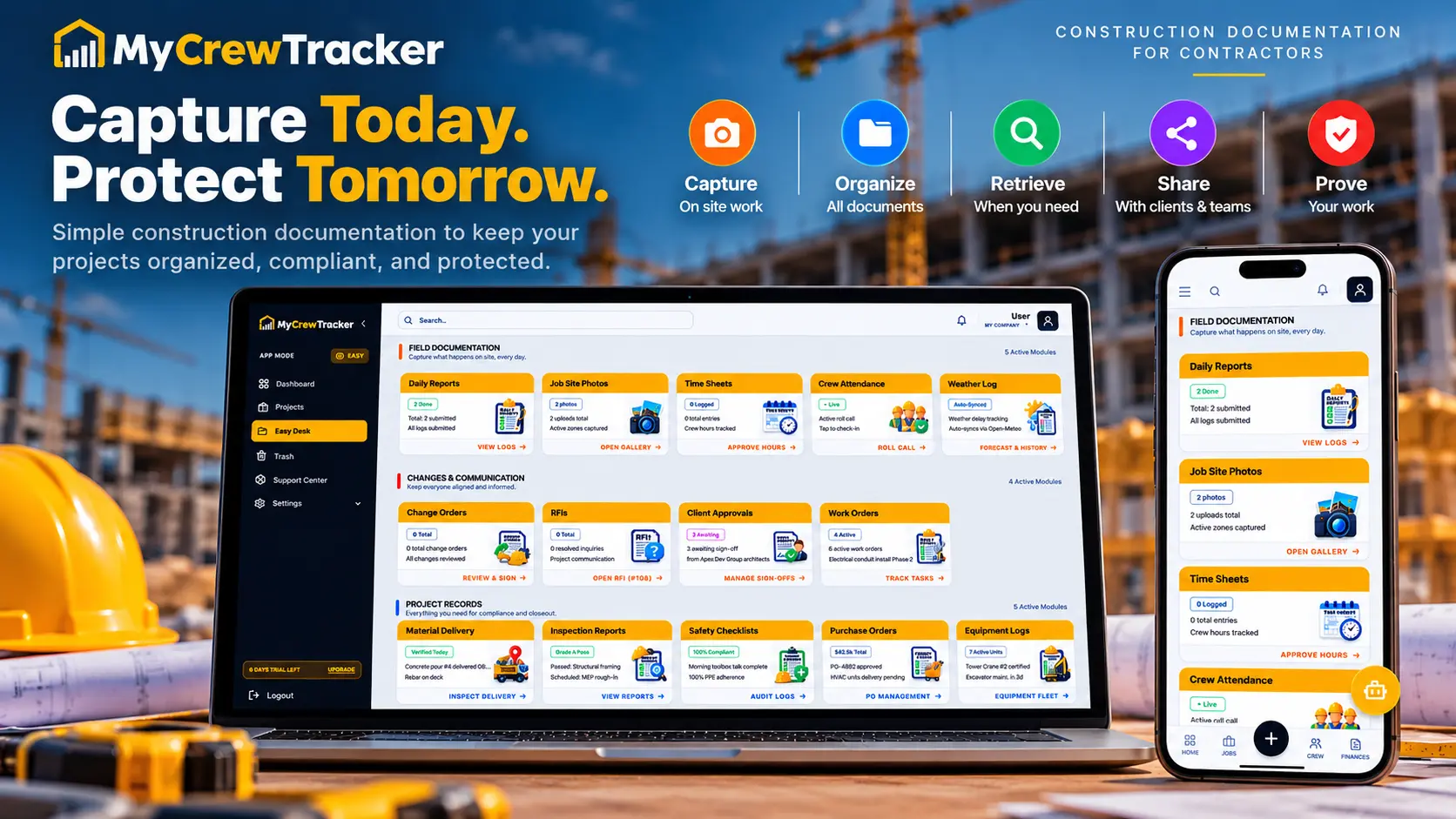
MyCrewTracker provides a centralized, cloud-based platform designed to help North Dakota contractors organize, retrieve, and securely retain vital project documentation. By moving away from scattered paper files and disorganized email threads, your team can maintain a single source of truth for all job site records, lien notices, and change orders.
North Dakota Mechanics Lien Law (N.D.C.C. Chapter 35-27)
1. Right to a Construction Lien (N.D.C.C. § 35-27-02)
Under N.D.C.C. § 35-27-02, any person who improves real estate by performing labor or furnishing skill, material, or machinery under a contract with the owner, or their agent, is entitled to a construction lien upon the improvement and the land on which it is situated. This includes contractors, subcontractors, material suppliers, and design professionals.
The lien attaches to the property from the time of the first contribution of labor, skill, material, or machinery. However, simply contributing to a project does not automatically perfect a lien — the claimant must follow a series of strict statutory steps, including the service of a Notice of Intent to Claim a Lien and the recording of a lien statement within the applicable deadlines.
2. Notice of Intent to Claim a Lien (N.D.C.C. § 35-27-09)
Unlike many other states, North Dakota does not require a universal preliminary notice at the start of a construction project. Instead, the state mandates a pre-lien notice known as the Notice of Intent to File a Lien (also referred to as a Notice that a Lien Will be Claimed).
Under N.D.C.C. § 35-27-09, any claimant (including contractors, subcontractors, and material suppliers) must serve this written notice to the property owner at least ten (10) days before formally recording a mechanics lien. The notice must be sent by certified mail to the owner of the real estate. This notice serves as a final warning and an opportunity for the owner to resolve the dispute before a lien is attached to their property.
The statute does not prescribe a specific form for the notice, but best practice dictates that it should include:
- The claimant's name and address
- The property owner's name and address
- A description of the property (a street address is generally sufficient)
- A description of the labor, materials, or services provided
- The date the contract was executed
- The amount unpaid
- A statement that a lien will be claimed if payment is not made within ten (10) days
This notice must be received by the owner at least 10 days before the lien is recorded. The 10-day waiting period is a strict condition precedent to a valid lien.
3. Recording the Lien Statement (N.D.C.C. § 35-27-13)
Under N.D.C.C. § 35-27-13, every person desiring to perfect their lien must record a lien statement with the recorder of the county in which the property is located. The deadline for recording is ninety (90) days after all of the person's contribution is done. This means the lien statement must be recorded within 90 days of the claimant's last date of furnishing labor, materials, or services to the project.
What Happens If You Miss the 90-Day Deadline
Failing to record within the 90-day window does not automatically defeat the lien entirely. Under North Dakota law, a late-filed lien remains effective against the owner of the land during the project, but it is ineffective against any person who purchases the property or records an interest against the land (such as a mortgage) before the lien is recorded. Because most projects involve third-party lenders and potential purchasers, a late filing is highly risky and often renders the lien practically unenforceable.
What the Lien Statement Must Include
Under N.D.C.C. § 35-27-13, the recorded lien statement must include:
- A description of the property to be charged with the lien
- The amount due
- The dates of the first and last contributions to the project by the lien claimant
- The name of the person with whom the lien claimant contracted
4. Notice of Intent to Enforce the Lien (N.D.C.C. § 35-27-26)
Before commencing an action to foreclose a construction lien, the claimant must provide the owner with a written notice of intent to commence a lawsuit. Under N.D.C.C. § 35-27-26, this notice must be provided at least ten (10) days before commencing the lawsuit if served by personal service, or twenty (20) days in advance if served by registered mail.
5. Enforcement Deadline (N.D.C.C. § 35-27-26)
Under N.D.C.C. § 35-27-26, an action to enforce a mechanics lien must be initiated within three (3) years from the date on which the lien was filed. However, this deadline can be significantly shortened. If the property owner, or another interested party, serves a proper demand on the claimant, the deadline is shortened to 30 days from receipt of that written demand. Failure to file suit within the applicable period will result in the lien being void.
6. Attorney Fees — An Unusual Rule
North Dakota has an unusual statute regarding attorneys' fees in construction lien lawsuits. Unlike many states that allow a prevailing contractor to recover attorneys' fees, North Dakota law provides that if the owner successfully contests the validity or accuracy of a construction lien in district court, the owner must be awarded the full amount of all costs and reasonable attorney's fees incurred by the owner. This creates a significant risk for claimants who file liens that are later invalidated or reduced.
North Dakota Lien Deadlines at a Glance
| Action | Deadline | Statute |
|---|---|---|
| Serve Notice of Intent to File a Lien | At least 10 days before recording lien | N.D.C.C. § 35-27-09 |
| Record Lien Statement | Within 90 days of last contribution | N.D.C.C. § 35-27-13 |
| Serve Notice of Intent to Enforce Lien (personal service) | At least 10 days before lawsuit | N.D.C.C. § 35-27-26 |
| Serve Notice of Intent to Enforce Lien (registered mail) | At least 20 days before lawsuit | N.D.C.C. § 35-27-26 |
| File suit to enforce lien | Within 3 years of recording lien | N.D.C.C. § 35-27-26 |
| File suit (if owner serves demand) | Within 30 days of receipt of demand | N.D.C.C. § 35-27-26 |
| Public Prompt Payment (State Agency) | Within 45 days of invoice | N.D.C.C. § 13-01.1-01 |
| Late Payment Interest Penalty | 1.75% per month | N.D.C.C. § 13-01.1-02 |
| Public Retainage Cap | 10% until 50% completion | N.D.C.C. § 43-07-23 |
| Private Retainage Cap | 10% until 50% completion | N.D.C.C. § 43-07-23 |
| Construction Defect Statute of Repose | 10 years from substantial completion | N.D.C.C. § 28-01-44 |
How to File a Mechanics Lien in North Dakota: Step by Step
1. Log your first day of work. The construction lien attaches from the time of your first contribution to the project. MyCrewTracker's Daily Reports timestamp this automatically.
2. Serve the Notice of Intent to File a Lien. Under N.D.C.C. § 35-27-09, serve the notice on the property owner by certified mail at least 10 days before recording the lien. This notice must be received before the 10-day waiting period begins.
3. Track the last day of work. North Dakota's 90-day recording deadline starts from your last date of furnishing labor, materials, or services to the project. There are no extensions.
4. Prepare the lien statement. Under N.D.C.C. § 35-27-13, the statement must include a property description, the amount due, the dates of first and last contributions, and the name of the party with whom you contracted.
5. Record the lien statement with the County Recorder. File the lien statement in the county where the property is located within 90 days of your last contribution. The recorder's stamp establishes the priority date.
6. Serve the Notice of Intent to Enforce. If you need to foreclose, serve the owner with a written notice of intent to commence a lawsuit at least 10 days before filing suit (personal service) or 20 days before filing suit (registered mail) under N.D.C.C. § 35-27-26.
7. File suit within 3 years. Under N.D.C.C. § 35-27-26, you have 3 years from recording the lien to file a foreclosure action. If the owner serves a demand, the deadline shortens to 30 days.
8. Preserve all project documentation. Daily reports, delivery tickets, change orders, and photos become evidence in the enforcement action.
Documents to Preserve for a North Dakota Lien Claim
North Dakota courts require proof that you furnished labor or materials and that they were incorporated into the property. The following records are what you need:
- Signed contract or purchase order with the prime contractor
- Certified mail receipts for the Notice of Intent to File a Lien
- Delivery tickets signed by an authorized site representative
- Daily reports showing crew on site and work performed
- Photo evidence of installed work (timestamped and geotagged)
- Jobsite sign-in logs and crew attendance records
- Invoices, statements, and payment applications
- Email or text correspondence about scope and payment
- Change orders and extra work authorizations
- Copy of the recorded lien statement with county recorder stamp
MyCrewTracker stores all of these in one project record. When a lien deadline approaches, the back office can generate the timeline needed to prepare the lien statement without reconstructing months of field activity.
North Dakota-Specific Gotchas
No preliminary notice at the start — but a mandatory 10-day pre-lien notice. North Dakota does not require a preliminary notice when you start a project. However, you must serve a Notice of Intent to File a Lien at least 10 days before recording the lien. This notice is a strict condition precedent to a valid lien.
The 10-day notice must be received, not just sent. The statute requires that the notice be given at least 10 days before recording. Ensure the notice is mailed with enough time for delivery and that you have proof of receipt. Certified mail with return receipt is the required method.
The 90-day recording deadline is absolute. N.D.C.C. § 35-27-13 gives you exactly 90 days from your last contribution to record the lien statement. There are no extensions.
A late lien is ineffective against third parties. Failing to record within 90 days does not void the lien entirely, but it makes the lien ineffective against purchasers and mortgage holders who record an interest before your lien. This is often as good as losing the lien entirely on projects with construction financing.
The 3-year enforcement deadline can be shortened to 30 days. N.D.C.C. § 35-27-26 gives you 3 years from recording to file suit. However, if the owner serves a written demand, the deadline shortens to 30 days from receipt. This is a critical trap that catches many contractors off guard.
Notice of intent to enforce is required before filing suit. Before commencing a foreclosure action, you must serve the owner with a written notice of intent to commence a lawsuit. The notice must be served at least 10 days before suit if by personal service, or 20 days if by registered mail.
Owner can recover attorney fees for invalid liens. Under North Dakota law, if the owner successfully contests the validity or accuracy of a construction lien, the owner must be awarded costs and reasonable attorney's fees. This is the opposite of most states and creates significant risk for marginal lien claims.
Public prompt payment is 45 days. Under N.D.C.C. § 13-01.1-01, state agencies, political subdivisions, and school districts must pay for delivered items or services within 45 days after receipt of the invoice if no payment date is specified in the contract. Late payments accrue interest at 1.75% per month under N.D.C.C. § 13-01.1-02.
Subcontractor prompt payment mirrors the 45-day rule. Under N.D.C.C. § 13-01.1-06, a contractor that receives payment from a public entity must pay its subcontractors and suppliers within 45 days after receiving payment. Late payments accrue the same 1.75% monthly interest.
Private projects have no statutory prompt payment law. North Dakota does not have a general prompt payment statute for private construction projects. Payment terms, deadlines, and interest on late payments are governed entirely by the written contract between the parties.
Retainage is capped at 10% until 50% completion. Under N.D.C.C. § 43-07-23, the maximum retainage is 10% of each estimate presented until the project is 50% complete. After 50% completion, no further retainage may be withheld on subsequent estimates. If retained funds are invested, the contractor is entitled to the accrued interest upon final payment.
Retainage reduction at 95% completion. When the project reaches 95% completion, the governing body may pay up to 95% of the retained funds to the contractor. The remaining balance is released upon final completion and acceptance.
The statute of repose is 10 years with a potential 2-year extension. Under N.D.C.C. § 28-01-44, no action arising from deficiencies in design, planning, supervision, or construction may be brought more than 10 years after substantial completion. If an injury or damage occurs during the 10th year, an action may be brought within 2 years of the injury, capping the absolute maximum liability period at 12 years. Retain project records for at least 12 years.
Example Scenario: How Documentation Determines the Outcome
*The following is an illustrative scenario, not a specific case. It demonstrates how record-keeping affects outcomes in North Dakota lien disputes.*
Consider a Bismarck mechanical subcontractor on a $600,000 commercial office renovation. The sub first furnishes labor on March 1. The sub's last day of substantial work is August 15.
Under N.D.C.C. § 35-27-09, the sub must serve the Notice of Intent to File a Lien by certified mail at least 10 days before recording the lien. The sub mails the notice on October 15. The 10-day waiting period expires on October 25. Under N.D.C.C. § 35-27-13, the sub must record the lien statement within 90 days of August 15 — by November 13. The sub records the lien statement on October 28, within the 90-day window.
Under N.D.C.C. § 35-27-26, the sub has 3 years from October 28 to file suit to enforce the lien. That deadline is October 28 three years later. However, on December 1, the owner serves a written demand on the sub to institute a judicial proceeding within 30 days. Under N.D.C.C. § 35-27-26, the sub must now file suit by December 31 — a dramatically shortened deadline. If the sub misses this deadline, the lien is void.
Now consider the same sub who records the lien on November 20 — seven days late. Under N.D.C.C. § 35-27-13, the lien is ineffective against any purchaser or mortgage holder who recorded an interest before November 20. On a project with construction financing, the lender's mortgage likely predates the lien, rendering the lien practically unenforceable.
Documentation is what separates these outcomes. MyCrewTracker logs the first day of work, the notice mailing date, the recording date, and the daily reports that prove performance.
North Dakota Prompt Payment Act (N.D.C.C. Chapter 13-01.1)
North Dakota's Prompt Payment Act applies exclusively to public construction projects involving state agencies, political subdivisions, and school districts.
Public Entity Payment Deadlines
Under N.D.C.C. § 13-01.1-01, every state agency, political subdivision, or school district that acquires property or services pursuant to a contract with a business must pay for each complete delivered item of property or service on the date required by contract or, if no date is specified, within forty-five (45) days after receipt of the invoice.
Interest Penalty for Late Payment
Under N.D.C.C. § 13-01.1-02, interest must accrue and be paid on payments overdue at the rate of one and three-fourths percent (1.75%) per month, unless a different rate is specified in the contract. Interest accrues beginning the day after the payment due date (if specified by contract) or on the day of receipt of the invoice (if not paid within 45 days). Interest compounds under N.D.C.C. § 13-01.1-03.
Subcontractor Prompt Payment
Under N.D.C.C. § 13-01.1-06, upon payment by a state agency, political subdivision, school district, or agency of the United States, a business that has acquired property or services from a subcontractor or supplier must pay that subcontractor or supplier within forty-five (45) days after payment from the agency. Interest at the rate specified in § 13-01.1-02 accrues and is due to any subcontractor or supplier not paid within 45 days.
Private Projects — No Statutory Prompt Payment
For private projects, North Dakota does not have a statutory prompt payment law. Payment terms, deadlines, and interest on late payments are governed entirely by the written contract between the parties.
North Dakota Retainage Limits (N.D.C.C. § 43-07-23)
Under N.D.C.C. § 43-07-23, contracts entered between persons for the performance of work to be done by a contractor are subject to a maximum retention on amounts due under the contract as follows:
- 10% of each estimate presented is allowable until such time as the project is 50% complete
- Once the project reaches 50% completion, no further retainage may be withheld on estimates during the continuance of the contract
- If the owner, governing board, or authorized committee invests the retained estimate funds, the interest earned on those retained funds is payable at the time of final payment to the contractor on whose account the moneys were held
- Upon completion of 95% of the contract, the governing body may pay to the contractor up to 95% of the retained funds
Certain public works projects may have slightly different procedures under specific statutes, such as contracts entered with the Water District Board (N.D.C.C. § 61-35-103) or the North Dakota Mill and Elevator Association (N.D.C.C. § 54-18-18), but the maximum rate of retainage remains 10% of the contract estimate.
North Dakota Statute of Repose (N.D.C.C. § 28-01-44)
Under N.D.C.C. § 28-01-44, no action — whether in contract, tort, or otherwise — may be brought for deficiencies in the design, planning, supervision, or construction of an improvement to real property more than ten (10) years after the date of substantial completion of the improvement.
If an injury or damage occurs during the 10th year after substantial completion, the law provides a grace period, allowing an action to be brought within two (2) years of the injury, capping the absolute maximum liability period at twelve (12) years.
The statute of repose is an absolute bar to claims. It functions differently from a statute of limitations — it forecloses suit after the specified period has passed since substantial completion, regardless of when the alleged negligence occurred or when the defect was discovered. Retain project records for at least 12 years to defend against potential construction defect claims.
What MyCrewTracker Does (and Does Not Do) in North Dakota
MyCrewTracker is a construction documentation platform, not a legal service. Here is what it does for North Dakota contractors:
- Logs first day and last day of work per project so you can calculate the 10-day notice deadline and the 90-day recording window
- Stores certified mail receipts and Notice of Intent to File a Lien documents in the project file
- Records delivery tickets with photo and signature capture
- Captures timestamped, GPS-tagged site photos that document installation and project milestones like 50% completion for retainage release
- Generates daily report PDFs that serve as contemporaneous records
- Tracks retainage and payment dates for public works compliance
- Archives project records for 12+ years to support construction defect defense
What MyCrewTracker Does NOT Do: We do not provide legal advice, draft or file Notices of Intent, mechanics liens, or any other legal documents. We are a software platform, not a law firm. It is your responsibility to consult with a qualified North Dakota construction attorney to interpret the law and ensure your specific documents are legally binding and filed correctly.
❓ Frequently Asked Questions in North Dakota
Do I need to send a preliminary notice right when I start a project in North Dakota?
No, North Dakota does not require a preliminary notice at the start of a project. However, you must send a 10-day Notice of Intent to File a Lien before you can actually record a mechanics lien.
How must the Notice of Intent be sent?
The Notice of Intent to File a Lien must be sent to the property owner via certified mail under N.D.C.C. § 35-27-09. The notice must be received at least 10 days before recording the lien.
What is the deadline to file a mechanics lien in North Dakota?
You have 90 days from the last date you provided labor, materials, or services to record your mechanics lien with the county recorder. This is set by N.D.C.C. § 35-27-13.
When should I send my Notice of Intent to ensure I don't miss the lien deadline?
Because the Notice of Intent must be received by the owner at least 10 days prior to recording the lien, you should send it well before the 80th day following your last day of work. This ensures it is delivered and the 10-day waiting period is satisfied before the 90-day deadline expires.
What happens if I miss the 90-day recording deadline?
Failing to record within 90 days does not automatically void the lien, but it makes the lien ineffective against purchasers and mortgage holders who recorded an interest before your lien. On projects with construction financing, this often renders the lien practically unenforceable.
Does North Dakota have prompt payment laws for private construction projects?
No, North Dakota's prompt payment laws only apply to public projects. Payment terms for private projects are determined by the specific contract between the parties.
What is the penalty for late payments on public projects in North Dakota?
For public projects, late payments on undisputed amounts accrue interest at a rate of 1.75% per month after 45 days under N.D.C.C. § 13-01.1-02.
How much retainage can be withheld on a North Dakota construction project?
Typically, a maximum of 10% can be withheld, but only until the project is 50% complete. After 50% completion, no additional retainage can be withheld from subsequent payments. At 95% completion, the governing body may pay up to 95% of the retained funds.
How long do I have to enforce a North Dakota mechanics lien?
You have 3 years from recording the lien to file a foreclosure action under N.D.C.C. § 35-27-26. However, if the owner serves a written demand, the deadline shortens to 30 days from receipt.
Can a property owner sue a contractor for defective work 15 years after the project is finished?
Generally, no. North Dakota's Statute of Repose bars claims for construction defects 10 years after substantial completion (or up to 12 years if the injury occurred in the 10th year) under N.D.C.C. § 28-01-44.
Can I recover attorney fees if I win a lien foreclosure in North Dakota?
No. In fact, North Dakota law provides that if the owner successfully contests the validity or accuracy of a construction lien, the owner must be awarded costs and reasonable attorney's fees. This is the opposite of most states and creates significant risk for marginal lien claims.
Does MyCrewTracker file North Dakota mechanics liens?
No. MyCrewTracker is a secure document management platform that helps you organize the daily reports, invoices, and delivery receipts you need to prove your case. To officially file a mechanics lien in North Dakota, you must use a specialized legal service or a qualified construction attorney.
Legal Sources & References
-
Persons Entitled to Construction Lien — Notice N.D.C.C. § 35-27-02
Establishes the right to a construction lien for persons who improve real estate by performing labor or furnishing skill, material, or machinery.
-
Notice of Intention to Claim Lien — Recordation N.D.C.C. § 35-27-09
Requires written notice that a lien will be claimed to be given to the owner of the real estate by certified mail at least 10 days before recording the construction lien.
-
Time for Filing Lien Statement N.D.C.C. § 35-27-13
Requires every person desiring to perfect a lien to record a lien statement with the county recorder within 90 days after all of the person's contribution is done. A late filing is ineffective against purchasers or lienholders whose rights accrue before the lien is recorded.
-
Action to Foreclose Lien — Notice Required N.D.C.C. § 35-27-26
Provides that an action to enforce a mechanics lien must be initiated within 3 years from the date the lien was filed. If the owner serves a written demand, the deadline shortens to 30 days. Notice of intent to commence a lawsuit must be provided at least 10 days before suit (personal service) or 20 days (registered mail).
-
Prompt Payment Required N.D.C.C. § 13-01.1-01
Requires state agencies, political subdivisions, and school districts to pay for delivered items or services within 45 days after receipt of the invoice if no payment date is specified in the contract.
-
When Interest Payment Required N.D.C.C. § 13-01.1-02
Provides that interest must accrue on payments overdue under § 13-01.1-01 at the rate of one and three-fourths percent (1.75%) per month.
-
Subcontractor Prompt Payment Required N.D.C.C. § 13-01.1-06
Requires a business that receives payment from a public entity to pay its subcontractors and suppliers within 45 days after receiving payment.
-
Allowable Retention of Estimates — Interest on Retainage N.D.C.C. § 43-07-23
Establishes the maximum retainage of 10% of each estimate until the project is 50% complete, with no further retainage thereafter. Interest earned on retained funds is payable to the contractor at final payment.
-
Limitation of Actions — Statute of Repose N.D.C.C. § 28-01-44
Establishes the 10-year statute of repose for construction defect claims, with a potential 2-year extension if injury occurs in the 10th year, capping maximum liability at 12 years.
-
North Dakota Legislative Branch — North Dakota Century Code General Reference
Official North Dakota Legislative Branch website — Searchable index of all North Dakota Century Code sections.
Ready to organize your jobs?
Join contractors in North Dakota using MyCrewTracker.