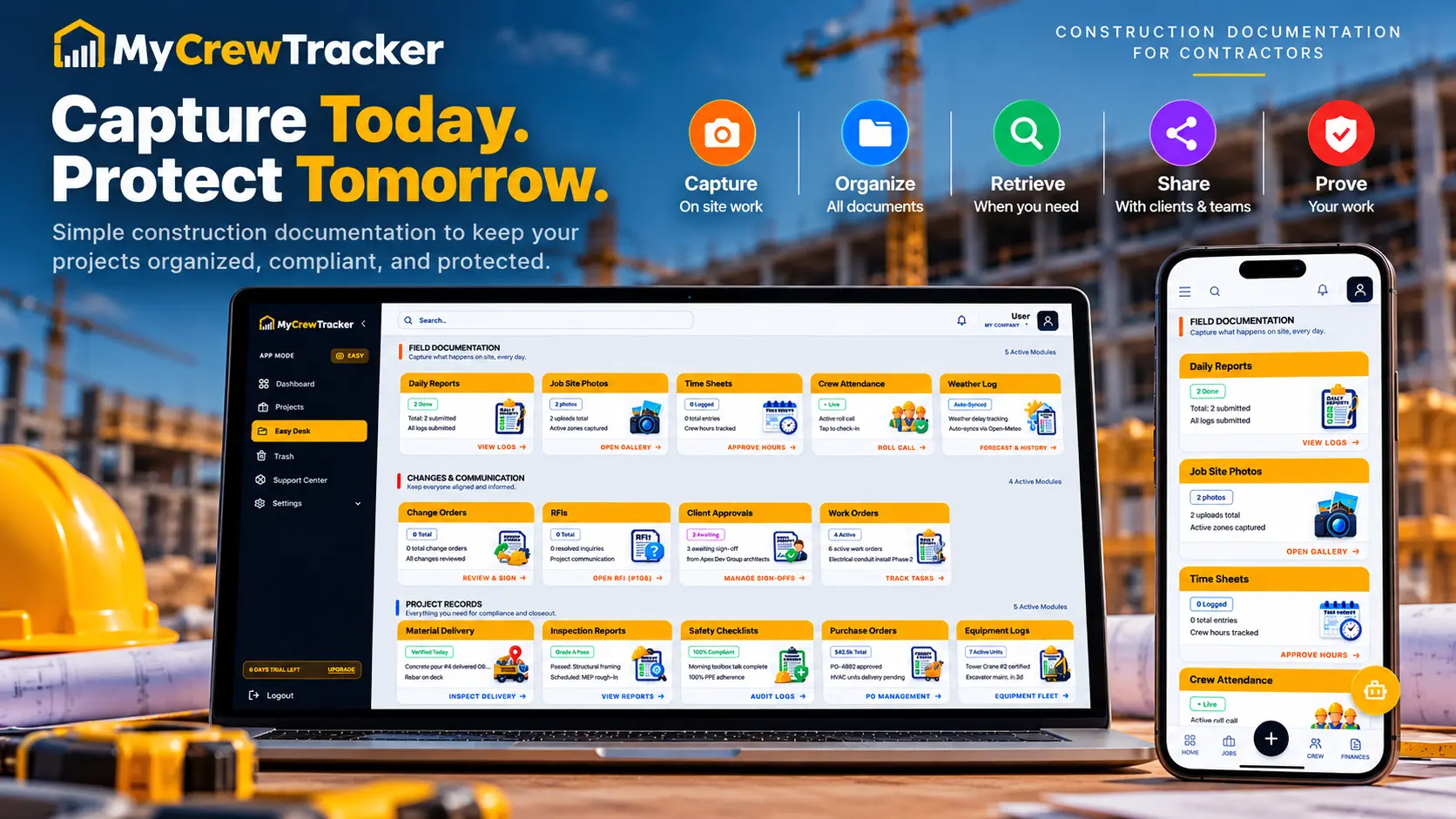
New Jersey’s dense infrastructure and commercial construction markets demand operational efficiency. With strict statutory payment guidelines under state law, contractors cannot afford disorganized paperwork. The state imposes aggressive prompt-payment deadlines, a judicial lien process that requires strict adherence to statutory procedures, and a construction defect statute of repose that can extinguish claims after a decade. MyCrewTracker offers New Jersey contractors a secure cloud platform to archive project files, track daily progress, and maintain the documentation required for payment disputes.
The New Jersey Prompt Payment Act (N.J.S.A. 2A:30A-2)
Cash flow delays are heavily regulated in New Jersey. Under N.J.S.A. 2A:30A-2, the state establishes strict statutory timelines for payments on both public and private construction contracts.
Owner to Prime Contractor: 30-Day Payment Rule
If a prime contractor has performed in accordance with the contract and the billing for the work has been approved and certified by the owner or the owner’s authorized approving agent, the owner must pay the amount due not more than 30 calendar days after the billing date. For a periodic billing, the billing date is the periodic billing date specified in the contract.
A billing is deemed approved and certified 20 days after the owner receives it — unless the owner provides a written statement of the amount withheld and the reason for withholding payment before the end of that 20-day period. This “deemed approved” provision is critical: if the owner fails to respond within 20 days, the full billing amount becomes due and payable on the 30th day.
Prime Contractor to Subcontractors: 10-Day Payment Rule
If a subcontractor or subsubcontractor has performed in accordance with its contract and the work has been accepted by the owner, the owner’s authorized approving agent, or the prime contractor, and the parties have not otherwise agreed in writing, the prime contractor must pay its subcontractor — and the subcontractor must pay its subsubcontractor — within 10 calendar days of the receipt of each periodic payment, final payment, or receipt of retainage monies. The amount paid must be the full amount received for the work of the subcontractor or subsubcontractor based on the work completed or services rendered.
Interest Penalty for Late Payment
If a payment due under this section is not made in a timely manner, the delinquent party is liable for the amount owed plus interest at a rate equal to the prime rate plus 1%. Interest accrues from the day after the required payment date and ends on the day the check for payment has been drawn.
Right to Suspend Work
A prime contractor, subcontractor, or subsubcontractor may, after providing seven calendar days’ written notice to the party failing to make the required payments, suspend performance of the construction contract without penalty for breach of contract until the required payment is made. This is a powerful remedy that requires careful documentation of the notice and the payment default.
Documentation Requirements for Prompt Pay Compliance
To enforce these rights, contractors must maintain flawless documentation. MyCrewTracker offers a secure cloud repository where New Jersey contractors can organize dated payment applications, approved invoices, and formal communications to prove statutory compliance.
New Jersey Construction Lien Law (N.J.S.A. 2A:44A-6)
New Jersey requires strict adherence to the Construction Lien Law to secure payment rights. The state’s lien framework is set forth in N.J.S.A. 2A:44A-1 et seq.
Filing a Lien Claim: The 90-Day Rule for Commercial Projects
Under N.J.S.A. 2A:44A-6, a contractor, subcontractor, or supplier entitled to file a lien must do so according to a specific process. The lien claim form must be signed, acknowledged, and verified by oath of the claimant, setting forth the specific work or services performed and the claimant’s contractual relationship with the owner and other known parties.
In all cases except those involving a residential construction contract, the lien claim form must be lodged for record within 90 days following the date the last work, services, material, or equipment was provided for which payment is claimed.
Residential Construction: Special Rules
For residential construction contracts, the timeline is different. The lien claim form must be lodged for record not later than 10 days after receipt by the claimant of the arbitrator’s determination, and within 120 days following the date the last work, services, material, or equipment was provided for which payment is claimed.
What the Lien Claim Must Include
Under N.J.S.A. 2A:44A-6, the lien claim must include:
- The specific work or services performed, or material or equipment provided pursuant to contract
- The claimant’s identity and contractual relationship with the owner or community association
- The contractual relationship with other known parties in the construction chain
When a Lien Attaches
A lien shall not attach or be enforceable unless the lien claim is filed in the manner and form provided by the statute, and a copy is served in accordance with N.J.S.A. 2A:44A-7. A document must be first filed to be enforceable against third parties without notice of the document, including an owner, bona fide purchaser, mortgagee, or lessee.
New Jersey Lien Deadlines at a Glance
Missing a single deadline in New Jersey can void your lien rights entirely. The table below summarizes the statutory deadlines every New Jersey contractor, subcontractor, and material supplier must track.
| Action | Deadline | Statute |
|---|---|---|
| Owner pay prime contractor | Within 30 days of billing date (or 20 days if deemed approved) | N.J.S.A. 2A:30A-2 |
| Prime contractor pay subcontractor | Within 10 days of receiving payment | N.J.S.A. 2A:30A-2 |
| Lodge lien claim for record (commercial) | Within 90 days of last work or materials | N.J.S.A. 2A:44A-6 |
| Lodge lien claim for record (residential) | Within 10 days of arbitrator’s determination, and within 120 days of last work | N.J.S.A. 2A:44A-6 |
| Serve copy of lien claim on owner | As required by N.J.S.A. 2A:44A-7 | N.J.S.A. 2A:44A-7 |
| File suit to enforce lien | Within 1 year of lien filing | N.J.S.A. 2A:44A-14 |
| Construction defect statute of repose | 10 years from performance or furnishing of services | N.J.S.A. 2A:14-1.1 |
| Retainage on public projects | 2% of amount due | N.J.S.A. 2A:30A-2 |
How to File a Construction Lien in New Jersey: Step by Step
The process below reflects the standard path for a New Jersey contractor, subcontractor, or supplier seeking to preserve and enforce lien rights under the Construction Lien Law.
1. Log your last day of work. New Jersey’s 90-day filing clock for commercial projects starts from the last date you provided work, services, materials, or equipment for which payment is claimed. MyCrewTracker’s Daily Reports timestamp this automatically.
2. Prepare the lien claim form. Under N.J.S.A. 2A:44A-6, the lien claim must be signed, acknowledged, and verified by oath. It must set forth the specific work performed and your contractual relationship with the owner and other known parties in the construction chain.
3. Lodge the lien claim for record. For commercial projects, file the lien claim with the county clerk within 90 days of your last day of work. For residential projects, file within 10 days of the arbitrator’s determination and within 120 days of last work.
4. Serve a copy of the lien claim on the owner. Under N.J.S.A. 2A:44A-7, a copy of the lien claim must be served on the owner in accordance with statutory requirements. The lien does not attach or become enforceable unless this service is completed.
5. File suit to enforce the lien within 1 year. Under N.J.S.A. 2A:44A-14, an action to enforce a construction lien must be commenced within 1 year from the date the lien claim is filed.
6. Preserve all project documentation. Daily reports, delivery tickets, change orders, and photos become evidence in the enforcement action.
Documents to Preserve for a New Jersey Lien Claim
New Jersey courts require proof that you furnished labor or materials and that they were incorporated into the property. The following records are what you need:
- Signed contract or purchase order with the prime contractor
- Proof of service of the lien claim on the owner
- Delivery tickets signed by an authorized site representative
- Daily reports showing crew on site and work performed
- Photo evidence of installed work (timestamped and geotagged)
- Jobsite sign-in logs and crew attendance records
- Invoices, statements, and payment applications
- Email or text correspondence about scope and payment
- Change orders and extra work authorizations
- Written demand letters and any response
MyCrewTracker stores all of these in one project record. When a lien deadline approaches, the back office can generate the timeline needed to prepare the lien claim without reconstructing months of field activity.
New Jersey-Specific Gotchas
The “deemed approved” provision is a powerful tool. Under N.J.S.A. 2A:30A-2, a billing is deemed approved and certified 20 days after the owner receives it unless the owner provides a written statement of the amount withheld and the reason for withholding before the 20-day period expires. If the owner fails to respond, the full amount becomes due on the 30th day.
The 10-day payment rule applies unless otherwise agreed in writing. The prime contractor must pay subcontractors within 10 days of receiving payment unless the parties have otherwise agreed in writing. This means a written contract provision can alter the statutory timeline — but absent such a provision, the 10-day rule is mandatory.
The 90-day filing deadline is absolute. N.J.S.A. 2A:44A-6 gives you exactly 90 days from your last day of work to lodge the lien claim for record on commercial projects. There are no extensions. Set two calendar reminders: one at 60 days, one at 80 days.
Residential projects have a different timeline. For residential construction contracts, the lien claim must be lodged within 10 days of the arbitrator’s determination and within 120 days of last work. The arbitration process adds an additional layer of complexity.
The 1-year enforcement deadline is absolute. N.J.S.A. 2A:44A-14 gives you exactly 1 year from the date the lien claim is filed to commence an action to enforce it. Set two calendar reminders: one at 9 months, one at 11 months.
Prospective lien waivers are void. Under N.J.S.A. 2A:44A-38, waivers of construction lien rights are against public policy, unlawful, and void unless given in consideration for payment for the work, services, materials, or equipment provided or to be provided. Even then, a waiver is effective only upon and to the extent that such payment is actually received.
Construction defect statute of repose. New Jersey’s statute of repose for construction defects is 10 years from the performance or furnishing of services and construction under N.J.S.A. 2A:14-1.1. This limitation serves as a bar to all actions, both governmental and private. Retain project records for at least 10 years.
Interest penalty for late payment. If a payment due under the Prompt Payment Act is not made in a timely manner, the delinquent party is liable for interest at a rate equal to the prime rate plus 1%. This interest accrues from the day after the required payment date until the check is drawn.
Example Scenario: How Documentation Determines the Outcome
*The following is an illustrative scenario, not a specific case. It demonstrates how record-keeping affects outcomes in New Jersey lien disputes.*
Consider a Newark mechanical subcontractor on a $750,000 commercial office renovation. The sub’s last day of substantial work is August 15. Under N.J.S.A. 2A:44A-6, the sub has 90 days from August 15 to lodge the lien claim for record with the Essex County Clerk. That deadline is November 13.
The sub prepares the lien claim on November 1, ensuring it includes the specific HVAC work performed, the amount claimed ($125,000), and the contractual relationship with the general contractor and owner. The sub lodges the claim for record on November 5 and serves a copy on the owner on November 8 — within the statutory service requirement.
Under N.J.S.A. 2A:44A-14, the sub has 1 year from November 5 to file suit to enforce the lien. That deadline is November 5 of the following year. The sub files suit on June 15, well within the window. The lien is enforceable.
Now consider the Prompt Payment Act side. The general contractor received a $500,000 progress payment from the owner on July 1. Under N.J.S.A. 2A:30A-2, the GC had 10 days to pay the sub — by July 11. The GC failed to pay. The sub is entitled to the amount owed plus interest at the prime rate plus 1% from July 12 until the check is drawn. If the prime rate is 7.5%, the interest rate is 8.5% annually.
Documentation is what separates these outcomes. MyCrewTracker logs the last day of work, the lien claim filing date, the service date, and the daily reports that prove performance.
New Jersey Prompt Payment Act Enforcement
The New Jersey Prompt Payment Act has been the subject of significant litigation. Courts have consistently enforced the statutory timelines and the “deemed approved” provision.
Key Provisions for Contractors
- Deemed approval: A billing is deemed approved 20 days after receipt unless the owner provides a written statement of withholding
- Interest penalty: Late payments accrue interest at the prime rate plus 1%
- Right to suspend work: After 7 days’ written notice, a contractor may suspend performance without penalty for breach of contract
- Public entity exception: Public entities that require governing body votes on payments may approve at the next scheduled public meeting
What This Means for New Jersey Contractors
- Document the date every billing is submitted
- Monitor the 20-day deemed approval window
- If payment is not received by the 30-day deadline, send a written demand
- Consider suspending work after 7 days’ written notice if payment is not made
- Track the interest accruing on late payments
What MyCrewTracker Does (and Does Not Do) in New Jersey
MyCrewTracker is a construction documentation platform, not a legal service. Here is what it does for New Jersey contractors:
- Logs first day and last day of work per project so you can calculate the 90-day lien filing window
- Stores proof of service and lien claim documents in the project file
- Records delivery tickets with photo and signature capture
- Captures timestamped, GPS-tagged site photos that document installation
- Generates daily report PDFs that serve as contemporaneous records
- Tracks payment application dates for Prompt Payment Act compliance
- Archives project records for 10+ years to support construction defect defense
It does not draft lien claims, file documents with the county clerk, or provide legal advice. Those steps require a New Jersey construction attorney.
❓ Frequently Asked Questions in New Jersey
What is the deadline under the New Jersey Prompt Payment Act?
Under N.J.S.A. 2A:30A-2, an owner generally has 30 days to pay a prime contractor after a billing is approved. The prime contractor then has 10 days after receiving payment to pay their subcontractors, unless their contract states otherwise.
What is the New Jersey commercial mechanics lien deadline?
Under N.J.S.A. 2A:44A-6, a commercial lien claim must generally be lodged for record within 90 days of the last date work, services, or materials were provided.
What happens if the owner doesn’t respond to a billing in New Jersey?
Under N.J.S.A. 2A:30A-2, a billing is deemed approved and certified 20 days after the owner receives it unless the owner provides a written statement of the amount withheld and the reason for withholding payment before the end of the 20-day period.
How long do I have to sue to enforce a New Jersey lien?
Under N.J.S.A. 2A:44A-14, you have 1 year from the date the lien claim is filed to commence an action to enforce it.
Can I be forced to waive my lien rights in New Jersey?
No. Under N.J.S.A. 2A:44A-38, waivers of construction lien rights are against public policy, unlawful, and void unless given in consideration for payment, and even then, a waiver is effective only upon and to the extent that payment is actually received.
What is the New Jersey construction defect statute of repose?
Under N.J.S.A. 2A:14-1.1, no action may be brought for construction defects more than 10 years after the performance or furnishing of services and construction.
What interest rate applies to late payments in New Jersey?
Under N.J.S.A. 2A:30A-2, late payments accrue interest at a rate equal to the prime rate plus 1%.
Can I suspend work if I’m not paid in New Jersey?
Yes. Under N.J.S.A. 2A:30A-2, after providing seven calendar days’ written notice to the party failing to make payment, you may suspend performance of the contract without penalty for breach of contract.
How long must New Jersey contractors keep records?
New Jersey does not impose a specific statutory record retention period for construction documents, but to defend against construction defect claims, contractors should retain project records for at least 10 years — preferably longer.
Does MyCrewTracker automatically track my NJ lien deadlines?
No. MyCrewTracker is a secure document management platform. It allows you to document your last day on the job through Daily Reports and store your lien waivers, but you must manually calculate your statutory deadlines or consult a New Jersey attorney.
Legal Sources & References
-
Prompt Payment Act — Owner to Prime Contractor; Prime to Subcontractor N.J.S.A. 2A:30A-2
New Jersey Prompt Payment Act — Owners must pay prime contractors within 30 days of billing date (or 20 days if deemed approved). Prime contractors must pay subcontractors within 10 days of receiving payment. Interest at prime rate plus 1% for late payments. Right to suspend work after 7 days’ notice.
-
Construction Lien Law — Filing Lien Claim N.J.S.A. 2A:44A-6
New Jersey Construction Lien Law — Commercial lien claims must be lodged for record within 90 days of last work or materials. Residential lien claims must be lodged within 10 days of arbitrator’s determination and within 120 days of last work.
-
Construction Lien Law — Service of Lien Claim N.J.S.A. 2A:44A-7
New Jersey Lien Service — A copy of the lien claim must be served on the owner in accordance with statutory requirements for the lien to attach and be enforceable.
-
Construction Lien Law — Waivers of Lien Rights N.J.S.A. 2A:44A-38
New Jersey Lien Waiver Law — Waivers of construction lien rights are against public policy, unlawful, and void unless given in consideration for payment. Even then, a waiver is effective only upon and to the extent that payment is actually received.
-
Construction Defect Statute of Repose N.J.S.A. 2A:14-1.1
New Jersey Statute of Repose — No action may be brought for construction defects more than 10 years after the performance or furnishing of services and construction. This limitation bars all actions, both governmental and private.
-
New Jersey Legislature — Statutes General Reference
Official New Jersey Legislature website — Searchable index of all New Jersey Statutes.
-
New Jersey Courts — Judicial Opinions General Reference
Official New Jersey Courts website — Published opinions and court rules.
Protect Your Projects & Retain Required New Jersey Records
Defend against back-charges, audit penalties, and mechanic's lien disputes. Keep GPS-timestamped photos, certified timesheets, and signed change orders safely backed up for just $40/month.