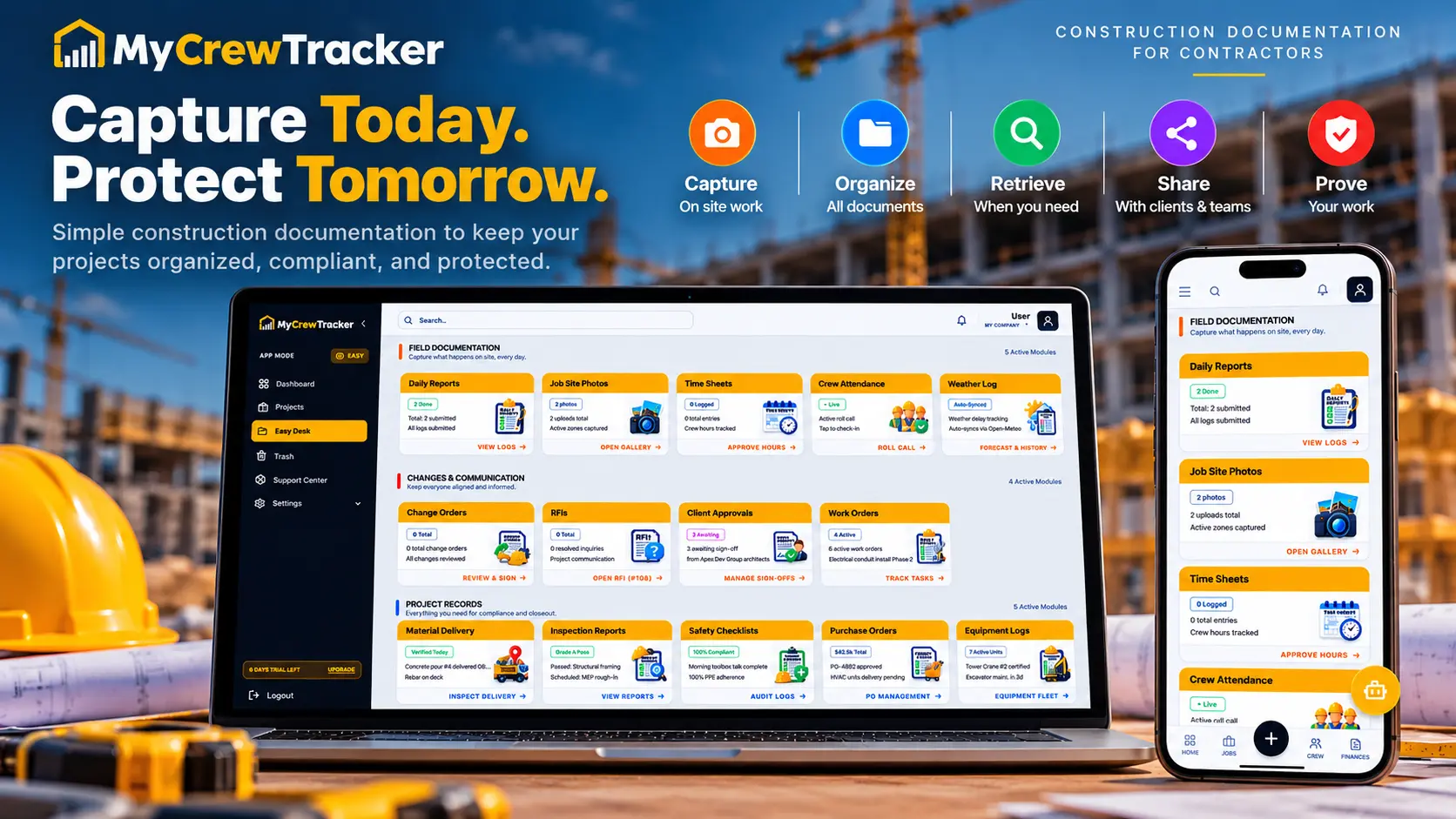
South Carolina's construction sector requires strict adherence to Notice of Project Commencement deadlines. The state operates a unique defensive filing system: a general contractor who files a Notice of Project Commencement within 15 days of starting work can limit the lien rights of lower-tier subcontractors and suppliers who fail to serve a Notice of Furnishing. Combined with a 90-day lien filing deadline, a 6-month enforcement window, and a 13-year statute of repose for construction defects, the compliance obligations are substantial. MyCrewTracker provides South Carolina contractors with a centralized platform to manage project documents and track statutory deadlines.
South Carolina Notice of Project Commencement (S.C. Code § 29-5-23)
South Carolina mechanics lien law allows for defensive filings. Under S.C. Code § 29-5-23, an owner or general contractor may file a Notice of Project Commencement with the Clerk of Court or Register of Deeds in the county where the real property is located.
The 15-Day Filing Deadline
The notice must be filed within fifteen (15) days of the commencement of work and must be accompanied by a filing fee of fifteen dollars to be deposited in that county's general fund. The notice must also be posted at the job site.
What the Notice Must Include
Under S.C. Code § 29-5-23, the Notice of Project Commencement must contain:
- A statement that the notice is filed pursuant to S.C. Code § 29-5-23
- The name and address of the owner or developer
- A general description of the improvement
- The location of the project
The Effect of Filing: Triggering the Notice of Furnishing Requirement
If a Notice of Project Commencement is properly filed, sub-subcontractors and suppliers to subcontractors must serve a Notice of Furnishing Labor or Materials to protect their lien rights. This is the core of South Carolina's defensive filing system: by filing the notice, the general contractor limits its exposure to remote claimants who fail to serve the required notice.
What Happens If You Fail to File
The failure to file a Notice of Project Commencement renders the provisions of S.C. Code § 29-5-20(B) and § 29-5-60(B) inapplicable . This means the general contractor loses the payment defense against remote claimants that the notice would have provided. South Carolina courts have held that when a construction company fails to file a Notice of Project Commencement, the statutory protections for the contractor are unavailable.
By utilizing MyCrewTracker's Daily Reports, field supervisors generate a verifiable, date-stamped log of when work actually commenced, ensuring the back office never misses these critical notice windows.
South Carolina Lien Deadlines at a Glance
Missing a single deadline in South Carolina can void your lien rights entirely. The table below summarizes the statutory deadlines every South Carolina contractor, subcontractor, and material supplier must track.
| Action | Deadline | Statute |
|---|---|---|
| File Notice of Project Commencement (owner/GC) | Within 15 days of commencement of work | S.C. Code § 29-5-23 |
| Serve Notice of Furnishing (remote claimants) | Best practice: as early as possible from first furnishing | S.C. Code § 29-5-20 |
| Serve and record mechanic's lien statement | Within 90 days of ceasing labor or furnishing materials | S.C. Code § 29-5-90 |
| Commence suit to foreclose lien | Within 6 months of last furnishing | S.C. Code § 29-5-120 |
| File notice of pendency of action | Within 6 months of last furnishing | S.C. Code § 29-5-120 |
| Owner pay contractor (Prompt Payment Act) | Within 21 days of receipt of pay request | S.C. Code § 29-6-30 |
| Contractor pay subcontractor | Within 7 days of receipt of payment | S.C. Code § 29-6-30 |
| Construction defect statute of repose | 13 years from substantial completion | S.C. Code § 15-3-640 |
How to File a Mechanics Lien in South Carolina: Step by Step
The process below reflects the standard path for a South Carolina contractor, subcontractor, or material supplier seeking to preserve and enforce lien rights under Chapter 5 of Title 29 of the South Carolina Code.
1. Log your first day of work. If you are a general contractor, the 15-day Notice of Project Commencement clock starts from your first day of work. MyCrewTracker's Daily Reports timestamp this automatically.
2. File the Notice of Project Commencement (owner/GC). Under S.C. Code § 29-5-23, file the notice with the Clerk of Court or Register of Deeds in the county where the project is located, within 15 days of commencement of work. Post the notice at the job site.
3. Serve a Notice of Furnishing (remote claimants). If a Notice of Project Commencement has been filed, sub-subcontractors and suppliers to subcontractors must serve a Notice of Furnishing Labor or Materials to protect their lien rights.
4. Track the last day of work. South Carolina's 90-day filing clock starts from the date you cease to labor or furnish labor or materials for the building or structure.
5. Serve and record the mechanic's lien statement. Under S.C. Code § 29-5-90, the lien must be dissolved unless the person desiring to avail themselves of it, within 90 days after ceasing to labor or furnish labor or materials, serves upon the owner or the owner's agent a statement of account designating the amount due and records the lien.
6. Commence suit within 6 months. Under S.C. Code § 29-5-120, the claimant must commence suit for enforcing the lien within 6 months after the claimant's last furnishing of labor or materials on the project.
7. File a notice of pendency of action. Under S.C. Code § 29-5-120, the claimant must also file a notice of pendency of the action within the same 6-month period.
8. Preserve all project documentation. Daily reports, delivery tickets, change orders, and photos become evidence in the foreclosure action.
Documents to Preserve for a South Carolina Lien Claim
South Carolina courts require strict compliance with the statutory requirements of Title 29, Chapter 5. The following records are what you need:
- Signed contract or purchase order with the prime contractor
- Proof of service of the Notice of Furnishing (if applicable)
- Copy of the filed Notice of Project Commencement (if applicable)
- Delivery tickets signed by an authorized site representative
- Daily reports showing crew on site and work performed
- Photo evidence of installed work (timestamped and geotagged)
- Jobsite sign-in logs and crew attendance records
- Invoices, statements, and payment applications
- Email or text correspondence about scope and payment
- Change orders and extra work authorizations
- Proof of service of the lien statement on the owner
MyCrewTracker stores all of these in one project record. When a lien deadline approaches, the back office can generate the timeline needed to prepare the lien statement without reconstructing months of field activity.
South Carolina-Specific Gotchas
The Notice of Project Commencement is a defensive filing. By filing the notice within 15 days of starting work, the general contractor triggers the Notice of Furnishing requirement for remote claimants. Failure to file the notice renders the payment defense against remote claimants inapplicable.
The 90-day lien filing deadline is absolute. S.C. Code § 29-5-90 gives you exactly 90 days from your last day of labor or materials to serve and record the lien statement. The South Carolina Court of Appeals has held that the deadline runs from the last day of labor, regardless of whether the final work is insignificant or delayed.
The 6-month enforcement deadline is absolute. S.C. Code § 29-5-120 gives you exactly 6 months from your last day of furnishing to commence suit to foreclose the lien. You must also file a notice of pendency of action within the same 6-month period. Set two calendar reminders: one at 4 months, one at 5 months.
The Prompt Payment Act applies to private construction. Under S.C. Code § 29-6-30, owners must pay contractors within 21 days of receipt of a pay request based on work completed or service provided under the contract. Contractors must pay subcontractors within 7 days of receipt of each periodic or final payment.
Construction defect statute of repose. South Carolina's statute of repose for construction defects is 13 years from substantial completion under S.C. Code § 15-3-640. This is one of the longer statutes of repose in the country. Retain project records for at least 13 years.
Attorney fees may be recoverable. Under S.C. Code § 29-5-20(A), if the party defending against the lien prevails, the defending party must be awarded costs of the action and a reasonable attorney's fee as determined by the court.
Example Scenario: How Documentation Determines the Outcome
*The following is an illustrative scenario, not a specific case. It demonstrates how record-keeping affects outcomes in South Carolina lien disputes.*
Consider a Columbia mechanical subcontractor on a $500,000 commercial office renovation. The general contractor files a Notice of Project Commencement with the Richland County Register of Deeds on March 10, within 15 days of starting work. The notice is posted at the job site.
The mechanical sub is a subcontractor to the general contractor. Under South Carolina law, first-tier subcontractors in direct contract with the prime are not required to serve a Notice of Furnishing. The sub's last day of substantial work is August 15.
Under S.C. Code § 29-5-90, the sub has 90 days from August 15 to serve and record the lien statement. That deadline is November 13. The sub serves the statement on the owner and records it with the Register of Deeds on November 5.
Under S.C. Code § 29-5-120, the sub has 6 months from August 15 to commence suit to foreclose the lien and file a notice of pendency of action. That deadline is February 11. The sub files suit and the notice of pendency on January 15, well within the window. The lien is enforceable.
Now consider the general contractor's perspective. By filing the Notice of Project Commencement, the GC limited its exposure to remote claimants (sub-subcontractors and suppliers to subcontractors) who failed to serve a Notice of Furnishing. If the GC had failed to file the notice, the GC would have lost that payment defense.
Documentation is what separates these outcomes. MyCrewTracker logs the first day of work, the notice filing date, the last day of work, and the daily reports that prove performance.
South Carolina Prompt Payment Act (S.C. Code § 29-6-30)
For private construction contracts, S.C. Code § 29-6-30 mandates that an owner generally must pay the prime contractor within 21 days of receiving a proper invoice based upon work completed or service provided under the contract. Subcontractors must similarly be paid within 7 days of the contractor receiving payment.
What the South Carolina Prompt Payment Act Requires
- 21-day payment: Owners must pay contractors within 21 days of receipt of an undisputed pay request
- 7-day payment: Contractors must pay subcontractors within 7 days of receipt of each periodic or final payment
- Interest penalty: If a periodic or final payment to a contractor is delayed by more than 21 days, the owner must pay interest at a rate of 1% per month on the unpaid balance
To enforce these rights or defend against withholding claims, contractors must maintain flawless documentation. MyCrewTracker offers a secure cloud repository where South Carolina contractors can organize dated payment applications and disbursement records to prove statutory compliance.
What MyCrewTracker Does (and Does Not Do) in South Carolina
MyCrewTracker is a construction documentation platform, not a legal service. Here is what it does for South Carolina contractors:
- Logs first day and last day of work per project so you can calculate the 15-day notice filing and the 90-day lien window
- Stores proof of service and Notice of Furnishing documents in the project file
- Records delivery tickets with photo and signature capture
- Captures timestamped, GPS-tagged site photos that document installation
- Generates daily report PDFs that serve as contemporaneous records
- Tracks payment application dates for Prompt Payment Act compliance
- Archives project records for 13+ years to support construction defect defense
It does not draft Notices of Project Commencement, file lien statements with the Clerk of Court, or provide legal advice. Those steps require a South Carolina construction attorney.
❓ Frequently Asked Questions in Montana
What is a South Carolina Notice of Project Commencement?
Under S.C. Code § 29-5-23, general contractors can file a Notice of Project Commencement within 15 days of starting work, which triggers additional notice requirements (Notice of Furnishing) for lower-tier subcontractors to protect their lien rights.
What happens if a general contractor fails to file a Notice of Project Commencement?
The failure to file a Notice of Project Commencement renders the provisions of S.C. Code § 29-5-20(B) and § 29-5-60(B) inapplicable, meaning the general contractor loses the payment defense against remote claimants.
How long do I have to file a mechanics lien in South Carolina?
You have 90 days from your last day of labor or materials to serve and record the lien statement with the Clerk of Court or Register of Deeds. This is set by S.C. Code § 29-5-90.
How long do I have to sue to enforce a South Carolina lien?
You have 6 months from your last day of furnishing labor or materials to commence suit to foreclose the lien and file a notice of pendency of action. This is set by S.C. Code § 29-5-120.
What is the South Carolina Prompt Pay deadline for subcontractors?
Under S.C. Code § 29-6-30, prime contractors must generally pay lower-tier subcontractors within 7 days of receiving payment for their work.
What is the South Carolina construction defect statute of repose?
Under S.C. Code § 15-3-640, no action may be brought for construction defects more than 13 years after substantial completion of the improvement.
Does South Carolina require a preliminary notice on all projects?
No. First-tier subcontractors and suppliers in direct contract with the prime contractor are not required to serve a preliminary notice. However, if a Notice of Project Commencement has been filed, remote claimants (sub-subcontractors and suppliers to subcontractors) must serve a Notice of Furnishing.
Can I recover attorney fees in a South Carolina lien action?
Yes. Under S.C. Code § 29-5-20(A), if the party defending against the lien prevails, the defending party must be awarded costs of the action and a reasonable attorney's fee as determined by the court.
Does MyCrewTracker calculate my lien deadlines?
No. MyCrewTracker is a secure document storage platform. It helps you definitively prove your first and last day of work using Daily Reports, but you must manually calculate the deadlines.
Legal Sources & References
-
Notice of Right to Claim Lien Required — Exceptions MCA 71-3-531
Montana Construction Liens — Details the requirements and 20-day deadline for providing preliminary notice, the 45-day extension for lender-funded projects, and the 5-business-day recording requirement with the county clerk and recorder.
-
Attachment of Lien — Filing MCA 71-3-535
Montana Construction Liens — Explains the 90-day deadline for filing a construction lien and the 2-year enforcement deadline.
-
Limit on Retainage for Private Contracts MCA 28-2-2110
Montana Prompt Payment Act — Establishes the 5% maximum retainage limit on private construction contracts and the requirement that retainage be released upon final acceptance of each divisible portion of work.
-
Limit on Retainage for Public Contracts MCA 18-2-316
Montana Public Contracts — Sets the 5% maximum retainage limit for state and local government projects.
-
Payment to Contractor and Subcontractor MCA 28-2-2103
Montana Prompt Payment Act — Establishes the 7-day payment deadlines for owners to contractors and contractors to subcontractors, and the 21-day deemed approval provision.
-
Obligations Upon Delay of Payment MCA 28-2-2104
Montana Prompt Payment Act — Provides for interest on late payments at 1.5% per month.
-
Exception for Certain Residential Dwellings MCA 28-2-2107
Montana Prompt Payment Act — Exempts residential projects with a total cost of less than $400,000 from the Prompt Payment Act.
-
Actions for Damages Arising Out of Work on Improvements to Real Property MCA 27-2-208
Montana Statute of Repose — Defines the time limits for actions arising from construction or design of real property improvements. Effective October 1, 2025, the statute of repose is 6 years from completion.
-
Montana Code Annotated — Official Website General Reference
Official Montana Code Annotated website — Searchable index of all Montana statutes.
Ready to organize your jobs?
Join contractors in Montana using MyCrewTracker.