Executing construction projects in Pennsylvania requires a strong operational foundation to manage complex supply chains, unpredictable weather, and aggressive statutory payment laws. For general contractors and subcontractors, maintaining a clear paper trail is the ultimate defense against payment disputes.
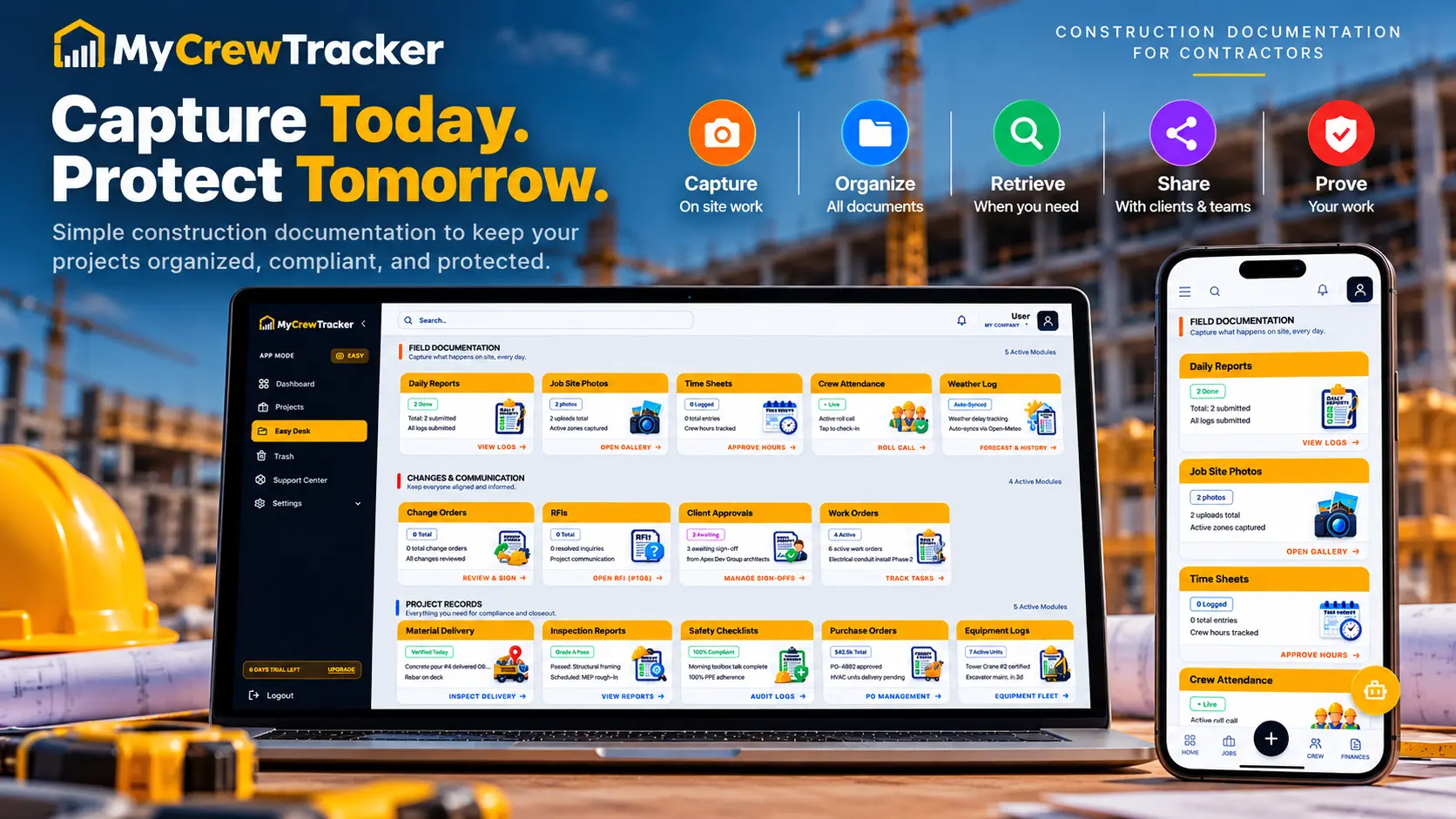
MyCrewTracker provides a centralized, cloud-based platform designed to help Pennsylvania contractors organize, retrieve, and securely retain vital project documentation. By moving away from scattered paper files and disorganized email threads, your team can maintain a single source of truth for all job site records, invoices, and change orders.
Contractor and Subcontractor Payment Act (CASPA) — 73 P.S. § 501 et seq.
In Pennsylvania, timely payment on commercial construction projects is mandated by the Contractor and Subcontractor Payment Act (CASPA), codified at 73 P.S. § 501 et seq. This powerful statute protects contractors from abusive withholding of funds by establishing strict payment timelines and imposing significant penalties on parties who withhold payment in bad faith.
The 20-Day and 14-Day Payment Rules
Under CASPA, property owners generally have 20 days to pay a general contractor after receiving a proper invoice. The 20-day period runs from the later of the end of the billing period or the delivery of the invoice to the owner. Once the general contractor is paid, they have 14 days to pay their subcontractors.
If payment is not made within the statutory timeframe, the withholding party may be subject to interest penalties. Under CASPA, interest begins to accrue on the eighth day after the established due date at a rate of 1 percent per month. If the withholding is found to be in bad faith, the court may impose an additional penalty of 1 percent per month, along with reasonable attorney fees and litigation costs.
Deficiency Notices: The 14-Day Response Window
A critical component of CASPA is the deficiency notice requirement. If an owner or contractor wishes to withhold payment based on a deficiency claim, they must provide written notice of the deficiency within 14 days of receiving the invoice. Failure to provide timely notice of a deficiency waives the right to withhold payment on that basis.
The written notice must include a good-faith explanation of the reason for withholding payment. This documentation requirement is central to CASPA enforcement — without a documented, timely deficiency notice, the withholding party cannot justify non-payment.
What CASPA Does Not Cover
CASPA does not apply to public projects or to government agencies. The Pennsylvania Supreme Court has ruled that CASPA does not extend to government projects. For public construction projects, the Pennsylvania Prompt Payment Act (PPA) governs payment obligations.
Documentation Requirements for CASPA Compliance
The core of any CASPA claim relies heavily on document tracking. MyCrewTracker's Quick Docs system empowers Pennsylvania contractors to securely store properly dated invoices, proofs of delivery, and signed contracts in the cloud. By establishing an irrefutable timeline of when an invoice was submitted, contractors can confidently assert their rights under CASPA.
Pennsylvania Lien Deadlines at a Glance
Missing a single deadline in Pennsylvania can void your lien rights entirely. The table below summarizes the statutory deadlines every Pennsylvania contractor, subcontractor, and material supplier must track.
| Action | Deadline | Statute |
|---|---|---|
| Owner pay contractor (CASPA) | Within 20 days of billing period or invoice | 73 P.S. § 501 et seq. |
| Contractor pay subcontractor (CASPA) | Within 14 days of receiving payment | 73 P.S. § 501 et seq. |
| Deficiency notice (CASPA) | Within 14 days of receiving invoice | 73 P.S. § 501 et seq. |
| Subcontractor notice of intent to lien | At least 30 days before filing lien | 49 P.S. § 1501 |
| File mechanics lien claim with Prothonotary | Within 6 months of completion of work | 49 P.S. § 1502 |
| Serve notice of lien filing on owner | Within 1 month after filing | 49 P.S. § 1502 |
| File affidavit of service | Within 20 days after service | 49 P.S. § 1502 |
| File Notice of Furnishing (Searchable Projects) | Within 45 days of first work | 49 P.S. § 1501.3 |
| Construction defect statute of repose | 12 years from completion of construction | 42 Pa.C.S. § 5536 |
| Retainage cap (public projects) | 5% of contract price | 62 Pa.C.S. § 3903 |
Pennsylvania Mechanics Lien Law — 49 P.S. § 1501 et seq.
Pennsylvania's Mechanics Lien Law provides a powerful remedy for contractors, subcontractors, and material suppliers who have not been paid. However, the process is strictly procedural, and missing a deadline can result in complete forfeiture of lien rights.
Notice of Intent to Lien — 49 P.S. § 1501
Under 49 P.S. § 1501, a subcontractor must provide formal written notice to the owner of their intention to file a mechanics lien at least 30 days before the lien claim is filed. This notice is a condition precedent to a valid subcontractor lien — no claim by a subcontractor shall be valid unless this 30-day notice has been given.
The notice may be served by first-class, registered, or certified mail on the owner or their agent, or by personal service in the same manner as a writ of summons.
Filing the Lien Claim — 49 P.S. § 1502
Under 49 P.S. § 1502, every claimant must file a claim with the prothonotary (the clerk of the Court of Common Pleas) in the county where the property is located within six (6) months after the completion of their work. The lien claim must include the names of the parties, the amount claimed, the nature of the work or materials, and a description of the property sufficient for identification.
Serving the Lien Claim — 49 P.S. § 1502
After filing the lien claim, the claimant must serve written notice of the filing upon the owner within one (1) month after filing. An affidavit of service must be filed within twenty (20) days after service, setting forth the date and manner of service. Failure to serve the notice or file the affidavit of service within the specified times is sufficient grounds for striking the lien claim.
Pennsylvania State Construction Notices Directory
Pennsylvania operates a unique online registry for large construction projects. The State Construction Notices Directory was created in accordance with Act 142 of 2014 (49 P.S. §§ 1501.1 – 1501.6) to provide additional protections under the Mechanics' Lien Law.
What Is a Searchable Project?
A "Searchable Project" is a construction project costing $1,500,000 or more where the owner voluntarily registers the project by filing a Notice of Commencement in the State Construction Notices Directory. The Directory provides a convenient online platform for owners, contractors, and subcontractors to access, register, and file construction notices.
Notice of Furnishing Requirement
For Searchable Projects, subcontractors must file a Notice of Furnishing within 45 days after first performing work or providing materials to the job site. This notice is filed with the Directory and serves as an additional layer of protection for subcontractors.
Notice of Nonpayment
Subcontractors who have not received full payment for their work on a Searchable Project may file a Notice of Nonpayment with the Searchable Project Owner, the owner's agent, or the contractor acting as agent. This notice is filed for informational purposes and provides documentation of non-payment.
Pennsylvania Construction Defect Statute of Repose — 42 Pa.C.S. § 5536
Under 42 Pa.C.S. § 5536, any action against a person arising from the design, planning, supervision, observation of construction, or construction of any improvement to real property must be commenced within 12 years after completion of construction of such improvement.
The Pennsylvania Supreme Court has confirmed that the 12-year statute of repose is an absolute bar to claims, rejecting the application of tolling doctrines such as nullum tempus. This means that after 12 years, covered claims are barred even if the alleged defect was not discovered until much later. Contractors should retain project records for at least 12 years to support any defense against defect claims.
How to File a Mechanics Lien in Pennsylvania: Step by Step
1. Log your last day of work. Pennsylvania's 6-month filing clock starts from the completion of your work. MyCrewTracker's Daily Reports timestamp this automatically.
2. Serve the 30-Day Notice of Intent (subcontractors only). Under 49 P.S. § 1501, serve a formal written notice on the owner at least 30 days before filing the lien.
3. Prepare the lien claim. The claim must include the names of the parties, the amount claimed, the nature of the work, and a description of the property.
4. File the lien claim with the Prothonotary. File in the Court of Common Pleas of the county where the property is located, within 6 months of completing your work.
5. Serve notice of filing on the owner. Within 1 month after filing, serve written notice of the lien filing on the owner.
6. File the affidavit of service. Within 20 days after service, file an affidavit of service setting forth the date and manner of service.
7. Preserve all project documentation. Daily reports, delivery tickets, change orders, and photos become evidence in the enforcement action.
Documents to Preserve for a Pennsylvania Lien Claim
Pennsylvania courts require strict compliance with the procedural requirements of the Mechanics Lien Law. The following records are what you need:
- Signed contract or purchase order with the prime contractor
- Proof of service of the 30-Day Notice of Intent to Lien
- Delivery tickets signed by an authorized site representative
- Daily reports showing crew on site and work performed
- Photo evidence of installed work (timestamped and geotagged)
- Jobsite sign-in logs and crew attendance records
- Invoices, statements, and payment applications
- Email or text correspondence about scope and payment
- Change orders and extra work authorizations
- Proof of service of the lien claim and affidavit of service
MyCrewTracker stores all of these in one project record. When a lien deadline approaches, the back office can generate the timeline needed to prepare the lien claim without reconstructing months of field activity.
Pennsylvania-Specific Gotchas
CASPA penalties are severe. Interest accrues at 1% per month on the overdue amount, and bad-faith withholding can trigger an additional 1% per month penalty plus attorney fees. Document every invoice date and every deficiency notice.
The 14-day deficiency notice is a strict deadline. If you fail to provide a written deficiency notice within 14 days of receiving an invoice, you waive the right to withhold payment on that basis.
The 30-day Notice of Intent is a prerequisite for subcontractors. No claim by a subcontractor is valid unless the owner received formal written notice at least 30 days before the lien was filed.
The 6-month filing deadline is absolute. 49 P.S. § 1502 gives you exactly 6 months from completion of your work to file the lien claim with the Prothonotary.
The 1-month service requirement is often overlooked. After filing the lien, you must serve notice on the owner within 1 month, and file the affidavit of service within 20 days of service.
The 12-year statute of repose is an absolute bar. Under 42 Pa.C.S. § 5536, no construction defect claim may be brought more than 12 years after completion of construction. Retain project records for at least 12 years.
Searchable Projects require a Notice of Furnishing. For projects registered in the State Construction Notices Directory, subcontractors must file a Notice of Furnishing within 45 days of first performing work.
Example Scenario: How Documentation Determines the Outcome
*The following is an illustrative scenario, not a specific case. It demonstrates how record-keeping affects outcomes in Pennsylvania lien disputes.*
Consider a Philadelphia mechanical subcontractor on a $750,000 commercial office renovation. The sub's last day of substantial work is August 15. Under 49 P.S. § 1501, the sub must serve the 30-Day Notice of Intent to Lien by September 15. The sub serves it via certified mail on September 10.
Under 49 P.S. § 1502, the sub has 6 months from August 15 to file the lien claim with the Philadelphia County Prothonotary. That deadline is February 15. The sub files the lien claim on January 20 and serves notice on the owner on February 10 — within the 1-month requirement. The affidavit of service is filed on February 25 — within the 20-day requirement.
Now consider the CASPA side. The general contractor received a $500,000 progress payment from the owner on July 1. Under CASPA, the GC had 14 days to pay the sub — by July 15. The GC failed to pay. The sub is entitled to interest at 1% per month from July 16 until the check is drawn. If the withholding is found to be in bad faith, the court may impose an additional 1% monthly penalty and award attorney fees.
Documentation is what separates these outcomes. MyCrewTracker logs the last day of work, the notice service date, the filing date, and the daily reports that prove performance.
What MyCrewTracker Does (and Does Not Do) in Pennsylvania
MyCrewTracker is a construction documentation platform, not a legal service. Here is what it does for Pennsylvania contractors:
- Logs first day and last day of work per project so you can calculate the 6-month lien filing window
- Stores certified mail receipts and Notice of Intent documents in the project file
- Records delivery tickets with photo and signature capture
- Captures timestamped, GPS-tagged site photos that document installation
- Generates daily report PDFs that serve as contemporaneous records
- Tracks payment application dates for CASPA compliance
- Archives project records for 12+ years to support construction defect defense
It does not draft Notices of Intent to Lien, file lien claims with the Prothonotary, or provide legal advice. Those steps require a Pennsylvania construction attorney.
❓ Frequently Asked Questions in Pennsylvania
What is CASPA in Pennsylvania?
The Contractor and Subcontractor Payment Act (CASPA) is a Pennsylvania statute (73 P.S. § 501 et seq.) designed to mandate timely payments on commercial construction projects. It sets strict deadlines for owners to pay general contractors (20 days) and for general contractors to pay subcontractors (14 days), while penalizing unjustified withholding with interest, penalties, and attorney fees.
How many days does a GC have to pay a subcontractor in Pennsylvania?
Under CASPA, once a general contractor receives payment from the property owner for a subcontractor's work, the general contractor has 14 days to pass that payment down to the subcontractor.
What is the 14-day deficiency notice requirement under CASPA?
If an owner or contractor wishes to withhold payment based on a deficiency claim, they must provide written notice of the deficiency within 14 days of receiving the invoice. Failure to do so waives the right to withhold on that basis.
How long do I have to file a mechanics lien in Pennsylvania?
You have 6 months from the completion of your work to file the lien claim with the Prothonotary of the county where the property is located.
Do subcontractors need to provide notice before filing a lien in Pennsylvania?
Yes. Under 49 P.S. § 1501, a subcontractor must provide formal written notice to the owner at least 30 days before filing the lien claim.
What is the Pennsylvania State Construction Notices Directory?
It is an online registry for construction projects costing $1,500,000 or more. Owners may voluntarily register their project by filing a Notice of Commencement, which triggers additional notice requirements for subcontractors, including a Notice of Furnishing within 45 days of first performing work.
What is the Pennsylvania construction defect statute of repose?
Under 42 Pa.C.S. § 5536, any action arising from the design, planning, or construction of an improvement to real property must be commenced within 12 years after completion of construction. This is an absolute bar to claims.
Does CASPA apply to public projects?
No. The Pennsylvania Supreme Court has ruled that CASPA does not extend to government projects. Public projects are governed by the Pennsylvania Prompt Payment Act.
Can I use MyCrewTracker to track Pennsylvania mechanics lien deadlines?
Yes, while MyCrewTracker does not calculate legal deadlines for you, our platform is an excellent tool for storing the certified mail receipts, dated invoices, and daily reports you will need to prove that you met Pennsylvania's strict statutory deadlines.
Legal Sources & References
-
Contractor and Subcontractor Payment Act 73 P.S. § 501 et seq.
Pennsylvania CASPA — Establishes strict payment timelines (20 days for owners, 14 days for general contractors), interest at 1% per month, bad-faith penalties, and attorney fee recovery for non-payment on commercial construction projects.
-
Mechanics Lien Law — Formal Notice by Subcontractor 49 P.S. § 1501
Pennsylvania Mechanics Lien — No claim by a subcontractor shall be valid unless formal written notice of intention to file a claim is given to the owner at least 30 days before filing.
-
Mechanics Lien Law — Filing and Notice of Claim 49 P.S. § 1502
Pennsylvania Lien Filing — Every claimant must file a claim with the Prothonotary within 6 months after completion of work. Written notice of filing must be served on the owner within 1 month, and an affidavit of service must be filed within 20 days after service.
-
State Construction Notices Directory 49 P.S. §§ 1501.1 – 1501.6
Pennsylvania Searchable Projects — Established by Act 142 of 2014, the Directory provides an online platform for filing Notices of Commencement, Notices of Furnishing, and Notices of Nonpayment on projects costing $1,500,000 or more.
-
Construction Defect Statute of Repose 42 Pa.C.S. § 5536
Pennsylvania Statute of Repose — No action arising from the design, planning, supervision, observation of construction, or construction of an improvement to real property may be commenced more than 12 years after completion of construction.
-
Pennsylvania General Assembly General Reference
Official Pennsylvania General Assembly website — Searchable index of all Pennsylvania Consolidated Statutes.
Protect Your Projects & Retain Required Pennsylvania Records
Defend against back-charges, audit penalties, and mechanic's lien disputes. Keep GPS-timestamped photos, certified timesheets, and signed change orders safely backed up for just $40/month.