Operating a construction business in California involves navigating a complex landscape of regulatory requirements, safety standards, and liability risks. For small and tiny contractors, maintaining organized project records is not just good business practice—it is essential for long-term operational health.
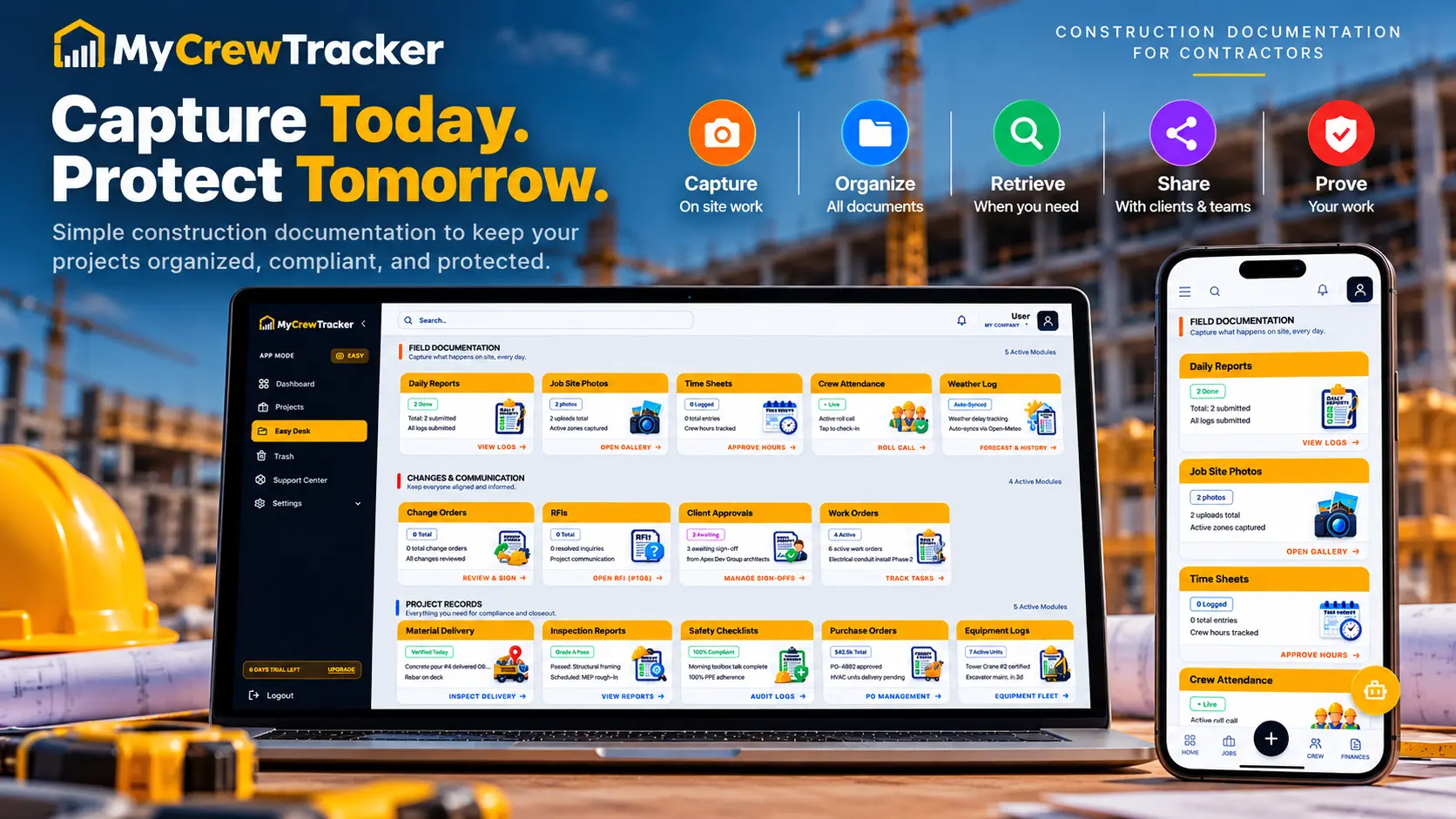
MyCrewTracker provides a centralized, cloud-based platform designed to help California contractors organize, retrieve, and securely retain vital project documentation. By moving away from scattered paper files and disorganized email threads, your team can maintain a single source of truth for all job site records.
California Contractor Record-Keeping (CSLB Requirements)
The California Contractors State License Board (CSLB) has strict guidelines for business records. Under California Business and Professions Code (BPC) § 7111, licensed contractors are required to make and keep records showing all contracts, documents, records, receipts, and disbursements of all transactions as a contractor. Failure to keep these records, or failure to have them available for inspection by the CSLB Registrar, is a cause for disciplinary action.
These records must generally be kept for a period of not less than five years after the completion of the project and must be available for inspection by the CSLB upon request. MyCrewTracker assists contractors in meeting this standard by providing secure, long-term cloud storage (Quick Docs) where project files can be neatly archived and rapidly retrieved if an inspection occurs.
What Records Must California Contractors Keep?
Under BPC § 7111, the records that must be maintained include:
- All contracts and contract documents
- All records of receipts
- All records of disbursements
- All documents related to transactions as a contractor
These records must be available for inspection by the Registrar or a duly authorized representative for a period of not less than five years after completion of any construction project or operation to which the records refer.
Safety Documentation and Cal/OSHA
Safety is paramount on California job sites. The Department of Industrial Relations (Cal/OSHA) mandates that employers maintain specific work-related injury and illness logs for a minimum of five years.
Cal/OSHA Recordkeeping Requirements
Under California Code of Regulations, Title 8, § 14300.33, employers must save the following records for five (5) years following the end of the calendar year that these records cover:
- Cal/OSHA Form 300 — Log of Work-Related Injuries and Illnesses
- Cal/OSHA Form 300A — Summary of Work-Related Injuries and Illnesses
- Cal/OSHA Form 301 — Injury and Illness Incident Report
- Privacy case list (if one exists)
The log, summary, and incident reports are not required to be submitted to Cal/OSHA but must be maintained on file for five years.
What This Means for California Contractors
For a contractor operating in California, this means:
- Every recordable injury or illness must be logged on Form 300 within 7 calendar days of learning about it
- Form 300A must be posted at each establishment from February 1 to April 30 each year
- All records must be retained for 5 years following the year they cover
- Failure to maintain these records can result in Cal/OSHA citations and penalties
While specific safety hazards (like lead or asbestos) may require even longer retention periods, MyCrewTracker's Daily Reports and Photo Management features allow job site supervisors to consistently log daily conditions, safety meetings, and site photos, creating a permanent, date-stamped historical record to support your company's safety program.
Construction Defect Liability (Statute of Repose)
California law distinguishes between "patent" (obvious) and "latent" (hidden) construction defects. Under California Code of Civil Procedure (CCP) § 337.15, no action may be brought to recover damages from any person who develops real property or performs construction of an improvement to real property more than 10 years after substantial completion of the improvement.
This 10-year statute of repose is an absolute bar. Even if a latent defect is not discovered until after the 10-year period, the claim is barred.
The Right to Repair Act (SB 800)
For residential homes sold on or after January 1, 2003, the SB 800 "Right to Repair Act" governs construction defect actions. Under this law, homeowners have 10 years to file suit in most instances if the builder does not make a repair offer or fails to fix the problem correctly.
Practical Implications for Record Retention
To defend against defect claims years after a project wraps, contractors often choose to retain blueprints, RFIs, approved change orders, and daily logs for at least a decade. MyCrewTracker serves as a reliable archive, ensuring that crucial project communications and sign-offs are not lost when an employee leaves or a physical hard drive fails.
Documents to Retain for Construction Defect Defense
| Document Type | Retention Period | Why |
|---|---|---|
| Contracts and change orders | 10+ years | Proves scope of work and authorized changes |
| Daily reports and field logs | 10+ years | Establishes contemporaneous conditions |
| Site photos (timestamped) | 10+ years | Visual proof of work quality and conditions |
| RFIs and responses | 10+ years | Shows design clarifications and approvals |
| Inspection records | 10+ years | Documents code compliance at each phase |
| Subcontractor agreements | 10+ years | Defines responsibility boundaries |
| Warranty documents | 10+ years | Tracks manufacturer and installer warranties |
Mechanic's Liens and Payment Documentation
Securing your right to payment in California requires strict adherence to mechanic's lien deadlines, starting with the 20-Day Preliminary Notice.
California 20-Day Preliminary Notice
Under California Civil Code § 3097, a "Preliminary 20-day notice" is a written notice from a claimant that is given prior to recording a mechanic's lien, prior to filing a stop notice, and prior to asserting a claim against a payment bond.
Key rules for California's 20-Day Preliminary Notice:
- Must be served on the owner, general contractor, and construction lender (if known)
- Must be given no later than 20 days after the claimant first furnishes labor, service, equipment, or materials to the job site
- If served late, the claimant loses lien rights for work done or materials delivered more than 20 days before the notice
- The notice is not a lien and is not a reflection on the integrity of any contractor
California Lien Deadlines at a Glance
| Action | Deadline | Statute |
|---|---|---|
| Serve 20-Day Preliminary Notice | Within 20 days of first furnishing labor or materials | Civil Code § 3097 |
| Record mechanic's lien (direct contractor) | Within 90 days after completion of the work of improvement | Civil Code § 8412 |
| Record mechanic's lien (subcontractor) | Within 90 days after completion of the work of improvement | Civil Code § 8412 |
| Serve notice of lien | Within 10 days of recording lien | Civil Code § 8416 |
| File suit to enforce lien | Within 90 days after recording lien | Civil Code § 8460 |
Documents to Preserve for California Lien Claims
Maintaining proof of service, signed contracts, and approved change orders is vital if a payment dispute arises. MyCrewTracker helps contractors centralize these financial and contractual documents so they are immediately accessible when pursuing a claim.
- Certified mail receipt for the 20-Day Preliminary Notice
- Signed contract and all change orders
- Payment applications and invoices
- Daily reports showing work performed
- Delivery tickets and materials receipts
- Photo evidence of installed work
- Correspondence about payment and scope
California-Specific Gotchas
- The 20-Day Preliminary Notice is a prerequisite. Under California Civil Code § 3097, serving this notice is a condition precedent to recording a valid mechanic's lien, serving a stop payment notice, or making a payment bond claim. Unlike some states where the notice is optional for certain claimants, California requires it for most subcontractors and suppliers.
- CSLB inspection is not optional. BPC § 7111 requires that contractor records be made available for inspection by the CSLB Registrar upon request. Failure to comply can result in disciplinary action against your license.
- The 10-year statute of repose is absolute. CCP § 337.15 bars any action for latent construction defects more than 10 years after substantial completion, regardless of when the defect is discovered. Keep your project records for at least 10 years.
- Cal/OSHA Form 300A must be posted annually. From February 1 to April 30 each year, you must post the annual summary of work-related injuries and illnesses at each establishment. Even if you have no recordable injuries, you must still post the form showing zero injuries.
- Public works retainage is different. On California public works projects, the retention is typically 5% but can be higher under certain conditions. Labor Code § 1776 requires contractors to keep accurate certified payroll records showing name, address, social security number, work classification, and straight time and overtime hours worked each day and week.
- Payroll records for public works must be certified. Each payroll record must contain or be verified by a written declaration that it is made under penalty of perjury. Failure to maintain these records can result in penalties and debarment from public works projects.
Example Scenario: How Documentation Determines the Outcome
The following is an illustrative scenario, not a specific case. It demonstrates how record-keeping affects outcomes in California construction disputes.
Consider a Los Angeles drywall subcontractor on a $650,000 commercial tenant improvement. The sub first furnishes labor on March 1. Under Civil Code § 3097, the 20-Day Preliminary Notice must be served by March 21. The sub serves it on March 15 via certified mail to the owner, general contractor, and construction lender. The green cards return signed by March 18.
The project completes on October 15. Under Civil Code § 8412, the sub has 90 days from completion to record a mechanic's lien. That deadline is January 13. The sub records the lien on January 5 and serves notice on the owner on January 10, well within the 10-day requirement.
Under Civil Code § 8460, the sub must file suit within 90 days of recording the lien. That deadline is April 5. The sub files suit on March 20. The lien is enforceable.
Now consider the same sub who failed to serve the Preliminary Notice. Under Civil Code § 3097, the sub cannot record a valid mechanic's lien at all. The sub loses all lien rights and must pursue payment through contract claims or stop payment notices (which also require the preliminary notice). The $85,000 owed on the project becomes significantly harder to collect.
Documentation is what separates these outcomes. MyCrewTracker logs the first day of work, the notice service date, the completion date, and the daily reports that prove performance. When the 90-day deadline approaches, the back office has the complete timeline needed to prepare and record the lien.
What MyCrewTracker Does (and Does Not Do) in California
MyCrewTracker is a construction documentation platform, not a legal service. Here is what it does for California contractors:
- Logs first day and last day of work per project so you can calculate the 20-day notice deadline and the 90-day filing window
- Stores certified mail receipts and 20-Day Preliminary Notice documents in the project file
- Records delivery tickets with photo and signature capture
- Captures timestamped, GPS-tagged site photos that document installation
- Generates daily report PDFs that serve as contemporaneous records
- Tracks safety logs for Cal/OSHA Form 300 compliance
- Archives project records for 10+ years to support construction defect defense
- Maintains certified payroll records for public works projects
It does not draft lien notices, file documents with the county recorder, or provide legal advice. Those steps require a California construction attorney.
❓ Frequently Asked Questions in California
How long does a contractor need to keep records in California?
According to California Business and Professions Code § 7111, licensed contractors must retain business and project records for at least five (5) years after the completion of a project. However, to defend against potential latent construction defect claims, many legal professionals recommend retaining critical project documents for up to 10 years.
Does the CSLB audit contractor records?
Yes. BPC § 7111 requires that contractor records be made available for inspection by the CSLB Registrar (or an authorized representative) upon request. Failure to comply can result in disciplinary action.
How long must I keep Cal/OSHA injury logs?
Cal/OSHA generally requires that work-related injury and illness logs (Forms 300, 300A, and 301) be retained for five (5) years following the end of the calendar year they cover.
What is the California 20-Day Preliminary Notice?
Under California Civil Code § 3097, the 20-Day Preliminary Notice is a written notice that subcontractors, suppliers, and laborers must serve on the owner, general contractor, and construction lender within 20 days of first furnishing labor or materials. It is a prerequisite to recording a valid mechanic's lien.
What happens if I serve the 20-Day Preliminary Notice late?
If the notice is late, the claimant loses lien rights for work done or materials delivered more than 20 days before the notice was served.
How long is California's statute of repose for construction defects?
Under California Code of Civil Procedure § 337.15, no action may be brought for latent construction defects more than 10 years after substantial completion of the improvement. This is an absolute bar, regardless of when the defect is discovered.
What is the Right to Repair Act (SB 800)?
For residential homes sold on or after January 1, 2003, SB 800 governs construction defect actions. It gives builders the opportunity to repair defects before being sued, and homeowners generally have 10 years to file suit if the builder does not make a repair offer.
What payroll records must I keep for California public works?
Under Labor Code § 1776, contractors and subcontractors must keep accurate certified payroll records showing name, address, social security number, work classification, and straight time and overtime hours worked each day and week. Each record must be verified under penalty of perjury.
Can MyCrewTracker generate my California lien notices?
No. MyCrewTracker is a document organization platform. It helps you track your project start dates, store notices, and preserve the records you will need. You must manually draft and serve your notices with the assistance of a licensed California construction attorney.
Legal Sources & References
-
Contractor Record-Keeping Requirement BPC § 7111
California Business and Professions Code § 7111 — Licensed contractors must keep records of all contracts, documents, receipts, and disbursements for not less than five years after completion of any construction project. Failure to maintain records is a cause for disciplinary action.
-
Cal/OSHA Recordkeeping Retention 8 CCR § 14300.33
California Code of Regulations, Title 8, § 14300.33 — Requires employers to save Cal/OSHA Forms 300, 300A, and 301 for five years following the end of the calendar year they cover.
-
Construction Defect Statute of Repose CCP § 337.15
California Code of Civil Procedure § 337.15 — Bars any action for damages from latent construction defects more than 10 years after substantial completion of the improvement.
-
20-Day Preliminary Notice Civil Code § 3097
California Civil Code § 3097 — Defines the Preliminary 20-day notice required before recording a mechanic's lien, filing a stop notice, or asserting a payment bond claim on private works.
-
Right to Repair Act (SB 800) Civil Code § 895 et seq.
California Civil Code §§ 895–945.5 — The Right to Repair Act governs construction defect actions for residential homes sold on or after January 1, 2003.
-
California Contractor State License Board (CSLB) General Reference
Official CSLB website — License verification, consumer resources, and contractor law publications.
-
California Department of Industrial Relations (Cal/OSHA) General Reference
Official Cal/OSHA website — Safety and health regulations, recordkeeping requirements, and compliance resources.
Ready to organize your jobs?
Join contractors in California using MyCrewTracker.