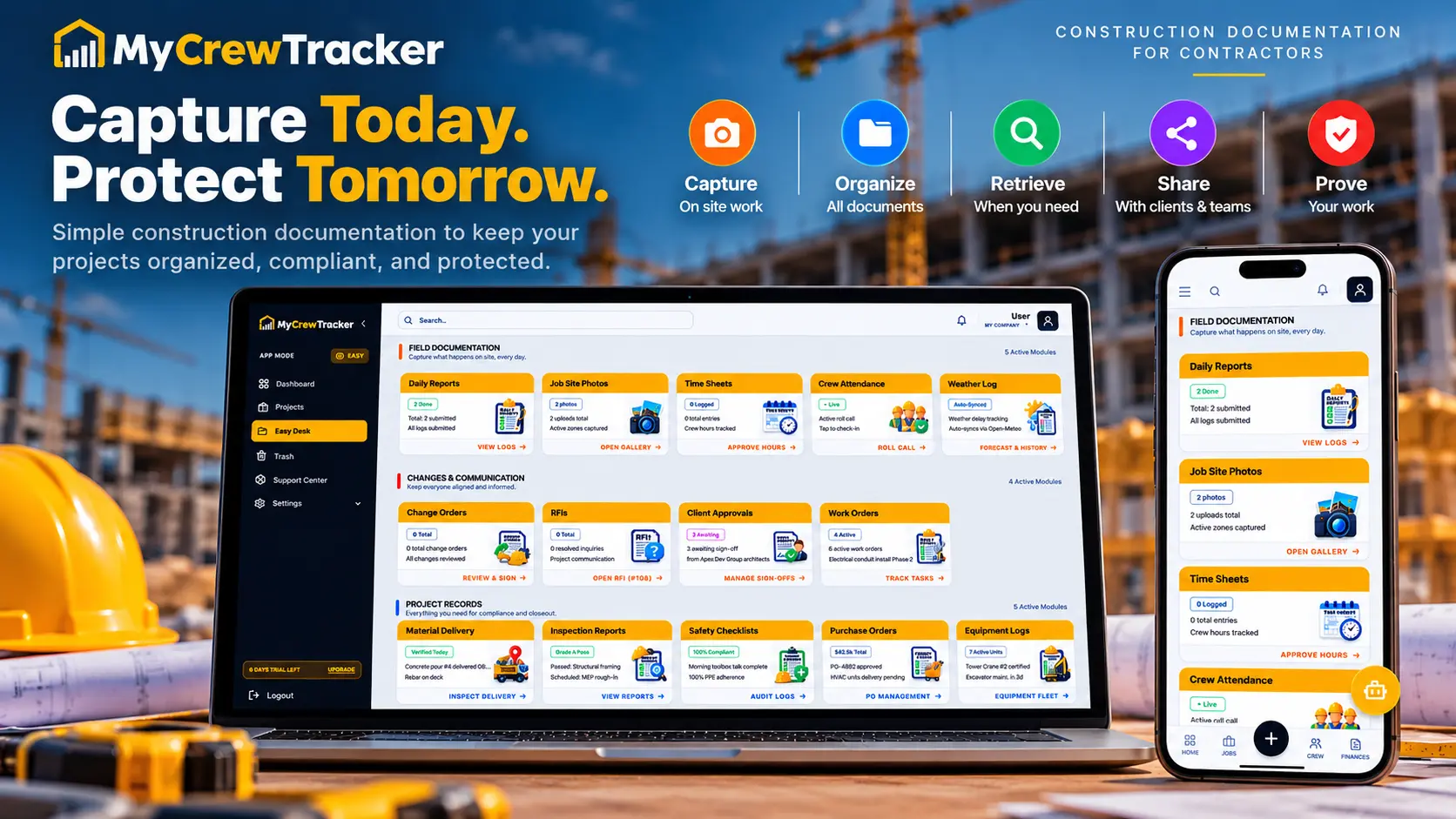
Hawaii's vibrant construction industry, spanning across its unique island geography, requires diligent project management and adherence to specific local regulations. From high-rise developments in Honolulu to residential projects on the Big Island, contractors and subcontractors must navigate Hawaii's distinct legal landscape, which often involves formal court proceedings for dispute resolution and lien claims. Unlike most states where a mechanic's lien is recorded with a county clerk, Hawaii requires lien claimants to file an Application for a Lien and a Notice of Lien with the circuit court where the property is located. Missing the 45-day filing deadline or the 3-month enforcement window can extinguish your lien rights entirely. On public projects, mechanics liens are prohibited — claims must be made against the payment bond. MyCrewTracker is designed to streamline construction document management in Hawaii by providing a centralized platform for tracking project timelines, storing essential communications, and documenting site conditions. By helping construction professionals stay organized and maintain comprehensive records, MyCrewTracker simplifies the complex process of managing projects under Hawaii's specific construction laws, ensuring teams can focus on building rather than administrative burdens.
Hawaii Mechanics and Materialmen's Liens (HRS § 507-41 to § 507-49)
Unlike many states, Hawaii's mechanics lien process is not just a simple filing but involves a formal court proceeding. To secure a lien, a contractor, subcontractor, or supplier must file an "Application for a Lien" and a "Notice of Lien" with the circuit court where the property is located.
Who Is Entitled to a Lien?
Under HRS § 507-42, any person or association of persons furnishing labor or material in the improvement of real property shall have a lien upon the improvement as well as upon the interest of the owner of the improvement in the real property upon which the same is situated. This includes general contractors, subcontractors, sub-subcontractors, suppliers, laborers, design professionals, architects, and engineers. However, an architect's or design professional's work must be incorporated into the project in order to have lien rights.
The 45-Day Filing Deadline
Under HRS § 507-43, the Application and Notice must be filed with the circuit court not later than 45 days after the date of completion of the improvement against which it is filed. If a formal Notice of Completion is filed with the Bureau of Conveyances or Land Court, the 45-day deadline runs from that filing date.
If no Notice of Completion is filed, the improvement will be considered completed one year after the substantial completion of the project — and a mechanics lien must be filed within 45 days of that date. This means the effective deadline can be up to 14 months from substantial completion if no Notice of Completion is filed.
The Court Process
Filing the Application and Notice does not automatically attach the lien. The lien attaches only after the court finds probable cause and enters an Order Directing Lien to Attach. Approximately 3 to 10 days after the lien is filed, the court will determine if probable cause exists.
Enforcement (Foreclosure) Deadline
After the court enters an order directing the lien to attach, a lawsuit to foreclose on the lien must be filed within 3 months. Hawaii liens cannot be extended, and the failure to meet this deadline for enforcement will result in the expiration of the lien claim.
Public Projects
Mechanics liens cannot be filed against public projects in Hawaii. Claims on public works must be directed against the project's payment bond. This is a critical distinction that contractors working on state or county projects must understand.
Hawaii Preliminary Notice (Voluntary)
Hawaii law (HRS Chapter 507, Part II) does not mandate a statutory preliminary notice to preserve mechanics lien rights on private construction projects.
Voluntary Notice Best Practices
While not legally required, it is highly recommended to send a preliminary notice voluntarily. This establishes visibility with the property owner and general contractor, encourages open communication, and helps prevent payment disputes. Since the notice is optional, there are no strict statutory deadlines or mandatory formats, though sending it early in the project via certified mail is considered best practice.
Hawaii Public Works Retainage (HRS § 103-32.1)
Hawaii statutes regulate retainage limits primarily on public works projects.
Public Projects
Under HRS § 103-32.1, any public contract may include a provision for the retainage of a portion of the amount due under the contract to the contractor to ensure the proper performance of the contract, provided that:
- The sum withheld by the procurement officer from the contractor shall not exceed 5% of the total amount due the contractor
- After 50% of the contract is completed and progress is satisfactory, no additional sum shall be withheld; provided further that if progress is not satisfactory, the procurement officer may continue to withhold, as retainage, sums not exceeding 5% of the amount due the contractor
- The retainage shall not include sums deducted as liquidated damages from moneys due or that may become due the contractor under the contract
Subcontractors on Public Projects
If a prime contractor withholds retainage from a subcontractor, the percentage cannot exceed the percentage of retainage withheld from the prime contractor by the public agency. Where a subcontractor has provided evidence of a valid performance and payment bond, the retention amount withheld by the contractor from its subcontractor shall be not more than the same percentage of retainage as that of the contractor.
Private Projects
Hawaii state law does not provide a specific retainage statute for private construction projects. Retainage terms on private jobs are governed entirely by the contract between the parties.
Hawaii Statute of Repose and Limitations (HRS § 657-8)
Hawaii law establishes an absolute outer limit for bringing construction defect claims, along with shorter statutes of limitations.
Statute of Repose (10 Years)
Under HRS § 657-8, no action, whether in contract, tort, statute, or otherwise, to recover damages for any injury to property, real or personal, or for bodily injury or wrongful death, arising out of any deficiency or neglect in the planning, design, construction, supervision and administering of construction, and observation of construction relating to an improvement to real property shall be commenced more than 10 years after the date of completion of the improvement. This is an absolute bar, regardless of when the defect was discovered.
Statutes of Limitations
Within that 10-year period, standard statutes of limitations apply:
- Tort claims: Must be filed within 2 years of when the cause of action accrues
- Contract claims: Must be filed within 6 years of when the cause of action accrues (e.g., when the defect is or should have been discovered)
Date of Completion Defined
Under HRS § 657-8, "date of completion" means the time when there has been substantial completion of the improvement or the improvement has been abandoned. The filing of an affidavit of publication and notice of completion with the circuit court where the property is situated in compliance with section 507-43(f) shall be prima facie evidence of the date of completion.
Contractor Repair Act (HRS Chapter 672E)
For residential claims, owners must generally provide the contractor with written notice and an opportunity to inspect and offer repairs before filing a lawsuit. Under HRS § 672E-3, a claimant must serve the contractor with a written notice of claim no later than 90 days before filing an action. The notice must state that the claimant asserts a claim for a construction defect and describe the claim in detail sufficient to determine the circumstances constituting the alleged defect and damages.
Hawaii Lien Deadlines at a Glance
| Action | Deadline | Statute |
|---|---|---|
| File Application and Notice with Circuit Court | Within 45 days of completion (or Notice of Completion filing) | HRS § 507-43 |
| Effective deadline if no Notice of Completion filed | 45 days after 1 year from substantial completion | HRS § 507-43 |
| Enforcement/Foreclosure Action | Within 3 months after Order Directing Lien to Attach | HRS § 507-43 |
| Public Works Retainage | 5% cap; no additional withholding after 50% completion | HRS § 103-32.1 |
| Contractor Repair Act Notice | 90 days before filing suit | HRS § 672E-3 |
| Statute of Repose | 10 years from date of completion | HRS § 657-8 |
| Tort Statute of Limitations | 2 years from accrual | HRS § 657-7 |
| Contract Statute of Limitations | 6 years from accrual | HRS § 657-1 |
How to File a Mechanics Lien in Hawaii: Step by Step
1. Log your first day of work. While there is no mandatory preliminary notice, tracking your first day of furnishing labor or materials is critical for establishing the timeline. MyCrewTracker's Daily Reports timestamp this automatically.
2. Monitor for a Notice of Completion. Under HRS § 507-43, if the owner files a Notice of Completion with the Bureau of Conveyances or Land Court, the 45-day filing clock starts from that date. If no notice is filed, the improvement is deemed completed one year after substantial completion.
3. Prepare the Application and Notice. Under HRS § 507-43, the Application for a Lien and Notice of Lien must be filed with the circuit court where the property is situated. The notice must include a description of the property, the amount claimed, and the names of the parties.
4. File the Application and Notice with the Circuit Court. The filing must occur not later than 45 days after the date of completion of the improvement.
5. Attend the probable cause hearing. Approximately 3 to 10 days after filing, the court will determine if probable cause exists to attach the lien.
6. File the enforcement action within 3 months. Once the court enters the Order Directing Lien to Attach, you have 3 months to file a lawsuit to foreclose on the lien.
7. Preserve all project documentation. Daily reports, delivery tickets, change orders, and photos become evidence in the enforcement action.
Documents to Preserve for a Hawaii Lien Claim
Hawaii courts require proof that you furnished labor or materials and that they were incorporated into the property. The following records are what you need:
- Signed contract or purchase order with the prime contractor
- Delivery tickets signed by an authorized site representative
- Daily reports showing crew on site and work performed
- Photo evidence of installed work (timestamped and geotagged)
- Jobsite sign-in logs and crew attendance records
- Invoices, statements, and payment applications
- Email or text correspondence about scope and payment
- Change orders and extra work authorizations
- Copy of the filed Application and Notice with circuit court stamp
- Order Directing Lien to Attach (if issued)
MyCrewTracker stores all of these in one project record. When a lien deadline approaches, the back office can generate the timeline needed to prepare the Application and Notice without reconstructing months of field activity.
Hawaii-Specific Gotchas
The court process is mandatory. Unlike most states where a lien is recorded with a county clerk, Hawaii requires a formal court proceeding. The lien does not attach until the court finds probable cause and enters an Order Directing Lien to Attach. This adds time and cost to the lien process.
The 45-day filing deadline is strict. HRS § 507-43 gives you exactly 45 days from the date of completion (or the filing of a Notice of Completion) to file the Application and Notice with the circuit court. There are no extensions.
The 1-year effective deadline is a trap. If no Notice of Completion is filed, the improvement is deemed completed one year after substantial completion. This means your 45-day clock may not start until 12 months after you finished work. Document your substantial completion date carefully.
The 3-month enforcement deadline is absolute. After the court enters the Order Directing Lien to Attach, you have exactly 3 months to file a foreclosure action. Hawaii liens cannot be extended, and missing this deadline results in expiration of the lien claim.
Public projects are off-limits for mechanics liens. Mechanics liens cannot be filed against public projects in Hawaii. Claims on public works must be directed against the project's payment bond.
Retainage is capped at 5% and stops at 50% completion. Under HRS § 103-32.1, public works retainage cannot exceed 5% of the amount due, and no additional retainage may be withheld after 50% completion (if progress is satisfactory).
Private projects have no statutory retainage cap. Hawaii does not provide a retainage statute for private projects, so the amount is strictly governed by the contract between the parties.
Statute of repose is 10 years. Under HRS § 657-8, no action may be brought for construction defects more than 10 years after the date of completion. This is an absolute bar to claims. Retain project records for at least 10 years.
Contractor Repair Act applies to residential claims. Under HRS Chapter 672E, residential claimants must provide written notice and an opportunity to repair before filing a lawsuit. The notice must be served at least 90 days before filing suit.
Example Scenario: How Documentation Determines the Outcome
*The following is an illustrative scenario, not a specific case. It demonstrates how record-keeping affects outcomes in Hawaii lien disputes.*
Consider a Honolulu mechanical subcontractor on a $750,000 commercial office renovation. The sub first furnishes labor on March 1. The sub's last day of substantial work is August 15.
The owner files a Notice of Completion with the Bureau of Conveyances on September 1. Under HRS § 507-43, the sub has 45 days from September 1 to file the Application and Notice with the Circuit Court of the First Circuit. That deadline is October 16. The sub files the Application and Notice on October 10.
The court finds probable cause and enters an Order Directing Lien to Attach on October 20. Under HRS § 507-43, the sub has 3 months from October 20 to file a foreclosure action. That deadline is January 20. The sub files suit on December 15, well within the window. The lien is enforceable.
Now consider the same sub who misses the 45-day deadline. If the sub files on October 20 instead of October 16, the lien is void entirely. The sub loses all lien rights, regardless of how much documentation they have. The $125,000 owed becomes significantly harder to collect.
Documentation is what separates these outcomes. MyCrewTracker logs the first day of work, the Notice of Completion filing date, the circuit court filing date, and the daily reports that prove performance.
What MyCrewTracker Does (and Does Not Do) in Hawaii
MyCrewTracker is a construction documentation platform, not a legal service. Here is what it does for Hawaii contractors:
- Logs first day and last day of work per project so you can calculate the 45-day filing window and the 1-year effective deadline
- Stores certified mail receipts and preliminary notice documents in the project file
- Records delivery tickets with photo and signature capture
- Captures timestamped, GPS-tagged site photos that document installation
- Generates daily report PDFs that serve as contemporaneous records
- Tracks retainage and payment dates for public works retainage compliance
- Archives project records for 10+ years to support construction defect defense
What MyCrewTracker Does NOT Do: We do not provide legal advice, draft legal documents, or file lien applications with the Hawaii circuit courts. Because Hawaii's mechanics lien process involves formal judicial proceedings, we strongly advise consulting with a licensed Hawaii construction attorney for legal guidance and representation.
❓ Frequently Asked Questions in Vermont
Is a preliminary notice required in Hawaii?
No, Hawaii does not legally require contractors or suppliers to send a preliminary notice to protect their lien rights on private projects. However, sending a voluntary notice is recommended as a best practice to establish visibility with the owner and general contractor.
When is the deadline to file a mechanics lien in Hawaii?
An "Application for a Lien" and "Notice of Lien" must be filed with the circuit court within 45 days after the "date of completion" of the project. If a Notice of Completion is filed, the 45-day deadline runs from that filing date.
How is the "date of completion" determined in Hawaii?
The date of completion is usually established by the filing of a formal "Notice of Completion" in the circuit court. If no notice is filed, it is determined by the actual date of substantial completion or abandonment of the project — and the effective deadline is 45 days after one year from substantial completion.
Can I file a mechanics lien on a public project in Hawaii?
No, mechanics liens are not permitted on public property in Hawaii. Unpaid contractors on public projects must make a claim against the payment bond.
How long do I have to enforce a mechanics lien in Hawaii?
Once the court issues an Order Directing Lien to Attach, you have 3 months to file a lawsuit to foreclose on the lien. Hawaii liens cannot be extended.
What is the maximum retainage allowed on Hawaii public projects?
On public works, retainage is capped at 5% of the amount due. Furthermore, once the project reaches 50% completion with satisfactory progress, no further retainage may be withheld.
Are there retainage limits for private projects in Hawaii?
No, Hawaii does not have statutory retainage limits for private construction projects. Retainage is determined by the terms of the private contract.
What is the Statute of Repose for construction defects in Hawaii?
Hawaii's Statute of Repose is 10 years from the date of completion under HRS § 657-8. This means no construction defect claims can be filed after this 10-year period, regardless of when the defect was discovered.
Do I need to give notice before suing for a residential construction defect in Hawaii?
Yes, under the Hawaii Contractor Repair Act (HRS Chapter 672E), residential claimants must generally provide the contractor with written notice and an opportunity to repair the defect at least 90 days before filing a lawsuit.
Can MyCrewTracker file my Hawaii lien application?
No. MyCrewTracker is a secure document management platform that helps you organize the daily reports, invoices, and delivery receipts you need to prove your case. To officially file a mechanics lien in Hawaii, you must use a qualified construction attorney or specialized legal service.
Legal Sources & References
-
Extent of Lien; Notice 9 V.S.A. § 1921
Vermont Statutes — Details the creation of a mechanics lien and the necessity of providing written notice to the property owner. The lien extends only to the portions of the contract price remaining unpaid at the time the notice is received. Advance lien waivers are void.
-
Recording Notice of Lien 9 V.S.A. § 1923
Vermont Statutes — Outlines the requirement to file a written memorandum in the town clerk's office where the real estate is situated, charging the property with the lien as of the visible commencement of work.
-
Action to Enforce Lien 9 V.S.A. § 1924
Vermont Statutes — Specifies that an action to enforce the lien and a writ of attachment must be obtained within 180 days of recording the lien.
-
Owner's Payment Obligations 9 V.S.A. § 4002
Vermont Prompt Payment Act — Establishes that owners must pay contractors within 20 days of billing or invoice delivery, whichever is later. Late payments accrue interest at the statutory rate.
-
Retainage 9 V.S.A. § 4005
Vermont Prompt Payment Act — Covers the rules for withholding retainage and mandates its release within 30 days after final acceptance. Contractors must pay subcontractors within 7 days of receiving retainage. Retention on contracted materials is prohibited in certain circumstances.
-
Civil Action — Statute of Limitations 12 V.S.A. § 511
Vermont Statutes — Establishes the general six-year statute of limitations for civil actions, applicable to construction defect claims in the absence of a statute of repose.
-
H.589 — Six-Year Statute of Repose (Pending) Vermont General Assembly — 2026 Bill
Pending legislation that would establish a six-year statute of repose for actions arising out of improvements to real property, effective July 1, 2026 if enacted.
-
Vermont General Assembly — Vermont Statutes Online General Reference
Official Vermont General Assembly website — Searchable index of all Vermont Statutes Annotated.
Ready to organize your jobs?
Join contractors in Vermont using MyCrewTracker.