Every small contractor starts the same way. A spreadsheet for job costs. A spreadsheet for employee hours. A spreadsheet for material orders. Maybe a shared drive folder with a few subfolders and a naming convention that made sense six months ago.
And for a while, it works. You're managing two jobs, a handful of employees, and the volume of information is small enough to keep in your head.
Then something shifts. You pick up a third project. You hire a fourth employee. A client asks a question you can't answer without digging through three files. And suddenly the system that got you here starts working against you.
The problem is that the shift doesn't happen all at once. It's gradual—a series of small frustrations that compound until one day you realize you're spending more time managing paperwork than managing work.
Here are the five warning signs that you've outgrown your spreadsheets. If you recognize three or more, it's time to make a change.
Warning Sign #1: You Can't Answer "How's This Job Doing?" Without Doing Math
The scenario: You're on the phone with a client or a lender. They ask a simple question: "How's the Henderson job tracking against budget?" You should be able to answer in ten seconds. Instead, you say, "Let me pull that up and get back to you."
Then you spend the next twenty minutes opening three spreadsheets, cross-referencing numbers, and hoping the data is current. By the time you call back, the moment has passed.
Why it happens: When job costs live in separate spreadsheets—one for labor, one for materials, one for change orders—there's no single source of truth. To understand a job's status, you have to manually assemble the picture. And if any of those spreadsheets hasn't been updated recently, your picture is wrong.
What it costs you: Delayed decisions. Missed opportunities to course-correct. And a nagging sense that you're always reacting instead of managing.
Research shows that 57% of firms still rely on manual handoffs before site records become usable in finance. That manual handoff is the gap between what's happening on the job and what you know about it. When the gap is measured in weeks, you're managing with a rearview mirror.
The warning sign in plain terms: If you can't answer "How's this job doing?" in under a minute, you've outgrown your spreadsheets.
Warning Sign #2: Someone Has Worked From the Wrong Drawing Revision
The scenario: Your foreman installs a wall based on a printed drawing. Two days later, the architect uploads a revision. Nobody catches it. The wall has to come out and go back in.
Why it happens: When drawings live in a shared drive or a folder of PDFs, version control is a naming convention, not a system. "Henderson_Plan_Rev_C_FINAL_USE_THIS.pdf" is not version control. It's a hope.
A widely-cited industry estimate is that about a quarter of drawings on construction sites are out of date at any given moment. When a crew installs from an outdated drawing, the rework cost is the labor and material to remove and replace the work, plus the schedule impact, plus the documentation trail to figure out who is responsible.
What it costs you: Rework typically runs 5–10% of a construction project's total value—and as much as 20% on poorly controlled projects. For a $500,000 job, a single 2% rework incident costs $10,000.
The warning sign in plain terms: If you've had even one rework incident caused by a wrong drawing revision in the last year, you've outgrown your spreadsheets.
Warning Sign #3: Your Foreman Is Doing Paperwork at 9 PM
The scenario: Your foreman finishes a ten-hour day on site. He drives home. He eats dinner. And then he sits at the kitchen table writing up daily reports, organizing photos, and trying to remember what happened at 8 AM.
Why it happens: When documentation lives on paper and in camera rolls, it becomes an evening task instead of a field task. Your crew generates the information during the day, but they can't capture it in a usable form until they're off the clock.
Construction workers spend about 90 hours per year on paperwork alone. A significant chunk of that is daily reporting—writing up what happened, who was on site, what equipment was used, what issues arose.
What it costs you: Two things. First, your foreman is burning out. Second, the daily reports that get written at 9 PM are less accurate than the ones that would be written at 4 PM. Details get fuzzy. Photos don't get attached. The record becomes unreliable exactly when you need it most.
The warning sign in plain terms: If your foreman is doing paperwork after hours, you've outgrown your spreadsheets.
Warning Sign #4: You've Eaten a Change Order Because You Couldn't Prove It Was Approved
The scenario: A verbal change order is issued on site. The superintendent says "go ahead, we'll sort out the price later." The work gets done. The paperwork never gets created. Three months later, the client disputes the charge. You eat the cost.
Why it happens: When change orders are tracked in text threads and memory, they don't get documented until someone remembers to document them. And by then, the moment has passed.
Research shows that 53% of organizations have experienced delayed final accounts because of documentation or data gaps. Change orders are where those gaps hurt most.
What it costs you: For small contractors, the math of this pattern is brutal. Legal costs for pursuing a claim often exceed the value of the damages. One construction attorney noted he advises clients not to pursue litigation unless damages are in the $150,000 to $200,000 range or higher. Below that threshold, you swallow the cost—and then it happens again.
The warning sign in plain terms: If you've written off a change order cost in the last six months because you couldn't prove it was approved, you've outgrown your spreadsheets.
Warning Sign #5: Your Bookkeeper Is Chasing You for Paperwork
The scenario: It's the end of the month. Your bookkeeper needs invoices, receipts, and change order documentation to close the books. She sends you a list. You send her half of it. She follows up. You promise to get the rest "by Friday." Friday comes and goes.
Why it happens: When project documentation and accounting software don't talk to each other, someone has to manually transfer data between them. That manual transfer creates delays, errors, and frustration.
Manual data entry is a time-consuming task—and one that's prone to preventable errors. And when billing gets delayed, cash flow suffers. For a small contractor, a 30-day delay in invoicing can mean the difference between making payroll on time and scrambling.
What it costs you: Time. Errors. Delayed billing. Strained relationships. And a bookkeeper who spends more time chasing paperwork than doing actual accounting.
The warning sign in plain terms: If your bookkeeper is regularly chasing you for documentation, you've outgrown your spreadsheets.
The Pattern Behind All Five Warning Signs
Look at those five signs again. They're not separate problems. They're the same problem showing up in different places.
Spreadsheets don't scale because they don't connect. Each one is an island. Job costs don't talk to scheduling. Drawings don't talk to daily reports. Change orders don't talk to accounting. And because nothing connects, someone—usually you—has to manually bridge the gaps.
That's fine when you're running two jobs. It's manageable when you have three employees. But at some point, the manual bridging consumes more time than the actual work. And that's when the business stops growing.
The contractors who break through that ceiling aren't smarter or harder working. They just recognize the warning signs earlier and replace the manual bridging with systems that connect.
What Changes When You Replace Spreadsheets With a Connected System
Here's what happens when your documentation, job costing, and accounting finally work together:
You can answer "How's this job doing?" in seconds. Job costs update in real time. Budget vs. actual is visible on one screen. You stop assembling pictures and start making decisions.
Everyone works from the current drawing. Version control is automatic. When a new revision is uploaded, the old one is flagged as superseded. Your crew sees the current set on their phones—not a printed copy from last week.
Your foreman gets his evenings back. Daily reports draft themselves from photos, notes, and time sheets. Your foreman reviews and approves in minutes instead of writing from scratch.
Change orders get documented before they can be disputed. Verbal approvals get logged with timestamps. Backup packages assemble themselves from photos, emails, and original scope. Nothing gets eaten because you couldn't prove it was approved.
Your bookkeeper stops chasing you. Invoices and financial data sync automatically. The books stay current. Cash flow improves because billing happens faster.
None of this requires a tech team. None of it requires weeks of training. It just requires a tool built for how small crews actually work.
Where MyCrewTracker Fits
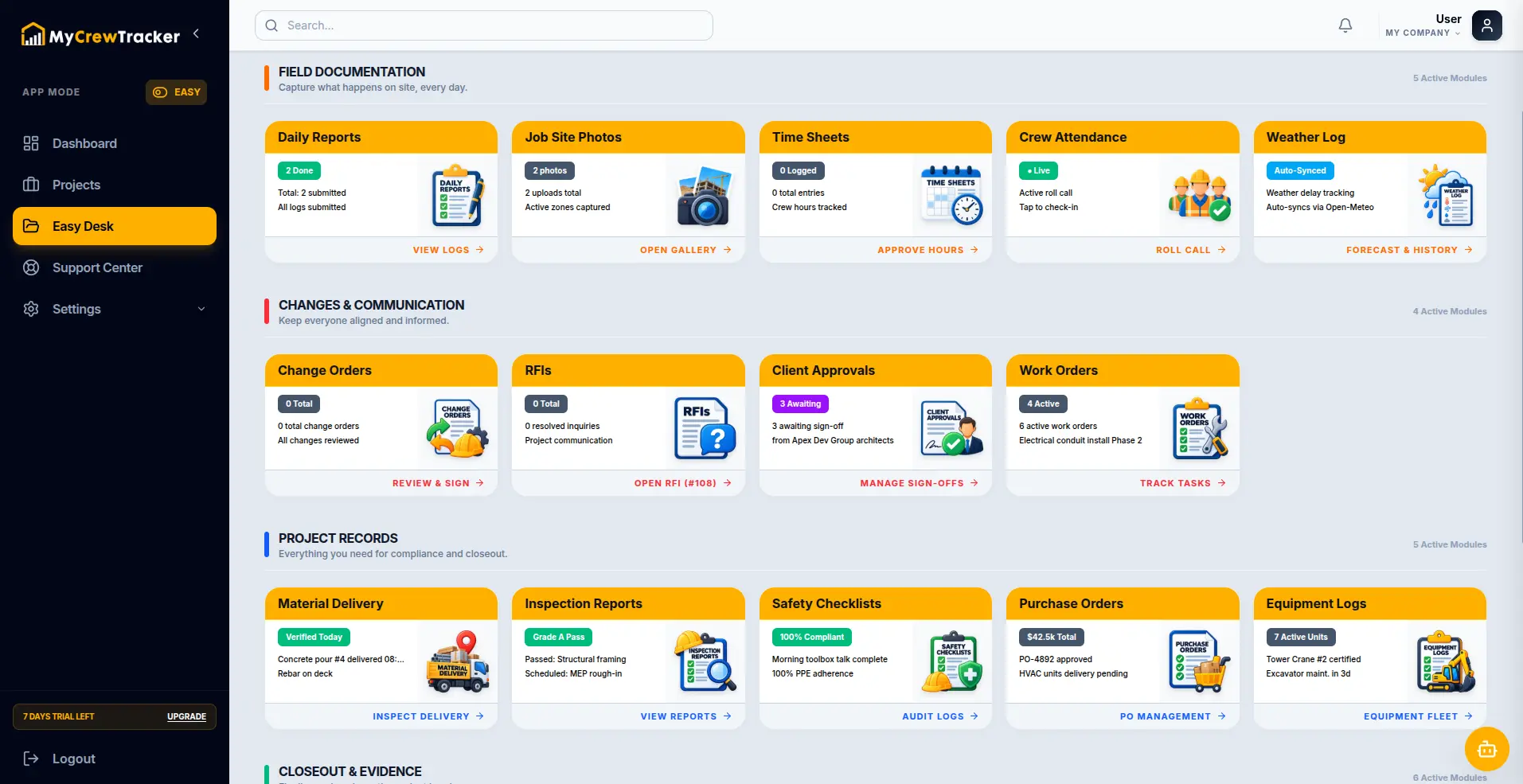
MyCrewTracker was built specifically for small contractors who've hit the spreadsheet ceiling. At $40/month flat—with unlimited projects, unlimited documents, and unlimited users—it replaces the tangle of spreadsheets with one connected platform.
Here's what you get:
Smart AI Assistant for documentation — ask questions in plain English and get answers from your plans, specs, permits, RFIs, and change orders, with the source highlighted
Real-time job costing — see where every job stands against budget without assembling spreadsheets
Automatic drawing version control — everyone works from the current set, and superseded revisions are flagged
Change order management with pending review workflows and timestamped approvals
Daily reports that draft from photos, notes, and time sheets
Crew time sheets integrated with project documents
Client approvals tracked chronologically to protect your profit
QuickBooks integration so invoices and financial data sync automatically
Estimating, invoicing, punch lists, submittals, and RFIs — all in one platform
And it comes with a 14-day full-feature free trial—no credit card required—so you can load a real project and see how it handles the problems your spreadsheets can't.
The Contractors Who Break Through
Every contractor hits the spreadsheet ceiling eventually. The question is whether you recognize it before it costs you a project—or a client—or a year of growth.
If you recognized three or more of the warning signs above, you're there. The spreadsheets that got you to this point won't get you to the next level. They'll just keep consuming more of your time while delivering less of what you need.
The contractors who thrive in 2026 won't be the ones with the most spreadsheets. They'll be the ones who replaced them with systems that connect.
Start your 14-day free trial of MyCrewTracker. Load a real project. See how it feels to answer "How's this job doing?" in ten seconds—and to close out the day without paperwork.
Ready to break through the spreadsheet ceiling? Start your 14-day free trial of MyCrewTracker and load a real project this week. No credit card required.