Every few months, another headline claims AI is coming for construction jobs. The stories paint a picture of robots on job sites, self-driving equipment, and algorithms making decisions that used to belong to experienced crews. It's a compelling narrative—and it's mostly wrong.
The 2026 data tells a different story. AI isn't replacing construction foremen. It's changing what the job looks like—and for small contractors, that change is overwhelmingly positive. Here's what the numbers actually say.
The Labor Shortage Is the Real Crisis (Not AI)
Before we talk about AI's impact on foremen, we need to talk about the crisis that's actually reshaping construction: the workforce shortage.
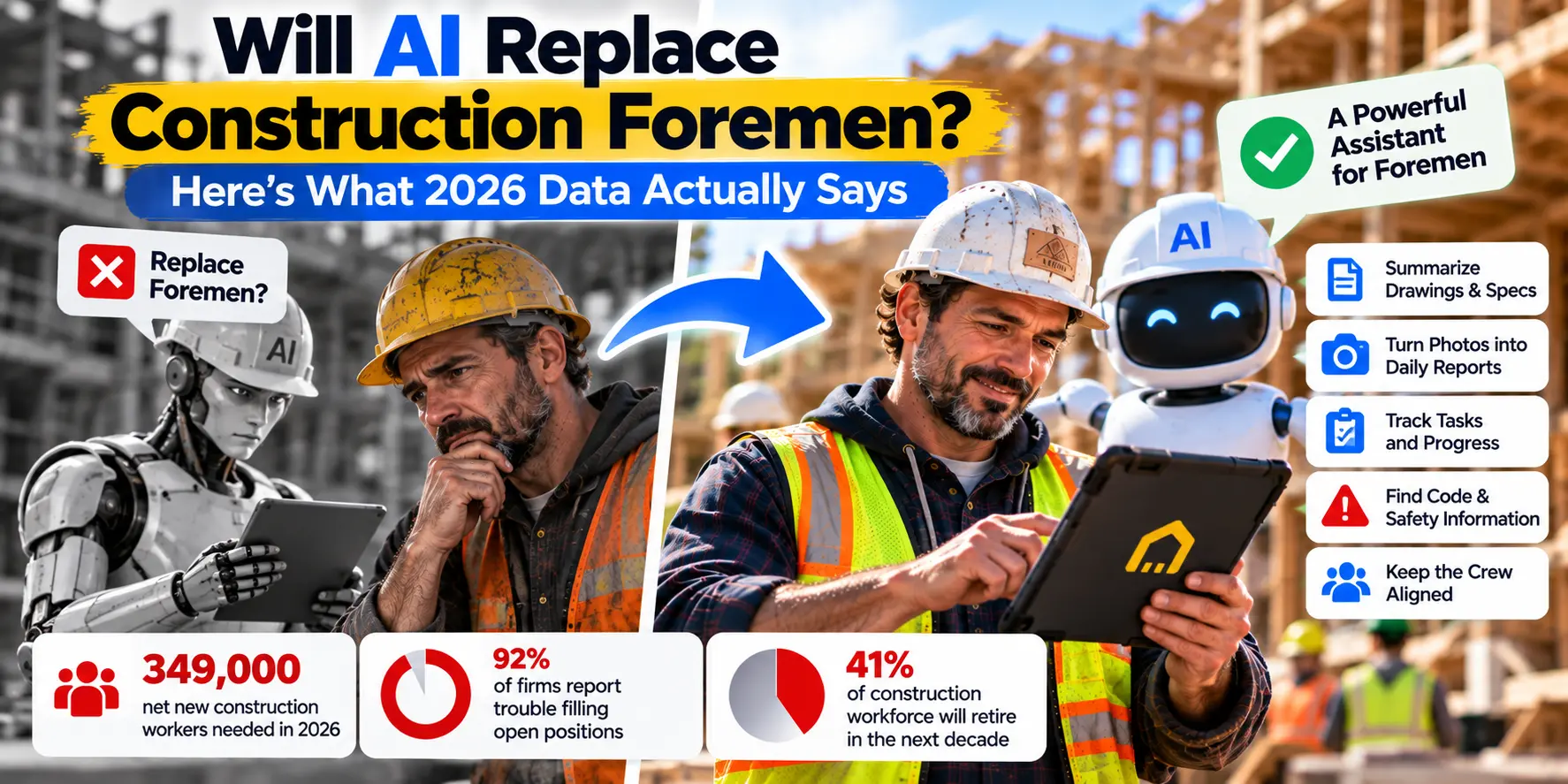
The U.S. construction industry needs approximately 349,000 net new workers in 2026 just to keep pace with demand, according to Associated Builders and Contractors' January 2026 report. More than half of those workers are needed simply to replace retirees—not to support growth. The industry is losing experienced people faster than it can replace them.
The numbers get more alarming from there:
92% of construction firms report trouble filling open positions as of 2026.
41% of the current construction workforce is expected to retire over the next decade.
Only around 10% of construction workers are under 25—meaning the pipeline of new talent is dangerously thin.
For foremen specifically, the squeeze is even tighter. Per 2026 staffing data, foreman roles are filling in about 7.8 days on average—nearly the same pace as superintendent roles, which tells you contractors are now competing for crew leaders the way they used to compete only for supers. Foremen are "the shortage within the shortage".
This is the context in which AI is entering construction. It's not replacing foremen because there's no surplus of foremen to replace. It's entering the industry because there aren't enough people to do the work that needs doing.
What AI Actually Does on a Job Site (It's Not What You Think)
Here's where the narrative gets distorted. AI in construction isn't about robots installing drywall or algorithms running a crew. It's about removing the administrative burden that keeps experienced foremen from doing what they're actually good at.
The data on administrative waste in construction is staggering. Site teams spend about 30% of their week—roughly 12 hours—searching for documents. Poor documentation contributes to $1.8 trillion in lost productivity across the global construction industry, with teams spending 10+ hours per week on avoidable tasks.
Construction workers spend about 90 hours per year on paperwork alone. Daily reports. RFI documentation. Change order tracking. Photo organization. Spec searches. All of it eats into productive time.
Now look at what AI actually absorbs. A useful framework comes from comparing the work AI handles versus the work a person keeps:
| Work AI Absorbs | Work the Foreman Keeps |
|---|---|
| Data entry and photo sorting | Deciding which issue gets attention |
| Assembling the weekly owner report | Judging whether a subcontractor is behind |
| Checking installed work against the schedule | Calling the sequencing change on the floor |
| Surfacing a plan-to-site discrepancy | Approving pay applications and schedule sign-off |
The pattern is clear: AI handles the surrounding load. The foreman handles the judgment. And judgment is exactly what AI struggles most to produce.
As one industry analysis put it: "The hard part of construction work is judgment applied to conditions that change hourly". A superintendent walking a floor filters forty possible problems down to the three that will delay projects if nobody acts today. That filtering draws on trade skills, decades of pattern recognition, and knowledge of how a crew works. No AI model can replicate that—at least not in 2026.
What Foremen Say About AI (And What the Data Shows)
The survey data from 2026 paints a picture of an industry that's optimistic about AI but still figuring out how to use it.
87% of contractors believe AI will have a meaningful impact on construction—up significantly from prior years. And 85% expect they will spend less time on repetitive, mundane tasks because of it.
Among contractors specifically, approximately 25% plan to increase AI spending in the next 12 months, while 28% have no AI investment plans and 22% remain unsure. Adoption is growing, but it's still early.
What's more telling is where AI is being deployed. Among firms using AI, 45% use it for office and administrative functions, 23% for estimating, and 20% for design and preconstruction. Administrative functions—not field operations—are where AI is making its first real impact.
And when it comes to field roles specifically, the short-term outlook is reassuring. Research analyzing AI's impact on construction trades suggests that jobs related to fieldwork remain relatively protected. The physical nature of the work, the need to adapt to site conditions, and the field expertise required make complete automation difficult. Skilled workers, site managers, and foremen will retain a central role in the execution and supervision of projects.
The jobs most exposed to AI are those involving repeatable, document-heavy tasks—estimating, quantity takeoffs, report assembly. The jobs least exposed are those requiring real-time judgment in unpredictable physical environments. Foreman work falls firmly in the second category.
The Iron Man Model: Augmentation, Not Replacement
The most useful way to think about AI in construction comes from a framing that's gaining traction in the industry: AI is more Iron Man than Terminator.
The analogy is this: AI is an exoskeleton that gives workers total recall and the ability to be in two places at once. It doesn't replace the person inside the suit. It makes the person inside the suit dramatically more capable.
What does that look like in practice?
Total recall across every project. A located visual record makes every square foot of a project retrievable months later. When a dispute arises about whether the waterproofing was installed correctly, you pull up the image and the argument ends. Photographic recall closes disputes in minutes that used to cost days.
Presence without travel. A project executive covering four projects across two states can review all of them before lunch. Senior judgment stays on more jobs when there aren't enough skilled workers to put a veteran on every site.
Time back in the evening. As one industry observer put it: "When a superintendent tells me the platform saved them time, they are almost never talking about the walk. They are talking about the hour after the walk. Sorting photos, labeling them, and hunting for the one that shows the sleeve before the wall closed. That work used to happen at night".
This is what AI actually does for foremen. It doesn't make decisions. It doesn't run crews. It doesn't replace judgment. It eliminates the administrative burden that keeps foremen from doing the work they're actually trained to do.
What AI Is NOT Good For at Foreman Scale
Honesty matters here. Not every AI feature is relevant to a small crew, and some are actively overkill.
According to a 2026 guide for small construction firms, the fastest payback on AI comes from document search, quantity takeoff, and daily report generation. Features worth piloting case by case include contract review, 360° walkthrough capture, and schedule simulation.
But several AI features are usually overkill at small-firm scale: AI safety monitoring, robotic layout, wearables, and submittal review AI. These tools are built for large enterprise operations with dedicated safety teams and IT departments. For a crew of six, they're unnecessary complexity.
The lesson: don't buy AI because it's AI. Buy it because it solves a specific problem you have today. For most small contractors, that problem is finding information—not automating safety inspections or deploying robots.
What This Means for Small Contractors
If you're running a small crew, the AI question isn't "Will this replace my foreman?" It's "Will this make my foreman more effective?"
The data suggests the answer is yes—if you choose the right tool.
Your foreman's time is your most valuable resource. Every hour they spend hunting for a spec detail or organizing photos is an hour not spent managing work, supporting the crew, or catching problems before they become expensive. AI that eliminates administrative burden directly extends your foreman's capacity.
Your crew is already stretched thin. With 92% of firms struggling to fill positions, you can't afford to waste the people you have. AI that recovers 5–10 hours per week in administrative time is equivalent to adding a part-time employee—without the hiring cost.
Your competitors are exploring AI. 25% of contractors plan to increase AI spending in the next 12 months. The ones who figure it out first will have a compounding advantage in efficiency and margin protection.
The question isn't whether to adopt AI for documentation. It's how to adopt it in a way that supports your crew instead of overwhelming them.
How to Start Using AI Without Overwhelming Your Foreman
The biggest mistake small contractors make with AI is trying to do too much at once. Here's a practical approach.
Step 1: Start with one question. Pick the thing your foreman searches for most often—a spec detail, a drawing revision, a submittal date. Find a tool that lets you ask that question in plain English and get an answer with the source cited.
Step 2: Train on one thing. Show your foreman how to ask a question. Show your project manager how to search for an RFI. Don't overwhelm anyone with features they don't need yet. The goal is to make AI feel like a tool, not a task.
Step 3: Measure the time saved. After two weeks, ask your team how much time they're saving on document searches. If the answer is "a few hours a week," you've found your ROI.
Step 4: Expand to the next use case. Once smart search is working, add photo search. Then daily report drafting. The momentum builds from there.
Where MyCrewTracker Fits
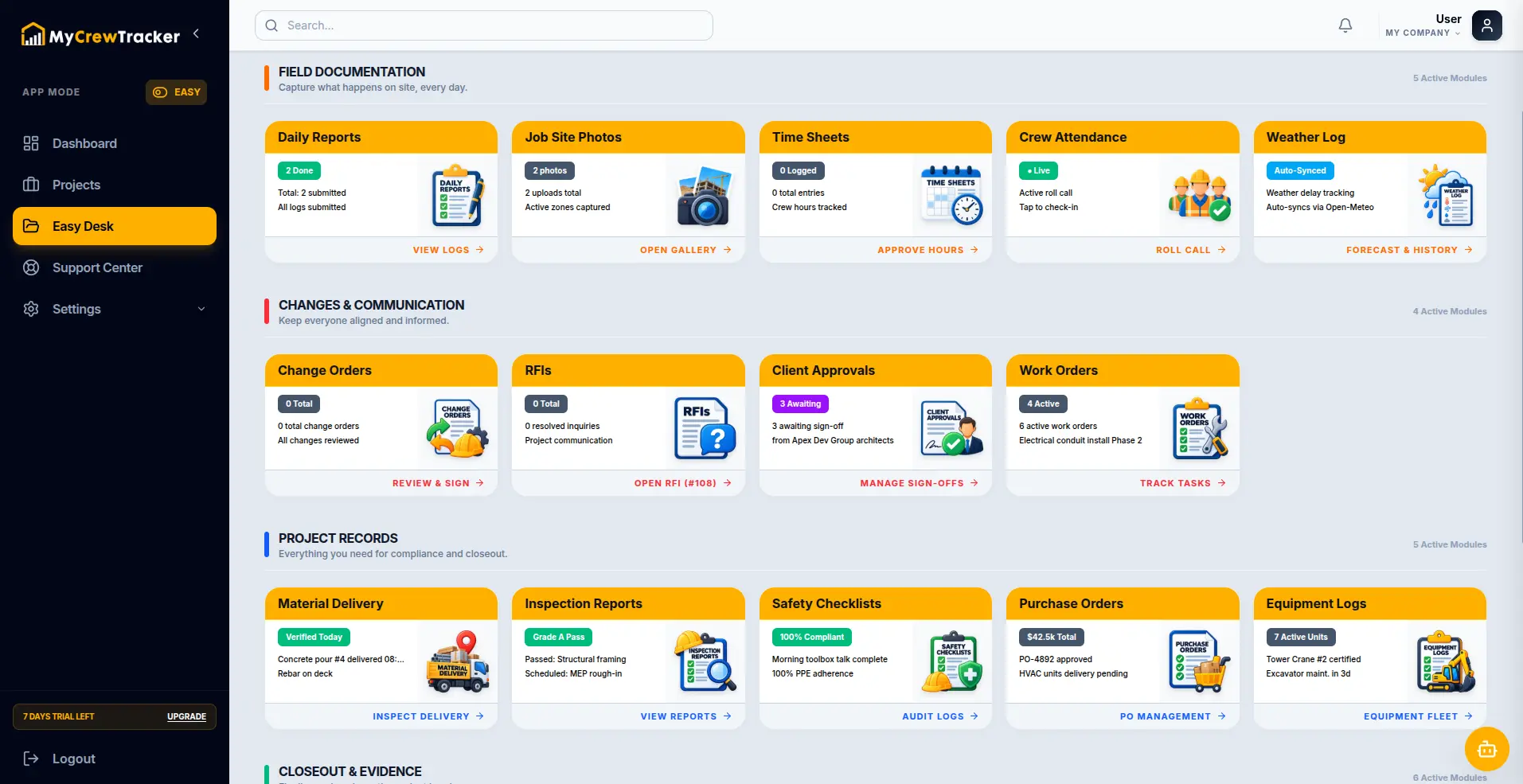
MyCrewTracker includes a Smart AI Assistant for documentation built directly into its platform. At $40/month flat—with unlimited projects, unlimited documents, and unlimited users—it's designed for small crews who want practical AI without the enterprise price tag.
The Smart AI Assistant lets you ask questions in plain English and get answers from your plans, specs, permits, RFIs, and change orders—with the source highlighted. It doesn't make decisions for you. It doesn't replace your foreman's judgment. It just finds what you already have, faster.
MyCrewTracker also includes the full feature set a small contractor needs: estimating, invoicing, job costing, punch lists, submittals, RFIs, crew time sheets, client approvals, and QuickBooks integration. And it comes with a 14-day full-feature free trial—no credit card required—so you can test the AI on real projects before committing.
The Bottom Line
Will AI replace construction foremen? The 2026 data says no.
What AI will do is change what the job looks like. It will absorb the administrative burden—the data entry, the photo sorting, the report assembly, the document searches—and free foremen to focus on the work that actually requires their expertise: judgment, leadership, and making decisions on a job site that changes hour by hour.
The contractors who thrive in 2026 won't be the ones who replace their foremen with AI. They'll be the ones who use AI to make their foremen more effective, and who start before their competitors do.
Your foreman is your most valuable asset. Give them the tools that let them focus on building—not on paperwork.
Ready to see how AI can support your crew instead of replacing it? Start your 14-day free trial of MyCrewTracker and test the Smart AI Assistant with your own plans, specs, and RFIs. No credit card required.