Ask any small contractor why a business failed, and you’ll get the same answer: bad bids. Bidding too low. Missing something in the estimate. Winning jobs that were never profitable to begin with.
It’s a comfortable story. It puts the blame on a single decision—one number on one piece of paper—instead of the slow, systemic problems that actually close construction companies.
Here’s the uncomfortable truth: most contractors who go broke had profitable jobs. Their bids were fine. Their work was good. Their P&L looked healthy right up until the day the doors closed.
They didn’t fail because they couldn’t win work. They failed because they couldn’t get paid for the work they’d already done. And the reason they couldn’t get paid was almost always the same: their documentation didn’t hold up.
The Cash Flow Disconnect Nobody Warns You About
Profit and cash are not the same thing. Most contractors know this intellectually. Very few internalize it until it’s too late.
Here’s how the disconnect works in practice. Work performed in March gets billed on a pay application submitted in early April. The client reviews, approves, and processes the payment through their accounts payable. Cash hits your bank account in late May or early June—60 to 90 days after the work was performed.
Meanwhile, labor costs, material costs, and equipment costs for that same work hit your accounts payable and bank account on weekly cycles. The structural gap between when you pay for work and when you get paid for it is 45 to 65 days—the largest single source of working capital tied up in any healthy growing contractor.
Now multiply that across multiple active projects. Add retention—typically 5 to 10% of every pay application, held until substantial completion of the entire project. On a $2 million scope, that’s $100,000 to $200,000 locked up for six months or more past completion of your work.
A $5 million subcontractor running an 8% net profit can still go bankrupt. Not because the business is bad, but because the structure underneath is broken. Profit pays the IRS. Cash pays the crew. Confusing the two is what closes the doors.
The 70% Problem: Payment Delays Are the Norm
If slow payment were the exception, contractors could plan around it. But it’s not the exception. It’s the operating model.
Roughly 70% of contractors and subcontractors report experiencing payment delays on a regular basis, according to PYMNTS Intelligence’s February 2026 report. This isn’t a problem with a few bad clients. It’s embedded in how the industry works.
The numbers get worse depending on where you look. Aon’s 2026 Working Capital Benchmarking Report found that construction firms face the longest payment delays of any industry—143 days on average, compared to 79 days across all businesses. For subcontractors specifically, the typical trade partner waits about 50 days after submitting a pay application.
Here’s the critical connection: missing supporting documents are the number one reason for payment delays. When a payment application lacks complete backup—approved change orders, signed daily logs, photo documentation, verified measurement sheets—it gets questioned. And when it gets questioned, it gets delayed.
Most payment applications are not rejected because the work is incorrect. They are delayed because the documentation creates uncertainty. Missing lien waivers. Expired insurance certificates. Thin stored materials documentation. Missing photographs. Absent bills of sale. Unclear storage locations. These are the gaps that consistently stall applications.
Every day your payment is delayed, you’re financing your client’s project with your own working capital. That’s cash you can’t use for payroll, materials, or the next project.
The Documentation Gap That Kills Contractors
The relationship between documentation and cash flow isn’t theoretical. It’s mechanical. Here’s exactly how poor documentation drains your bank account.
1. Change Orders That Never Get Billed
A verbal change order is issued on site. The superintendent says “go ahead, we’ll sort out the price later.” The work gets done. The paperwork never gets created. The client disputes the charge. You eat the cost because you can’t prove the work was authorized.
For small contractors, the math of this pattern is brutal. Legal costs for pursuing a claim often exceed the value of the damages. So you swallow the cost. And then it happens again.
Research shows that 53% of organizations have experienced delayed final accounts because of documentation or data gaps, while only 13% report true real-time cost visibility without a lag between site activity and the availability of coded financial information. When you can’t see costs in real time, you can’t bill for them in real time. And when you can’t bill for them, you don’t get paid for them.
2. Payment Applications That Get Rejected
A payment application without proper backup is a payment application that gets delayed. The documents that make or break your application include detailed measurement sheets, material invoices and delivery challans, before-and-after photographs, approved drawings and revisions, work orders and variation orders, test reports and quality certificates, and labour and machinery records.
When any of these are missing, your payment gets pushed back. And here’s the compounding problem: 57% of firms still rely on manual handoffs before site records become usable in finance. Manual handoffs mean delays. Delays mean your payment application sits in someone’s inbox instead of moving through the approval chain.
Missing photographs, absent bills of sale, or unclear storage locations produce immediate rejections. Not questions. Rejections. The difference between a payment that flows and a payment that stalls often comes down to whether you can prove—with timestamped, organized documentation—that the work was done.
3. Disputes That Drain Resources
When documentation fails, disputes follow. And disputes are expensive.
Contemporaneous records are key to defending disputes—site logs, progress reports, correspondence, minutes of meetings, variation orders, invoices, and payment records. When you have them, disputes resolve quickly. When you don’t, disputes escalate into arbitration, litigation, or write-offs.
For small contractors, the reputational calculus is different than for large firms. You’ll see the same client, the same inspector, the same subcontractor again. That’s why most small contractors don’t run to court every time there’s an issue—they eat the cost, burn weekends chasing invoices, and vent to their spouses. The problem is that swallowed costs pile up. Hidden costs compound.
The Productivity Tax You’re Already Paying
Poor documentation doesn’t just delay payment. It wastes time—the one resource you can’t recover.
Documentation-related tasks consume 35 to 40% of non-productive labor in construction, making it the single largest operational inefficiency in the industry. For a $10 million general contractor running on typical 4.5% net margins, that documentation overhead can represent 60 to 100% of annual profit.
Read that again. The time your team spends hunting for documents, re-entering data, and reconciling conflicting versions of drawings is equivalent to your entire annual profit.
Site teams spend about 30% of their week—roughly 12 hours—searching for documents. Poor documentation contributes to $1.8 trillion in lost productivity across the global construction industry. And every hour your foreman spends looking for a spec detail is an hour not spent managing work, supporting the crew, or catching problems before they become expensive.
Why "Just Bill Faster" Doesn't Work
The conventional advice to contractors struggling with cash flow is simple: bill faster. Submit pay applications sooner. Follow up more aggressively.
This advice fails because it addresses the symptom, not the cause. You can’t bill faster if your documentation isn’t organized. You can’t submit a complete pay application if you can’t find the photos from three weeks ago or the signed change order from last month.
The contractors who get paid fastest aren’t the ones who chase invoices hardest. They’re the ones whose documentation is complete, organized, and retrievable in seconds. When you can assemble a payment application in minutes instead of days, you bill sooner. When your backup is bulletproof, you get questioned less. When your records are timestamped and searchable, disputes resolve in your favor.
Documentation isn’t an administrative chore. It’s the infrastructure that makes cash flow possible.
What Changes When Documentation Works
When documentation is organized and accessible, three things happen to your cash flow.
You bill faster. Complete pay applications go out sooner because you’re not waiting to assemble backup. Change orders get approved and billed because you can prove the work was authorized. Invoices sync to your accounting software automatically because the data flows from the field to the office without manual re-entry.
You get questioned less. A payment application with complete backup—photos, signatures, daily logs, approved change orders—doesn’t get sent back for clarification. It gets approved. Missing lien waivers, expired insurance certificates, and thin stored materials documentation are the gaps that stall applications. When those gaps don’t exist, payments flow.
You have a defensible record. When a client disputes a charge, you pull up the photo from the date the work was done. You show the email where they approved the change. You produce the daily log that documents the conditions. The dispute ends in minutes instead of dragging on for months.
How MyCrewTracker Protects Your Cash Flow
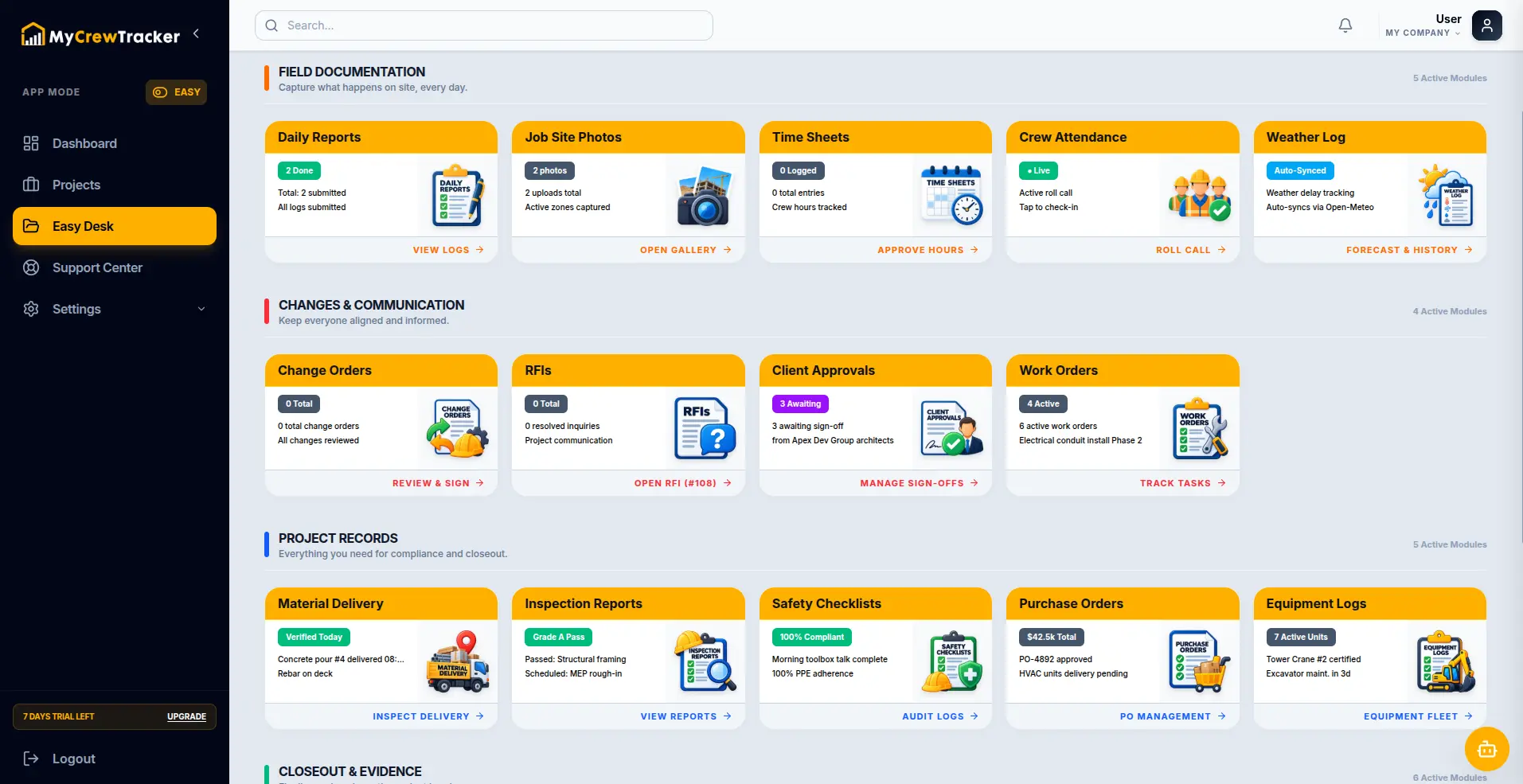
MyCrewTracker was built to solve the documentation problem that causes cash flow problems. At $40/month flat—with unlimited projects, unlimited documents, and unlimited users—it gives small contractors the tools to bill faster, get paid sooner, and protect their margins.
Here’s how it works:
Smart AI Assistant for documentation. Instead of digging through folders for a spec detail or a change order approval, you ask a question in plain English and get the answer with the source highlighted. Document searches that used to take twenty minutes take three seconds.
Change order management with pending review workflows. Every change order is tracked from request to approval. Nothing falls through the cracks. Nothing gets billed late. Nothing gets eaten because you couldn’t prove it was authorized.
Client approvals tracked chronologically. When scope decisions and change orders are logged in sequence, you have a defensible record if a payment dispute arises. The history is there. The timestamps are there.
Photo and document organization. Before, during, and after photos are organized by project, date, and location. When you need to prove the work was done, you find the photo in seconds instead of scrolling through a camera roll.
QuickBooks integration. Invoices and financial data sync bidirectionally with QuickBooks. When you process invoices and bills, they sync in minutes instead of hours. No manual re-entry. No delayed billing.
Estimating, invoicing, and job costing. The full financial picture—from estimate to final payment—lives in one platform. You know what you’ve billed, what you’ve been paid, and what’s outstanding.
And it comes with a 14-day full-feature free trial—no credit card required—so you can load a real project and see how it changes your cash flow before committing.
The Contractors Who Survive
The contractors who survive the next downturn won’t be the ones with the best bids. They’ll be the ones with the best documentation.
They’ll be the ones who can prove every change order was approved. Who can produce photos from every phase of every job. Who can assemble a pay application in an hour instead of a week. Who have a searchable record of every decision, every approval, and every day on site.
Bad bids can lose you a job. Bad documentation can lose you the business.
The choice isn’t between spending money on software and saving money. It’s between investing in the infrastructure that gets you paid and continuing to finance your clients’ projects with your own working capital.
Start your 14-day free trial of MyCrewTracker. Load a real project. Ask the AI a question. Build a payment application with complete backup. See how it feels to bill with confidence—and get paid without chasing.
Ready to stop financing your clients’ projects? Start your 14-day free trial of MyCrewTracker and load a real project this week. No credit card required.