Most construction disputes center on asking for more money: extra work, unexpected site conditions, or schedule delays. But there is another kind of change order that can bleed your company’s profit margins just as quickly: the Deductive Change Order.
Consider this familiar scenario: Your general contracting or specialty trade firm signs a $450,000 contract to renovate a commercial office floor. Included in that base contract is a high-end custom architectural millwork and glass wall package priced at $60,000.
Four weeks into construction, the building owner runs into budget overruns on another floor and decides to "Value Engineer" your project. The owner sends you an email:
"We have decided to eliminate the custom glass wall and millwork package completely. Please issue a Deductive Change Order for $60,000 and credit that full amount back to our contract."
If you blindly issue a $60,000 credit, you just handed the owner thousands of dollars of your own hard-earned money.
Why? Because your estimating team spent 35 hours coordinating shop drawings. Your procurement team issued non-refundable purchase orders for specialized tempered glass. Your distributor charges a 25% restocking fee. And most importantly: you calculated your general company overhead and anticipated net profit across the full $450,000 contract value when you scheduled your crew for the quarter.
Under standard construction contract law, an owner is NOT entitled to claw back your overhead and profit on deleted work. Below is the contractor’s guide to understanding deductive change order mechanics, defending your earned markup, and calculating the exact net credit you legitimately owe.
Gross Credit vs. Net Credit: The Industry Standard Legal Rules
Owners often assume that if a line item on your Schedule of Values (SOV) says $60,000, deleting that work results in a $60,000 reduction to the contract price. This is legally incorrect under standard industry contracts.
Look at the standard language in AIA Document A201 (Section 7.3.8):
"The amount of credit to be allowed by the Contractor to the Owner for a deletion or change that results in a net decrease in the Contract Sum shall be actual net cost as confirmed by the Architect. When both additions and credits covering related Work or substitutions are involved in a change, the allowance for overhead and profit shall be figured on the basis of net increase, if any, with respect to that change."
Notice the critical phrase: "actual net cost."
- Additive Change Orders: When an owner adds scope, you charge direct costs PLUS an allowance for Overhead and Profit (typically 10% to 15%).
- Deductive Change Orders: When an owner cuts scope, they receive credit ONLY for the unperformed direct costs (labor and unpurchased materials). The contractor retains their original overhead and profit allowance because that overhead was already allocated to support your business operations during that timeframe.
| Contract Standard | Deductive Markup Treatment | Contractor Protection Level |
|---|---|---|
| AIA A201 (Section 7.3.8) | Credit is based on actual net direct cost savings. Contractor does not credit back overhead and profit. | High: Overhead and profit are protected by contract. |
| ConsensusDocs 200 (Section 8.3) | Credits reflect actual direct cost decrease. Overhead and profit remain with the constructor unless expressly stipulated otherwise. | High: Prevents owner clawback of earned margins. |
| Federal FAR 52.243-4 (Changes Clause) | Government deducts estimated unexpended direct cost. Overhead and profit adjustments depend on whether the deletion causes unabsorbed home office overhead. | Moderate: Requires proof under the Eichleay formula for unabsorbed overhead. |
| Custom Subcontract Agreement | Often drafted aggressively by GCs attempting to claw back full Schedule of Values pricing. | Low: Requires vigilant pre-award contract negotiation. |
The 5 Sunk Costs You Must Deduct Before Issuing Any Credit
When an owner requests a scope reduction, do not just calculate unworked labor hours. You must systematically tally all sunk costs and administrative expenditures already invested into that scope:
-
Shop Drawings, BIM Coordination & Pre-Con Engineering:
Your team or drafting subcontractors already generated layout drawings, submitted product cut sheets, and coordinated clash detection. That labor was fully performed and cannot be refunded. -
Restocking Fees & Non-Refundable Custom Materials:
If purchase orders were released, manufacturers will charge between 15% and 30% restocking fees on standard goods. Custom-fabricated goods (tempered glass, architectural millwork, pre-hung doors) cannot be returned at all; the owner must pay 100% of the material invoice and take possession of the goods. -
Mobilization & Demobilization Logistics:
If equipment was reserved or mobilized (e.g., scaffolding, boom lifts, specialty rigging), delivery, rental minimums, and pickup fees must be deducted from the credit. -
Loss of Crew Momentum & Re-Sequencing Costs:
Deleting an entire phase leaves a sudden hole in your project schedule. If your journeymen lose half a day while you scramble to reassign them to another jobsite, that lost productivity is a direct consequential cost of the deletion. -
Original Contractor Overhead & Profit Margin:
Your original 10% overhead and 5%–10% profit allowance stays in your pocket pursuant to AIA A201 § 7.3.8.
The Mathematical Formula: How to Price a Deductive Change Order
Let’s walk through the actual math using the $60,000 custom millwork package example:
Case Study: The $60,000 Scope Deletion Breakdown
Original Base Bid Breakdown:
- Direct Material: $28,000
- Direct Field Installation Labor (300 hrs @ $60/hr): $18,000
- Specialty Equipment Rental: $4,000
- Subtotal Direct Cost: $50,000
- Contractor Overhead (10%): $5,000
- Contractor Net Profit (10%): $5,000
- Total Contract Value on SOV: $60,000
Actual Sunk Expenses Incurred Prior to Deletion:
- Shop Drawings & Engineering: $2,200
- Supplier Restocking Fee (20% on $28,000): $5,600
- Equipment Cancellation Surcharge: $800
- Administrative Processing & Re-sequencing: $650
- Total Sunk Costs: $9,250
The Net Deductive Calculation:
- Gross Direct Scope Value: $50,000
- LESS Total Sunk Direct Costs: -$$9,250
- LESS Original Contractor Overhead & Profit (Retained): -$$10,000 (already excluded from direct)
- Actual Net Direct Savings to Owner: $40,750
Contractor Margin Protected: $19,250 preserved in your company's revenue.
Value Engineering (VE) vs. Scope Deletion: Shared Savings
There is a profound difference between an owner simply slashing scope and a true Value Engineering (VE) proposal initiated by the contractor:
- Scope Deletion: The owner cuts a feature to save money, resulting in a deductive change order calculated at net direct savings.
- Value Engineering (VE): The contractor suggests an alternative material, design detail, or installation method that achieves the identical performance at lower cost.
Never provide free Value Engineering ideas to an owner or GC without a written Shared Savings Agreement. If you discover a way to save $30,000 by substituting PEX-a piping for copper without compromising code, insist on a 50/50 split: the owner receives a $15,000 deductive change order, and your company receives a $15,000 bonus on your contract sum.
Deductive Change Order Breakdown Letter (Template)
When submitting a deductive change order, present the calculation transparently using this structured breakdown:
// DEDUCTIVE CHANGE ORDER JUSTIFICATION & SCHEDULE OF VALUES ADJUSTMENT
TO: [Project Owner / General Contractor]
PROJECT: [Project Name & Number]
DATE: [Current Date]
DIRECTIVE: Owner Scope Deletion Request Dated [Date]
SUBJECT: DEDUCTIVE CHANGE ORDER REQUEST # [DCO-003] (AIA A201 § 7.3.8)
Dear [Recipient Name],
In response to your request to eliminate Specification Section [Section #] ([Scope Description]) from our contract scope, please find our itemized Net Deductive Credit calculation prepared pursuant to the General Conditions of the Contract:
1. Base Contract Scheduled Value: $[60,000.00]
2. Less Contractor Contractual Overhead & Profit (Retained): -$[10,000.00]
3. Unadjusted Direct Scope Cost: $[50,000.00]
LESS Sunk Costs Incurred Prior to Deletion:
- Pre-construction Engineering & BIM Coordination: -$[2,200.00]
- Manufacturer Non-Refundable Material Restocking Fees: -$[5,600.00]
- Equipment Cancellation & Demobilization Fees: -$[800.00]
- Administrative Processing & Schedule Revision: -$[650.00]
Subtotal Incurred Sunk Direct Costs: -$[9,250.00]
NET ADJUSTED CONTRACT DEDUCTION: -$[40,750.00]
Backup documentation, including manufacturer restocking invoices and engineering time logs, are attached hereto. Please issue an executed Change Order for the net amount of -$[40,750.00] to allow our accounting department to adjust our Schedule of Values.
Sincerely,
[Your Name]
[Your Title / Company Name]
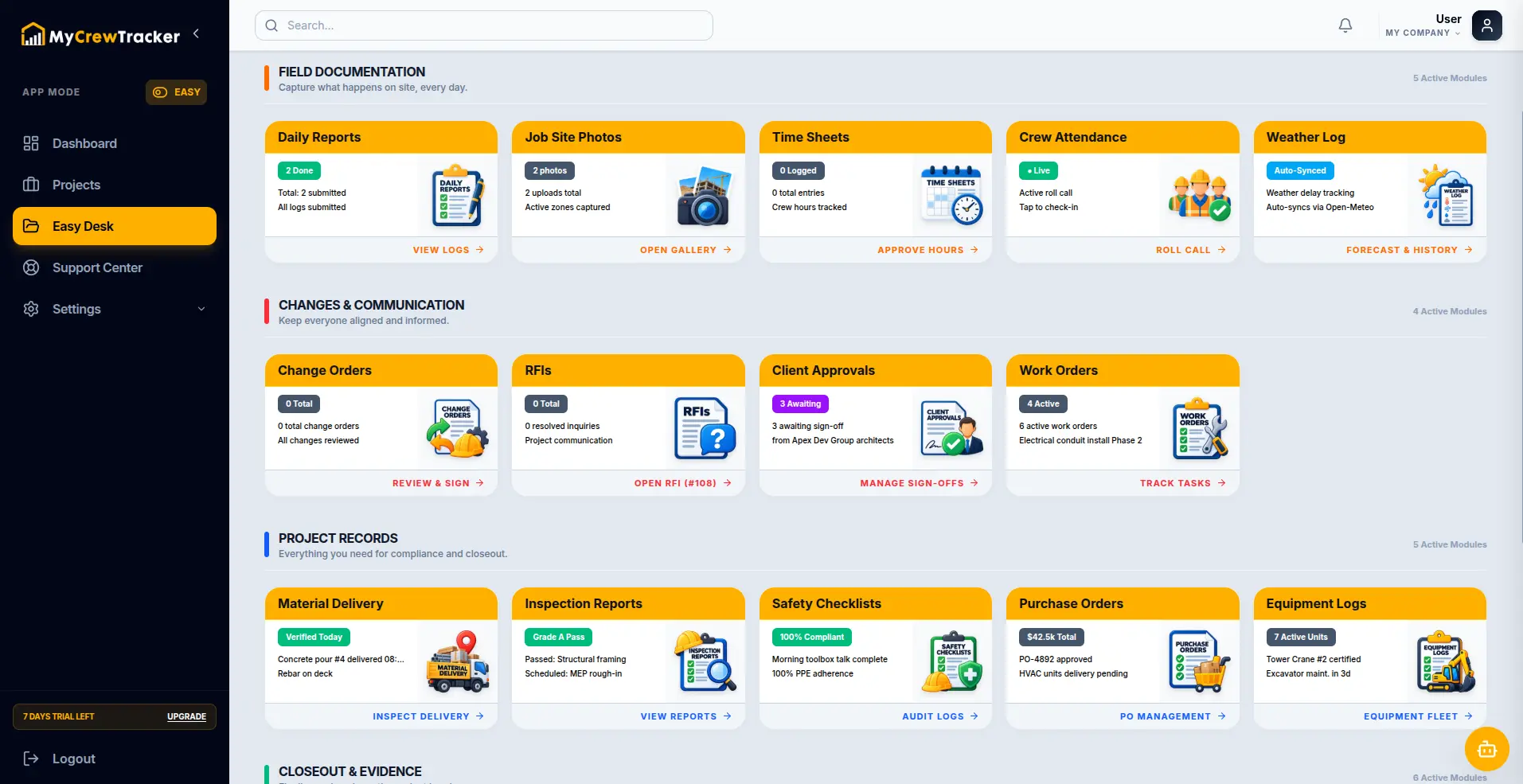
How MyCrewTracker Protects Your Earned Margins
When an owner tries to claw back full Schedule of Values pricing, you need instant access to historical purchase orders, engineering logs, and supplier delivery confirmations.
MyCrewTracker helps you document and defend every dollar:
- Purchase Order & Material Delivery Tracking: Log every material purchase order and receipt in real time. Prove exactly when materials were ordered and substantiate vendor restocking charges.
- Contemporaneous Engineering Time Logs: Track office PM, estimating, and BIM drafting hours against specific project phases so engineering sunk costs are auditable.
- Audit-Ready Change Order Logs: Manage both additive and deductive change orders in one centralized dashboard. See our guide to building a bulletproof change order log.
- Live Schedule of Values Updates: Sync net adjustments directly with progress billings to keep your accounting clean. Explore our Invoice Records System.
Never Surrender Your Overhead & Profit
Equip your project managers with transparent deductive change order tools, itemized sunk cost tracking, and mobile client approvals. Start with MyCrewTracker today.