If you've ever tried to find out what construction software actually costs, you already know the problem. Most vendors don't publish their prices. The ones that do structure their tiers around features you didn't know you needed. And the number on the marketing page rarely matches the number that lands on your invoice nine months later.
For small contractors, this pricing opacity is more than frustrating. It's a barrier. You can't budget for software when you don't know what it costs. You can't compare platforms when they're all quoting on different models. And you can't predict how your costs will change as your business grows.
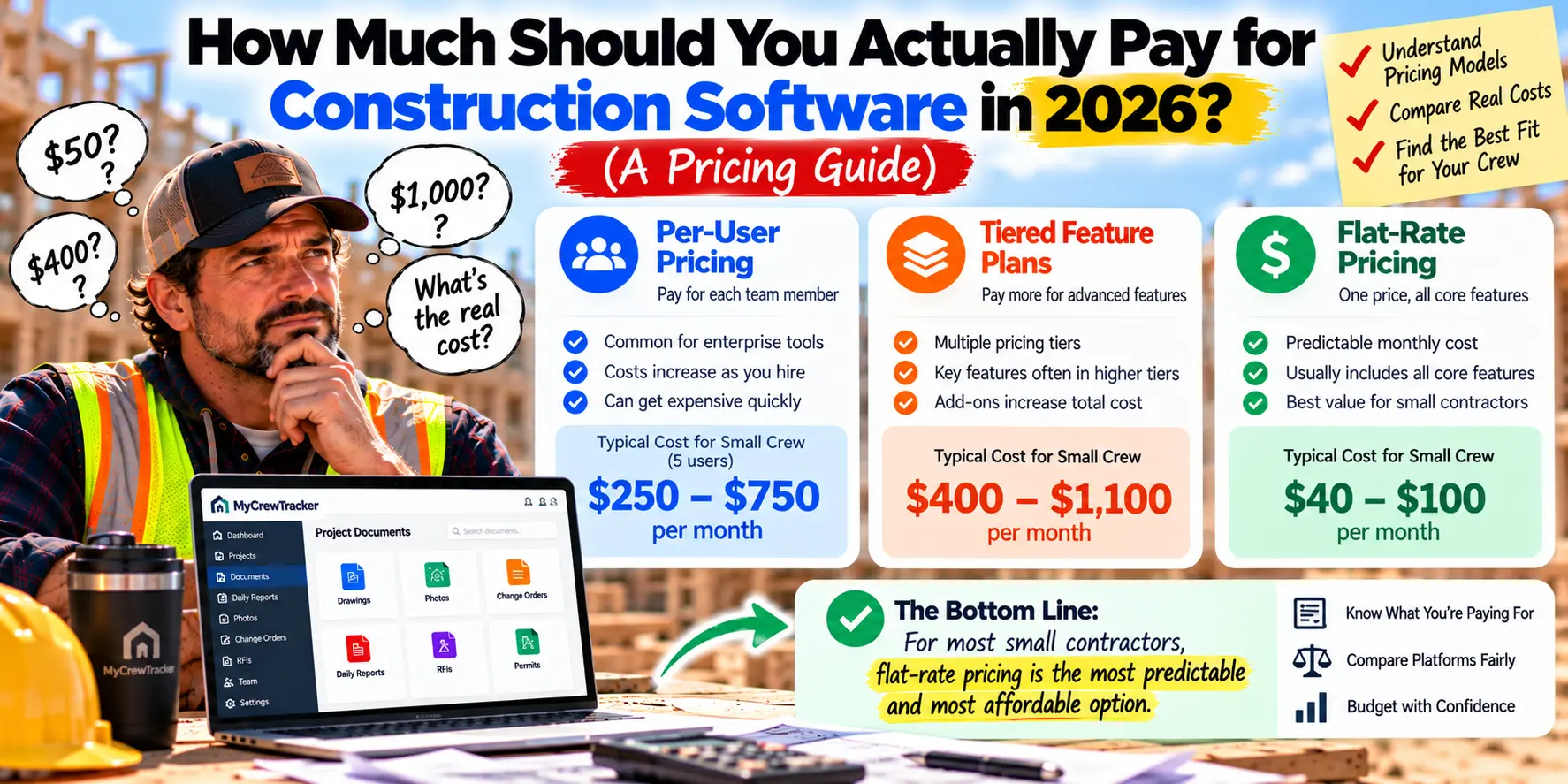
This guide cuts through the confusion. It breaks down the three main pricing models in construction software, shows you what each one actually costs for a small crew, and explains why flat-rate pricing is the most predictable—and most affordable—option for contractors who don't have an enterprise budget.
The Three Pricing Models (And Why the Model Matters More Than the Price)
Most contractors evaluating software focus on the headline number. The far more important question is what pricing model the vendor uses, because the model determines how the cost behaves as your business grows.
A $200-per-month per-user platform looks cheap until you do the math for a 10-person crew. A flat-rate platform that seems expensive at $500 per month looks affordable when you compare it against per-user pricing at scale.
Here are the three models you'll encounter.
Per-User Pricing
Per-user pricing is the most common model in the industry. You pay a monthly or annual fee for each named user who needs access to the software.
How it works: You're charged per seat. If you have 5 employees who need access, you pay for 5 seats. If you add a subcontractor or a part-time bookkeeper, you pay for another seat.
Typical costs: Small contractor platforms with per-user pricing typically run $29 to $99 per user per month. Some enterprise accounting tools charge $115 per user per month.
The problem for small crews: Per-user pricing is predictable when your team size is stable. It becomes punishing when the software needs to be in a lot of hands. A contractor with 10 field and office staff who all need access pays for 10 seats every month—whether or not every seat is actively used. The cost compounds quickly and creates an incentive to limit access, which then limits the value of the software.
Volume-Based Pricing
Volume-based pricing is common among enterprise platforms. Instead of charging per user, the vendor charges based on your annual construction volume—the total value of work you manage during the contract period.
How it works: Your subscription fee scales with your revenue. The more work you do, the more you pay—even if your team size and usage stay the same.
Typical costs: These platforms don't publish pricing. Based on verified reports from contractors, entry-level packages start around $4,500 per year and can climb past $60,000 per year depending on your volume.
The problem for small crews: Volume-based pricing punishes growth. Every time you win a bigger project, your software costs go up. And because the pricing is opaque, you can't predict what you'll pay next year until you've already signed the contract.
Flat-Rate Pricing
Flat-rate pricing is exactly what it sounds like: a single monthly or annual fee that covers unlimited users at your subscription tier.
How it works: You pay one price. Your whole team gets access. The cost doesn't change based on how many people use the software or how much revenue you generate.
Typical costs: Flat-rate platforms range from $49 per month for basic tools to $299–$900 per month for comprehensive platforms.
Why it works for small crews: Flat-rate pricing is predictable. You know exactly what you'll pay every month. You can invite your foreman, your bookkeeper, and your subcontractors without worrying about per-seat fees. And your costs don't climb as your revenue grows.
What You'll Actually Pay: Real-World Examples
To make this concrete, let's compare what three different pricing models cost for a crew of 10.
| Pricing Model | Example Cost | Annual Cost for 10 Users |
|---|---|---|
| Per-User | $50/user/month | $6,000 |
| Per-User (Enterprise) | $115/user/month | $13,800 |
| Volume-Based | ~$20,000/year (entry level) | $20,000+ |
| Flat-Rate (Budget) | $49/month | $588 |
| Flat-Rate (Mid-Range) | $299/month | $3,588 |
| Flat-Rate (MyCrewTracker) | $40/month | $480 |
The difference is staggering. For the cost of one month on a per-user platform, you can run a flat-rate platform for a full year. And that's before factoring in hidden costs.
The subscription fee is only part of the story. Most construction software vendors bury additional costs in line items that don't appear until after you've signed the contract. These hidden costs can add 30% to 60%—or more—to the base license fee.
Here's what to watch for.
Implementation and setup fees. Many platforms charge $500 to $2,000 per user for implementation, configuration, and data migration. For a 10-person crew, that's $5,000 to $20,000 before you've used the software for a single day.
Training costs. Some vendors charge $500 per user for training. Others require you to purchase a training package as part of onboarding. These costs rarely appear on the pricing page.
Premium support. Basic support may be included, but premium support—the kind that gets you a response within hours instead of days—often costs an additional 20% of your license fee.
Integration fees. If you need the software to connect with your accounting system or other tools, some vendors charge extra for integrations.
Annual renewal increases. Many contracts include an annual price increase of 5% to 14%. That means a $10,000 subscription can cost $11,400 in year two and $13,000 in year three—without adding any users or features.
Per-seat creep. On per-user platforms, every new hire, every subcontractor, and every temporary crew member adds to your bill. Over time, the cost compounds faster than you expect.
For a small contractor, these hidden costs can turn an "affordable" platform into an unaffordable one. The sticker price is rarely the full price.
The ROI of Predictable Pricing
When you're running a small construction business, predictability matters as much as the price itself.
Flat-rate pricing gives you three things that per-user and volume-based models can't:
A budget you can actually plan around. You know what you'll pay every month. There are no surprises. No volume-based increases. No per-seat creep. Your software cost is a fixed line item, not a variable you have to recalculate every time you hire someone or win a bigger project.
Freedom to invite your whole team. On a per-user platform, adding your foreman, your bookkeeper, and your subcontractors costs money. On a flat-rate platform, it doesn't. That means you can get the software into the hands of everyone who needs it—which is the entire point of buying software in the first place.
Costs that don't punish growth. Volume-based pricing means your software costs go up every time your revenue goes up. Flat-rate pricing means your software costs stay the same whether you're doing $500,000 or $5 million in annual revenue.
The contractors who thrive in 2026 won't be the ones who chase the lowest sticker price. They'll be the ones who choose pricing models that stay affordable as their business grows.
Where MyCrewTracker Fits
MyCrewTracker was built for small contractors who want predictable pricing and complete documentation tools without the enterprise price tag.
The pricing is simple:
| Plan | Monthly Cost | Annual Cost |
|---|---|---|
| Annual | $40/mo | $480/year |
| 6 Months | $48/mo | $288 |
| 3 Months | $54/mo | $162 |
| Monthly | $60/mo | Pay as you go |
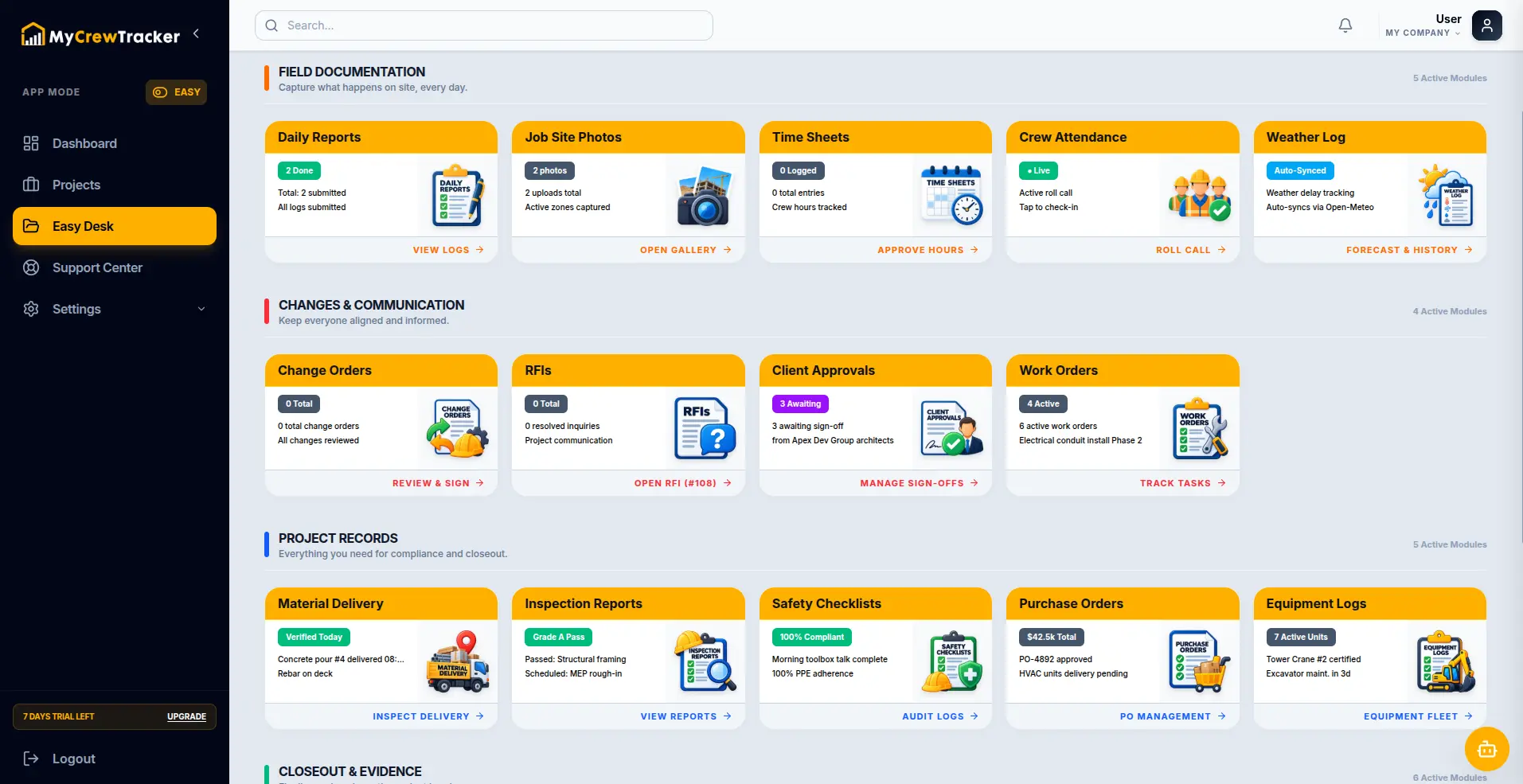
Every plan includes unlimited projects, unlimited documents, and unlimited users. No per-user fees. No volume-based increases. No hidden costs.
What you get:
Smart AI Assistant for documentation — ask questions in plain English and get answers from your plans, specs, RFIs, and change orders, with the source highlighted
Estimating, invoicing, and job costing — complete financial tools without separate software
Change order management with timestamped client approvals
Daily reports that draft from photos and time sheets
Punch lists, submittals, and RFIs — the documentation tools that matter most
QuickBooks integration — bidirectional sync eliminates manual data entry
Crew time sheets integrated with project documents
And it comes with a 14-day full-feature free trial—no credit card required. Load a real project. Invite your crew. See how it works before you commit.
The Bottom Line
Construction software pricing doesn't have to be confusing. The model matters more than the sticker price. Per-user pricing punishes team growth. Volume-based pricing punishes revenue growth. Flat-rate pricing doesn't punish either.
For small contractors, flat-rate pricing is the most predictable and most affordable option. It lets you budget with confidence, invite your whole team, and scale without watching your software costs climb.
MyCrewTracker delivers flat-rate pricing at $40/month—with unlimited users, unlimited projects, unlimited documents, and a Smart AI Assistant—all backed by a 14-day free trial.
Start your trial this week. Load a real project. See what predictable pricing feels like.
Ready to stop paying for software that punishes growth? Start your 14-day free trial of MyCrewTracker and load your first project this week. No credit card required.