It is a predictable ritual in commercial construction and high-end remodeling.
Your company executes $16,800 of necessary out-of-scope work requested by the general contractor or property owner. You assemble your Change Order Request (COR), detailing 120 journeyman electrician or carpentry hours at $85/hour, material receipts, two days of scissor lift rental, and standard 15% Overhead and Profit markup.
A week later, the GC project manager or owner’s representative sends back your proposal with red pen slashing across the page:
- "We looked up the prevailing wage or union scale, and your journeymen are only paid $45/hour on their paychecks. We are slashing your labor rate from $85 down to $50."
- "You billed 16 hours of foreman supervision. Supervision is non-billable overhead included in your base contract. We deleted that line item."
- "Our corporate policy limits change order markup to 5% overhead and 5% profit. Your 15% markup has been reduced to 10%."
Just like that, your $16,800 change order is unilaterally gutted down to $10,200. If you accept these cuts, you won't even cover your payroll taxes, insurance premiums, and tool wear. You will lose money on work you were forced to perform.
Why do owners and GCs push back so aggressively? Because they know most small contractors don't understand how to legally prove their fully burdened labor rate or defend their contractual markup rights. Below is the contractor's field guide to defending your labor pricing, supervision hours, and profit margins with undeniable documentary proof.
The Anatomy of a Fully Burdened Labor Rate (Why $45/hr Costs $85/hr)
The most common mistake clients make is confusing a craft worker's take-home wage with the contractor's actual cost of employing that worker.
When you pay an employee $45.00 per hour on their payroll check, your company incurs substantial mandatory statutory burdens, insurance premiums, and craft benefits before a single penny of overhead or company profit is earned.
| Labor Cost Component | Typical Percentage / Rate | Cost on $45.00 Base Wage |
|---|---|---|
| Base Hourly Craft Wage | Direct take-home wage (Davis-Bacon or market wage) | $45.00 / hr |
| Federal Payroll Taxes (FICA: Social Security & Medicare) | 7.65% mandatory employer match | $3.44 / hr |
| Federal & State Unemployment (FUTA / SUTA) | 3.5% to 6.2% depending on state experience rating | $2.15 / hr |
| Workers' Compensation Insurance | 12% to 28% depending on trade classification (framing/roofing vs electrical) | $9.00 / hr (assuming 20%) |
| General Liability & Commercial Auto Insurance | 6% to 10% allocated policy rate per craft hour | $3.60 / hr |
| Paid Time Off, Sick Leave & Holiday Allocation | 4% to 7% statutory paid sick / vacation reserve | $2.50 / hr |
| Small Tools, Consumables & PPE Allowance | Standard industry allowance for blades, drill bits, safety gear | $3.50 / hr |
| Total Fully Burdened Direct Labor Cost | 1.54x Labor Burden Multiplier | $69.19 / hr (Raw Direct Cost) |
| Billable Change Order Labor Rate (with 15% OH&P) | Contractual Markup Applied | $79.57 - $85.00 / hr |
When an owner claims you should only bill $50/hour, show them this transparent breakdown. If you billed $50/hr on a worker whose true burden is $69.19/hr, your company would literally lose $19.19 out of pocket for every hour of extra work performed.
Defending Direct Supervision: Why Foreman Time Is Billable
General contractors love to slash foreman hours by asserting: "Supervision is overhead; it’s covered by your 10% overhead markup."
This is a misrepresentation of construction accounting principles:
- General Overhead (Indirect Cost): Company executive salaries, office bookkeepers, corporate legal counsel, marketing, and the permanent office lease. These costs cannot be attributed to a specific job and are covered by your Overhead Markup.
- Direct On-Site Supervision (Direct Cost): A working foreman on the jobsite who lays out the extra work, coordinates trades, conducts safety tailgate meetings, and directs the crew. Because this individual is physically present executing the change, their time is a direct cost of the work under AIA A201 Section 7.3.7.1 ("Costs of labor, including social security, old age and unemployment insurance, fringe benefits... and workers' compensation insurance").
The "Working Foreman" Defense:
Always designate your field lead as a "Working Lead Foreman" or "Trade Crew Leader" rather than a general supervisor. In your daily logs, document that the foreman actively participated in layout, measurement, and installation alongside the journeymen.
Industry Standard Markups: What Contracts & Courts Allow
What is the standard allowable markup for construction change orders?
| Industry Standard / Contract Form | Self-Performed Work Markup | Sub-Tier Subcontractor Markup |
|---|---|---|
| AIA Standard Contracts (A201 / A401) | Typically 10% Overhead + 5% to 10% Profit (15% - 20% combined) | 5% to 10% markup on sub-tier trade costs |
| ConsensusDocs (Section 8.3) | Mutually agreed percentage (standard 15% combined OH&P) | 5% pass-through administrative fee |
| Federal & State Public Works (DOT / USACE) | 10% Overhead + 10% Profit (Strict statutory cap) | 5% tier markup allowance |
| American Arbitration Association Precedent | 15% is universally recognized as reasonable and customary | 5% reasonable fee for coordination |
The 4-Part Bulletproof Backup Package
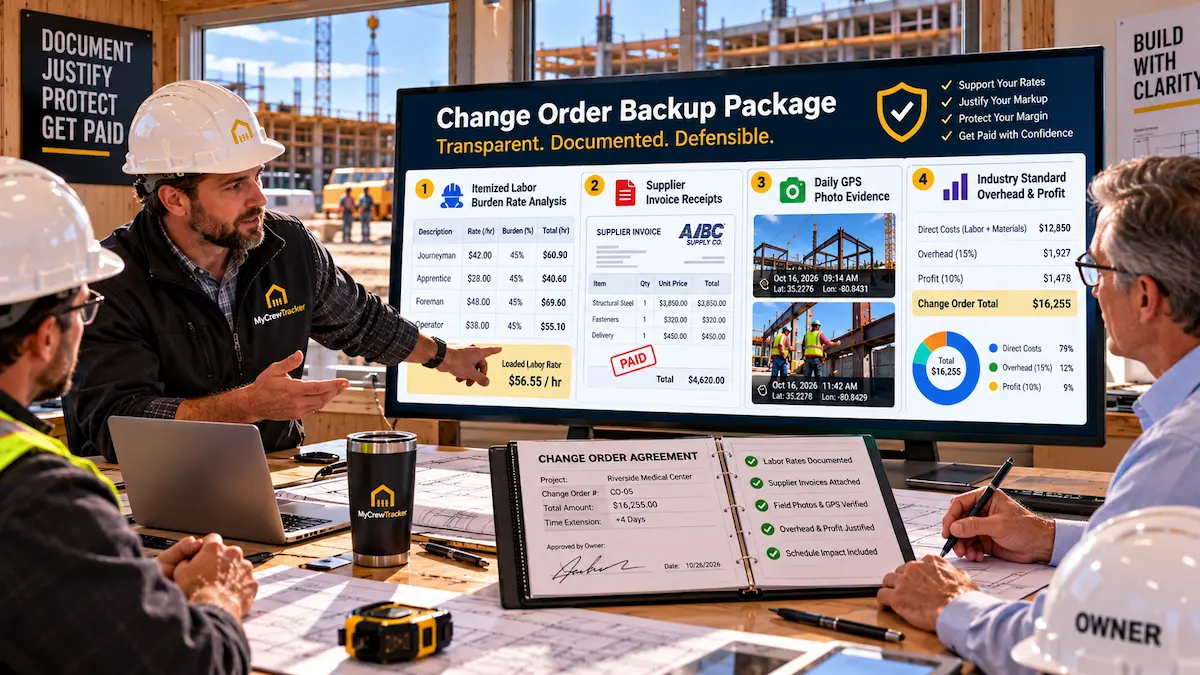
Owners slash change orders when they suspect the contractor is guessing or inflating numbers. When you submit a Change Order Request with this 4-part backup binder, you disarm their auditors completely:
- Part 1: Certified Labor Burden Calculation Sheet: A one-page notarized statement or CPA letter certifying your company’s actual payroll tax rates, workers' compensation modifier (EMR), and general liability rates.
- Part 2: Contemporaneous Daily Timecards & Signed Field Tickets: Copies of the daily T&M tags signed by the GC superintendent on site, with crew member names and hours.
- Part 3: Invoiced Material Receipts & Delivery Slips: Supply house invoices with unit prices clearly circled, matching the exact quantities installed.
- Part 4: Equipment Rental Rate Verification: Third-party invoices or nationally recognized equipment rate tables (such as AED Green Book or FEMA Equipment Rates) for contractor-owned machinery.
The Counter-Negotiation Script: Defending Your Price to the GC
When the general contractor attempts to unilaterally slash your change order pricing, deliver this firm, professional response:
Contractor Professional Response Script:
"Brian, I appreciate you reviewing our Change Order Request #04. However, we cannot accept your proposed cuts to our labor rate and supervision line items.
Our $85/hour billing rate is backed by our certified payroll burden schedule, which we have attached. As you can see, our raw direct employment cost—including mandatory workers' comp, state unemployment, and liability insurance—is $69.19/hour. Slicing our rate to $50/hour would require our company to subsidize the owner’s changes out of our own pocket.
Furthermore, our working foreman spent 16 hours physically laying out this complex reroute alongside the crew, as verified on your superintendent's signed daily tickets. Under AIA A201 § 7.3.7, direct on-site craft labor is fully reimbursable. Our 15% markup is the exact contractual standard agreed upon in Section 14 of our subcontract. We have provided 100% transparent audit proof for every dollar. Let's get this approved so we can maintain momentum."
How MyCrewTracker Automates Change Order Defense Packages
Manually assembling labor rate justification sheets, timesheets, supply receipts, and equipment logs takes hours of office time.
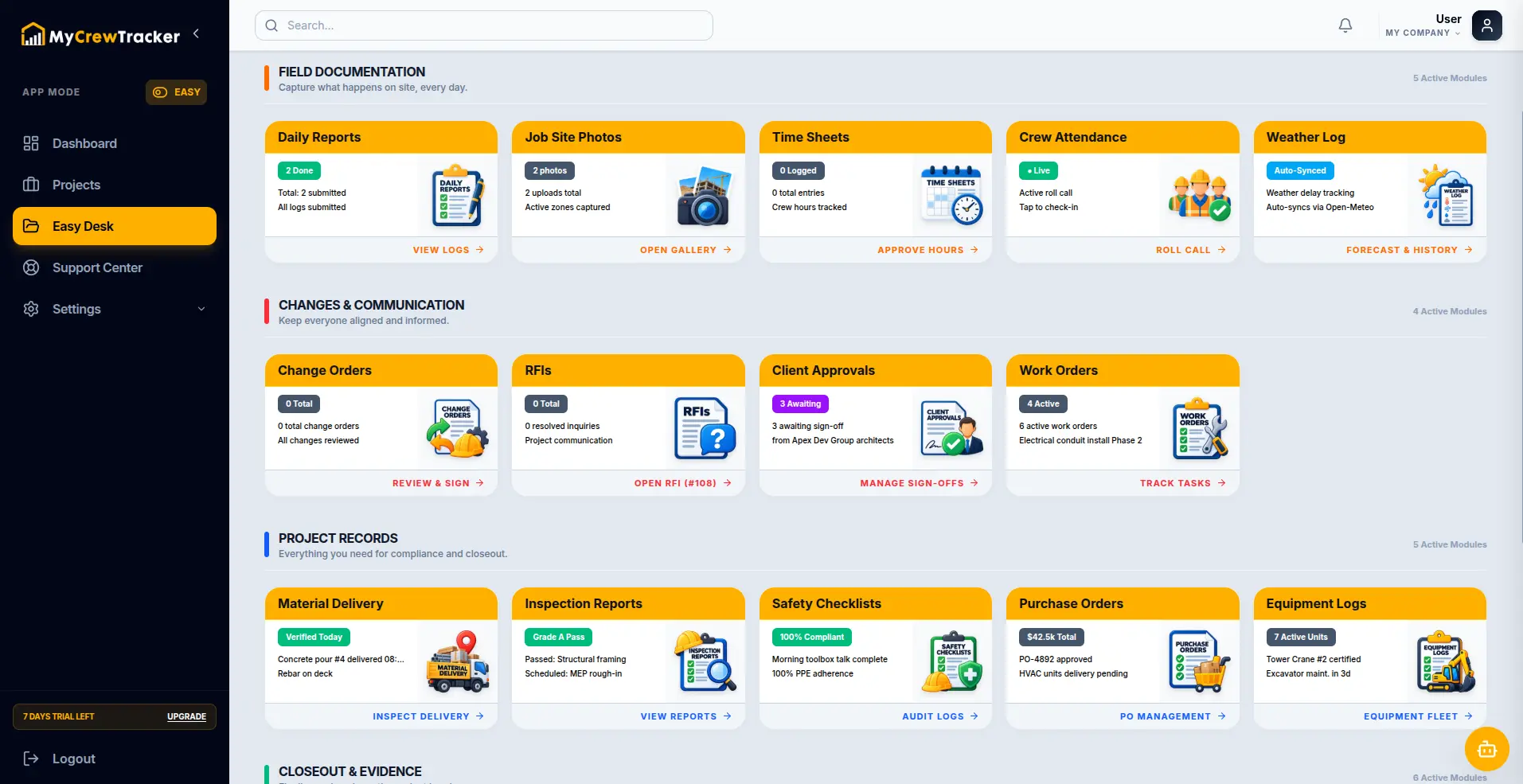
MyCrewTracker automates the entire backup assembly process:
- Pre-Configured Burdened Labor Rates: Set up your true fully burdened labor rates by craft code once. When foremen log extra work hours, the system calculates exact direct labor costs automatically.
- One-Click PDF Change Order Backup Packages: Bundle signed field tickets, itemized material receipts, and timestamped photos into a polished, professional PDF proposal with a single click. Learn about our Change Orders Feature.
- Real-Time Material & Equipment Tracking: Foremen snap photos of supply house delivery receipts right at the tailgate, attaching them instantly to the change order record.
- Seamless QuickBooks Sync: Push verified change order values directly to your invoice records and accounting software without double entry. See Invoice Records.
Defend Your Hard-Earned Profit Margins
Equip your construction business with transparent labor burden calculators, instant change order backup packages, and mobile client e-signatures.